 We are taking advantage of this home studio special to review small external accessories that can help us, depending on how our audio interfaces are set up (inputs, outputs, etc...).
When your "home studio" has a modest PCI card or a simple audio interface, you will very likely miss some of the features this mini mixing desk can offer you.
Obviously, the PV6 is just as suitable for any kind of process in which we need to receive different sources, mix them, tweak them and send them to different outputs: DJing, small fixed installations, etc...
Description
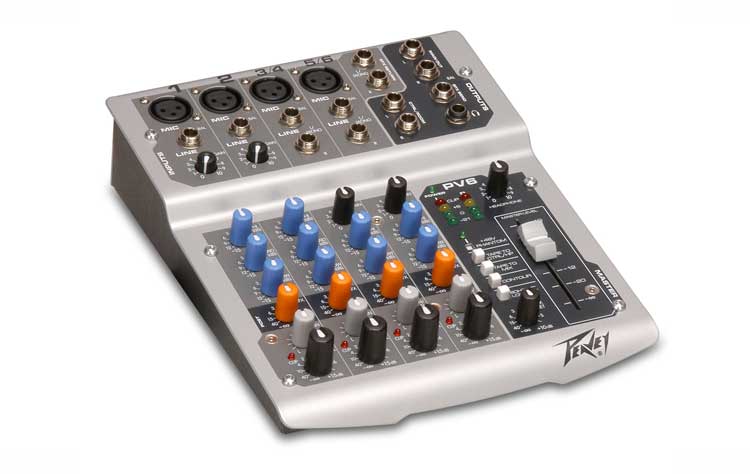
We are looking at a small console with eye-catching knobs in a mix of blue, orange, black and gray. Aesthetics aside, since some people will like it more than others, in low-visibility situations these somewhat "loud" colors may serve as a quick visual guide.
Channels, inputs and knobs
The first two channels are identical and feature a balanced XLR input, a ¼" jack input, gain, 3-band EQ, effects send control, pan and level. The next two have a balanced XLR input and a ¼" jack line input. On these last two, the gain replaces one of the EQ bands; that is, we have two bands (bass and treble) and the mid control disappears to make room for the gain. As with the first two, we find an effects send knob, pan and volume.
Outputs, send and return
Eight ¼" jack sockets make up the front/top connection panel. Among them we find the effects send and return (3 in total) plus a stereo headphone output and four others (two right, two left) for the "Main out" and "Control Room" outputs.
Master section
This block houses the effects return knob, the master fader, headphone level, the power LED, phantom power LED and button, level LEDs (green, yellow, red, from -21 dB to +6 dB) and the activation buttons for "tape to control/hp," "tape to mix," "contour" and an 80 Hz low-cut filter.
I was surprised by the inclusion of this "contour" control, since it is not common on other small competing consoles. Its function is to add "punch" to the mix. Interesting.
Rear panel
On/off switch, input for the external power supply (included), left and right RCA "tape in" inputs, and left/right RCA "tape out" outputs.
Applications in the home studio
We have already seen with other small-format consoles the uses we can get out of them, but let's go over them anyway.
As long as your audio interface doesn't already have these features, you may find yourself in situations such as:
a) Testing or using a condenser microphone that requires phantom power. The desk will take care of it.
b) Your PCI or USB card doesn't have enough inputs. If you connect two outputs from the desk to the system's inputs, you can use all of the desk's inputs to keep all your devices connected (as long as they don't exceed the desk's inputs) and ready to record.
c) The signal from one of your sources is weak and your recording doesn't reach adequate levels. The gain controls will let you boost those signals, sending your computer something that suits your needs.
d) Your card doesn't have a headphone output. If you want to record acoustic instruments with a mic, you should make sure the mic capturing the acoustic guitar (for example) doesn't pick up other signals, such as what you have already recorded in your sequencer. So the small console's headphone output is useful for this, among other things.
e) The LED signal meter will give you information about the signal you are sending to the computer, letting you correct it before recording and avoid later touch-ups.
Conclusions
In short, each of you should review what your gear offers and to what extent a small tool of this kind can help. Each of you will come up with new possibilities that improve or complement the options available.
Naturally, as I mentioned at the beginning, the PV6 is suitable for any other kind of application, from controlling small rooms with several sources to a small mixer for a headphone monitoring system for a drummer playing live... it's your imagination that opens up the possibilities of gear.
Looking at the retail price, I know enough to say that it surprised me on the low side. In other words, it is fully in line with its competitors (even those you imagine to be dirt cheap). Considering what the desk offers and what it costs, it is a minimal investment to improve quite a few things if you don't already have them.