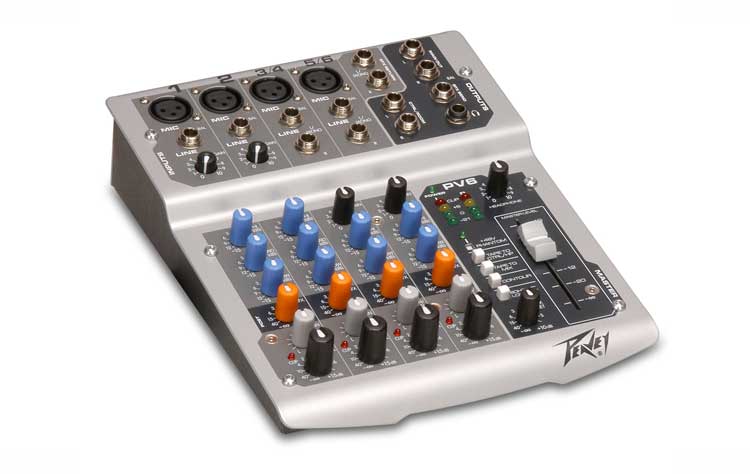
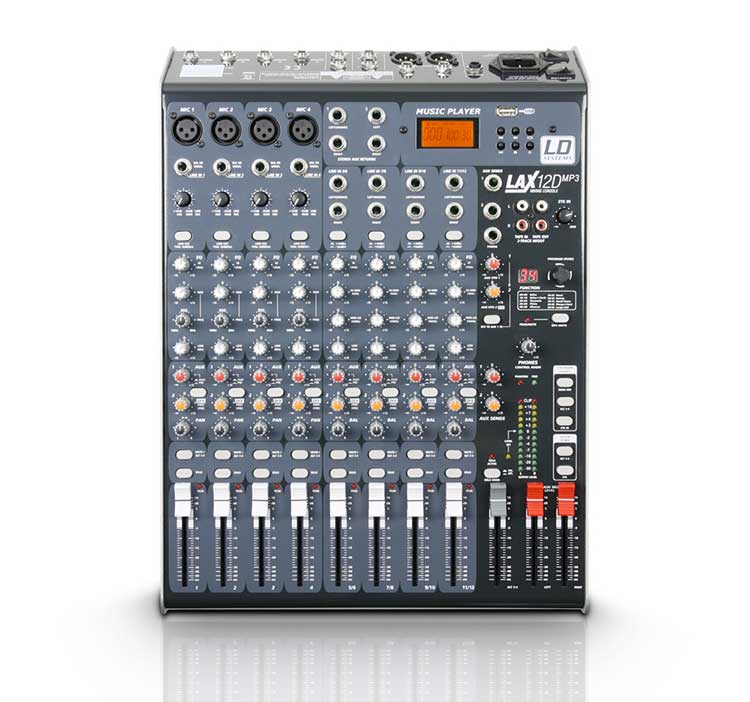
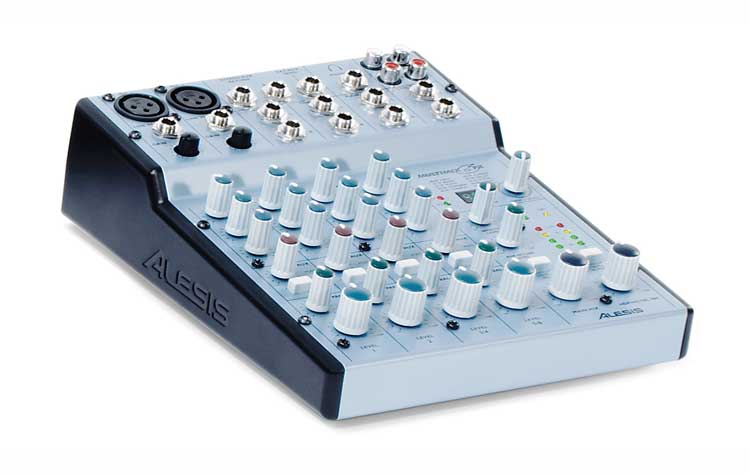
 Behringer's position in the consumer's mind (its positioning) is anchored in inexpensive, nicely styled and well-finished products, resulting in a wide range of features in each product and a polished look. The professional sector has its doubts about whether they meet the highest demands of the job. That said, we have found the company's gear in some professional studios.
One thing to be thankful for with this company is the abundant documentation in Spanish and its strong web presence, both in its graphic material (we can see the product clearly) and in its Spanish-language text and pricing. To test the capabilities of Behringer's tools, we've put together this test bench, in which we try to squeeze every euro we would invest in the purchase.
Put to the Test
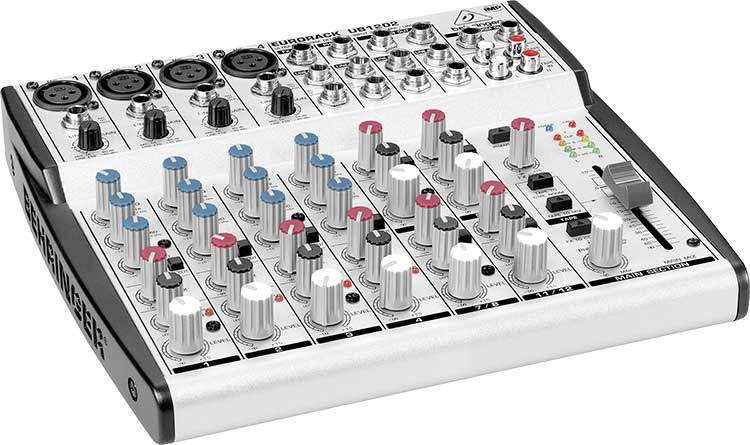
In the company's catalog, we find this product under "mixing consoles." It's a compact mixer with 4 mono channels and 4 stereo channels, for a total of 12.
There are several applications we can give this "little one." In our case today, we connected the mixer to an audio interface installed in a computer-based "home studio" recording system. This gives our interface's inputs a wide range of possibilities: XLR, ¼" jack, RCA (on the TAPE input). That way, if your hardware only had a stereo input, you could expand it to 12 simultaneous input channels, while also being able to shape the incoming signals considerably.
The console also offers balanced XLR inputs for your mics, with IMP preamps and the option to supply 48V power to those condenser mics (nearly all of them) that require phantom power.
What interested me most about the test was checking the quality of the preamps, since some signals that need a boost at the input called for the use of input gain. The test was simple: turn the gain up considerably, even deliberately lowering the source level (as a test) to see how far we could amplify the signal without getting noise.
The truth is that the results were very satisfactory, and we were able to record without noise even when abusing the preamp levels or using low-sensitivity dynamic mics.
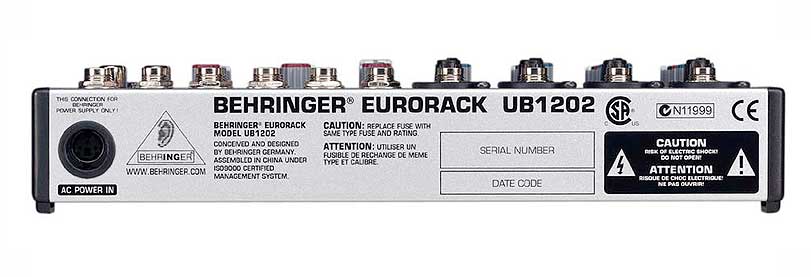
Eurorack UB1202
- MONO CHANNELS 1-4
XLR and ¼" jack inputs
Gain
EQ: HI - MID - LOW
High-pass filter (low cut)
FX sends
Pan
Peak LED on the mono channel
Level - STEREO CHANNELS 5/6 - 7/8 - 9/10 - 11/12
Left and right ¼" jack inputs
FX
Input level switch +4 / -10dB
Pan
Level
PHANTOM POWER (48 V)
- CONNECTION PANEL
Headphones
FX Send
Main Out (stereo)
Control Room Out (stereo)
Tape In and Tape Out. RCA, stereo - SIGNAL ROUTING
Tape-to-mix switch
Tape-to-control-room switch
FX-to-control-room switch
LED METERS: 20 - 0 - 6 - CLIP
Power and phantom power LEDs
Conclusions
As you can see, this compact mixer has a variety of uses, obviously not just the one in our test, but any situation where we need to handle a moderate number of signals and mix or modify them before sending them to the appropriate outputs.
The price is attractive and it performs well all the functions it was designed for, even better than you'd expect for 103 €. Comparing it with the ALESIS on the previous pages, we see that the UB1202 gives us more channels, high-pass filters on the mono channels, input sensitivity switches on the stereo channels, and it's cheaper (only slightly cheaper). On the other hand, the ALESIS offers a small built-in effects unit, whereas the BEHRINGER requires external effects, which, however little, will cost more (in euros) than the price difference between the two. The conclusion we might draw is that if you already have an effects unit, you get more with the UB1202, but if you don't, the Alesis unit may be the better option. In any case, your exact needs (in terms of channels) may point you to one or the other. Finally, Behringer also offers smaller formats (fewer channels) that are somewhat cheaper.