 As of this writing, the brand showed eight mixer models in its catalog. All of them are considered low-budget (cheap), and at least the two I'm putting through their paces at home right now, the subject of this review, can be considered, at the very least, outstanding value for the money.
LAX8D Mixer
I really liked its design from the start. Keep in mind that photographs can give you an idea, but it's never the same as having it in front of you in person. Sonically speaking, the LAX8D performs more than optimally, considering, as I mentioned, the price range we're in. Functionally, the unit under test turns out to have even more than is strictly necessary, bearing in mind, again, its price and the likely uses it is aimed at. Some applications where an LAX8D would fit well are, for example: bars with DJs, nightclubs (although it has no phono inputs), musicians in rehearsal or recording (if they don't need more inputs), submixes, fashion shows, houses of worship, karaoke, and a long list of related applications.
Inputs/Outputs and Controls
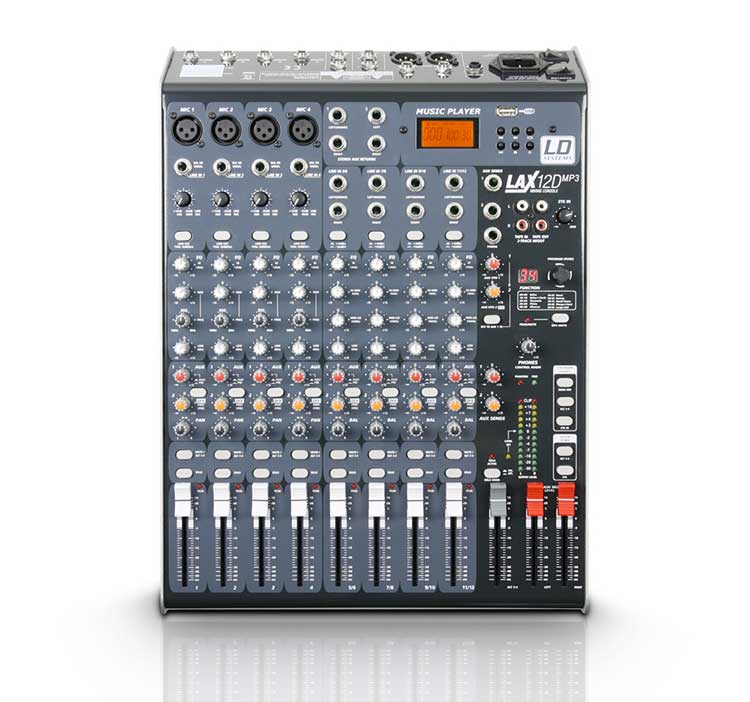
This mixer has six input channels, four of which are for mics (with 48-volt phantom power available), with balanced XLR and jack line connections, and, a great touch, inserts for a serial effects/processing loop. Each of these channels has a gain control, followed by a switch to engage/disengage a high-pass filter (Low Cut) centered at 75 Hz, three tone controls (bass centered at 80 Hz, mids at 2.5 kHz and treble at 12 kHz), and two auxiliary sends (one pre-fader, normally used to set up a monitor mix, and one post-fader that dials in how much signal we send to the effects processor built into this LAX8D). Next come the pan control and the channel fader; by the way, the faders have a very smooth action, and it's almost a pleasure to move them. All the channels on this mixing desk have a clip LED that starts to light up (flash) when the signal is 6 dB below clipping. The two remaining input channels are stereo and unbalanced. For inputs we also have two stereo aux returns (on jacks) and a stereo input, 2 Track In, for tape return (or any line-level source) on RCA.
As for outputs, we have: two for the aux sends (jack), the two-track out, two control room outputs, the headphone output and the Master or main outputs, on both XLR and jack, both balanced.
In the Master section we find the overall level controls for the aux returns, for Phones or control room, and for the main mix, plus the meters, made up of two 12-LED bars. We can also send the 2 Track In signal to the control room outputs, to the main mix, or to both, by choosing the appropriate buttons (2 Track To). This section has another pair of buttons: one enables the effects mix on aux send 1 (EFX TO AUX 1 button), and the other turns the desk's built-in effects on or off (DFX MUTE). This function is also available on a jack connector (FOOT SWITCH) where we can plug in a pedal for remote control. To finish the comments on this mixer, the built-in effects are of excellent quality (24-bit converters and resolution) and there is a great variety to choose from, with no fewer than 100 effects spread over ten different modes.
LAX12DA
If the LAX8D has a series of features (above all its cost) worth mentioning, the LAX12DA not only keeps up but pulls ahead. This is basically a powered mixing desk, with four mic/line inputs and four stereo inputs. Given its high functionality and, like the previous one, a moderate price, we have a more-than-recommendable unit in hand.
In Detail
This desk can provide amplification power of 2x 200 watts RMS into 8 ohms or 2x300 into 4 ohms (with a 1 kHz sine wave at a total harmonic distortion of 1%). The connections on its four Mic/Line inputs, the gain control and the high-pass filter are identical to those described for the desk above, but from here on we can see differences in control options. The EQ or tone controls on this LAX12DA are also three-band: a bass control centered at 80 Hz, a semi-parametric mid control with which we can tune a filter center frequency from 100 Hz up to 8 kHz and, finally, a treble control centered at 12 kHz. In all three cases, the filter boost/cut can reach +-15 dB (the same amplitude correction range as on the LAX8D). Being able to choose the mid frequency is a more than appreciable advantage compared with fixed mids, although perhaps I shouldn't even make that comparison.
Continuing with the breakdown of these Mic/Line channels, we find a pair of controls for mixing the aux sends; the first (AUX 1) can be assigned as Pre- or Post-fader with the switch provided for that purpose, while the second (AUX 2) is strictly Post-fader, which is very common, since it sets up an effects send mix that is influenced by the channel fader, thereby maintaining the dry-signal/effect proportion we have set; this is the main reason for a post-fader send. Then comes the ubiquitous pan control, which leads to a pair of silk-screened buttons, one as MUTE/ALT 3-4 and the other the famous SOLO. The Alt 3-4 function can come in wonderfully handy, because what it does is assign the signal of the channel where we activate it to an alternate bus where we can create a mix independent of the Master or main mix.
Four Stereo Input Channels
On the stereo input channels of this LAX12DA we can choose between two different input levels, selectable with a switch (it's really an input sensitivity change): the usual +4 dBu (professional level) and –10dBV (semi-pro or consumer level, for casual use). In this case, there are four tone controls on these stereo channels: bass and treble identical in character to the mono channels, and here is the difference, low mids (MID-LO) at 500 Hz and high mids (HI-MID) at around 3 kHz. The remaining controls and options are identical to those of the mono channels we just dissected, except, of course, for the pan control, which, as you all know or should know, is replaced on stereo channels by a balance control between channels.
As for the master section on this powered mixer model: the aux and main mix (MAIN MIX) masters, as well as the level indicators and the effects section, work like those of the LAX8D reviewed above. There is also a master fader for the ALT 3-4 bus mentioned earlier, and a status switch for the SOLO function that lets us choose between listening before or after the channel fader (Pre Fader Listening or After Fader Listening). This main section also has the aux send masters, the headphone or control room volume, and three buttons for assigning the preferred signal source to the control room outputs: the main mix, the alternate 3-4 bus, or the 2 Track inputs. With two other buttons located just below those, we can add the alternate 3-4 bus signal to the main mix (which would become a true stereo subgroup), or the 2 Track input signal. To wrap this up, this LAX12DA includes a strap so you can carry it over your shoulder like a shoulder bag, although it does weigh a little over 10 kg. Also note that both mixers come with rack ears so they can be mounted, if needed, in a standard 19-inch rack.
Until Next Time
I hope I've made it fairly clear what these two units are about. For anyone who hasn't gotten it, I can put it even more precisely by saying that either of these machines (as long as you don't need something bigger or very sophisticated) can be, and in fact is, an option to keep firmly in mind. Also keep in mind the rest of the models LD Systems offers. Visit ld-systems.com and you can see for yourself what I mean. Best regards.