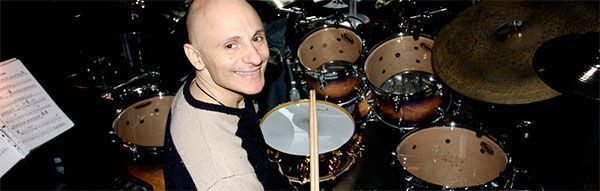
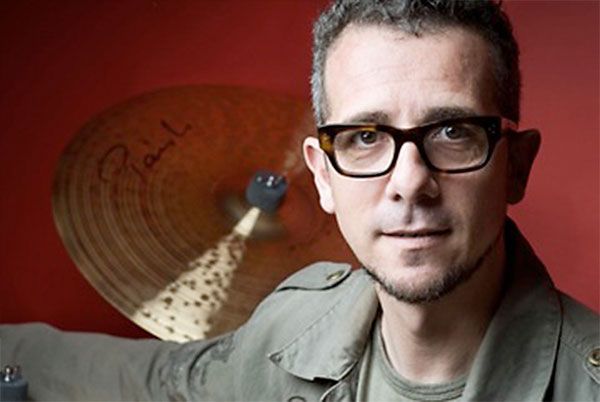
And the list keeps growing. We continue our tour of the most outstanding musicians on the percussion and drums scene. Along the way, we come across another interesting player, currently devoted to the blues that Javier Vargas's hands bestow on us. Gustavo Segura is in charge of laying down the rhythm in the Vargas Blues Band's sessions. With good taste and energy, his sticks travel across every piece, turning the sum of sounds into an acoustic pleasure for anyone passionate about percussion and drums.
Setup
I'm a Yamaha endorser, and the drum set I'm using is a Maple Custom Absolute Nouveau. Thanks to the collaboration of Yamaha Spain and Javier Ochoa, this set was built with the features and specifications I considered most suitable for achieving "my" sound.
All the toms are rack toms in even sizes (8, 10, 12, 14 and 16). The 2-inch difference between each tom lets me achieve more precise tuning. My main snare is a 14 x 7 Yamaha Maple Custom Absolute Nouveau. It's a new model they've just released, and with that extra 1/2 inch they've achieved a very powerful, aggressive sound. The second snare is a 13 x 5 1/2 Yamaha Maple Custom Absolute Nouveau, and I use it exclusively for the funkier songs in Javier (Vargas)'s repertoire. The bass drums that complete the set are 22 x 18 and 20 x 18. Depending on the venue and the repertoire we're going to play, I use one or the other. I've always liked bass drums with 18 inches of depth, since that way you can better achieve those "sub-lows" drummers want so much. The hardware kit consists of stands from the 800, 900 and 1000 lines (CS840 x 2, CS845 x 2, WS865 x 2, SS940 x 2, CHH920, HS1000, CH745 x 7, DFP9310 double foot pedal).
As for cymbals, sticks and heads, thanks to the collaboration of Music Distribución, and in particular Manel Punti, who have offered me endorsement of their brands, I'm using Zildjian and Evans, as well as Toca Percussion, Hardcase (flight cases) and Gibraltar. The cymbals are from the A Custom Brilliant line (except the Chinas, which are from the Avedis line). The sticks are 2B wood-tip hickory. I've been playing Evans heads for many years now. On the snares I use HDD14 and HDD13 (heavy duty dry) on the tops and SH30 on the snare sides. On the toms I use G2 Clear on the tops and G1 Clear on the bottoms. And on the bass drums I'm using EQ3 Clear on both the 22-inch and the 20-inch.
Gustavo, we welcome you to our pages, where we gather the small group of professional musicians on today's scene who have been working their way up from the most remote places, clubs and "dives," and who finally see each other's faces again after getting past the discouragement and the hurdles every musician faces until carving out a well-deserved place in recognition of their skill. Here we meet up to share and exchange our experiences, which are always well received by our readers, and we take this opportunity to ask you:
What made you start in this, and why?
I was 4 years old, sitting in front of the TV watching a Gene Krupa special, when I said to my mother: "That's what I want to do!" That's how it all started.
Are drummers born or made?
I think it's a bit of both. I believe you need something innate, but that "ability" has to be developed throughout your whole life with a lot of study and practice.
At home and abroad, who are your favorite players?
As for Spanish drummers, I've only heard a few, but they've all struck me as excellent in their style, such as Pepe Sánchez, Manolo Heredia, Pedro Barceló, Erik Franklin, Ángel Crespo.
My international favorites, or the ones I've taken influences from, are several, and I'd place them in different stages of my career. First: Ringo Starr, and almost at the same time John Bonham and Ian Paice. Second: the progressive stage with Bill Bruford, Carl Palmer and Barriemore Barlow. Third: the heavier period, more versatile in terms of styles, with Gregg Bissonette, Simon Phillips, Rod Morgenstein and Steve Smith. Fourth: the funk-fusion era led by Steve Gadd, Vinnie Colaiuta, Dave Weckl and Dave Garibaldi.
Do you think a drummer unwittingly becomes tied to one style, or on the contrary, is it enriching to know every genre?
I started out basically tied to rock, but when I began my Symphonic Percussion studies back in '84, I learned to approach my instrument in a different way and to enjoy other styles. It was only in '98 that I began developing other genres. Shortly after arriving in the USA, I found myself playing rock as well as blues, funk, disco, jazz, fusion, hard rock and heavy metal. The experience was very positive and the learning very beneficial.
How important can choosing a good set be for your style?
I think the first thing is to choose a set that suits the style you're going to play. If my band is basically a pop band, I don't think it would be very appropriate to choose a set like Mike Portnoy's (Dream Theater). The important thing is to feel comfortable with the chosen set and know that you can develop well with it and not feel limited.
What qualities do you look for in a drum set (toms and bass drum)?
Mainly I look for tuning, sustain, warmth and volume. For me, these are the fundamental qualities for feeling comfortable with a drum kit, regardless at first of whether the set is maple, birch, mahogany, beech, etc.
And in the snare? Metal or wood?
For several years now I've been using maple or birch wood snares. Before, I used steel or brass, but with wood you can achieve that "warm color" a metal shell can't give you, because metal gives you a much brighter sound, more suited to heavy metal, funk or genres that call for that "spicy" sound. My favorite sizes are 14 x 6 1/2 and 13 x 5 1/2.
What should a drummer look for when going to their dealer or store to buy cymbals?
Mainly that the person serving you is sufficiently trained and informed about what they're offering you. Ideally, the salesperson would also be a drummer, so that you can talk as equals about cymbals (brands, lines, models, sizes, etc.) and get a qualified answer to all your questions
I asked this in previous interviews, and I find it curious that there are clear differences (based on taste) when it comes to capturing the acoustics of the drum kit with a set of mics. What is the most suitable formula for you for miking the drums, and do you have any preference for brands or models?
My formula has no secret. The way I "amplify" my drums is rather classic. On the snares, I use one mic on top and another underneath (my favorites are Shure SM57s). On the toms I like to get the real sound, not one "created" with EQs, effects, compressors or gates. I like them to have sustain and not have it cut off by gates. I use several sets of mics live for the toms, but my favorites are the Sennheiser 421 or the Shure SM57. For the bass drum, I sometimes put the mic in front of the head or inside the shell. For that I like to use the Audio-Technica ATM25 or the AKG D112. On the cymbals, I love how the AKG C414, the AKG C3000 or the Shure SM81 pick up the sound.
What are your current and future projects? Where can we see you live?
Right now I'm going full steam with the Vargas Blues Band. For the moment I don't have time to throw myself into other projects, although I don't rule out that possibility. We've just finished a 20-concert tour all over Spain, and the nearest future is to keep playing a lot. That's what feeds a musician and gives them the most satisfaction. Seeing people enjoying your concerts is the best.
Do you think it's useful for audiences to attend master classes, out of curiosity or as a learning tool?
I think ideally they should leave you with a lesson. In my particular case, I like to go to clinics to learn. It's not every day that you get the chance to see drummers live as the main attraction, and if on top of that many of them are, in a way, "giving away" their experience and knowledge...!
Finally, our well-known open space, in which I give you complete freedom to address all our readers and share your recommendations for improving, learning and wisely expanding their gear.
Despite all the examples or advice I can give you that may be useful, "no one learns from someone else's experience." You have to have your own experiences. It's important to consider yourself unique and to be true to yourself. As you develop, you'll change your set again and again. Always keep in mind the style you're going to play when doing so. Don't let your "idols" influence you (although they always do... haha!) when it comes to how to set up your kit. Practicing and studying are the main thing, but above all, enjoy what you're doing. If you do, you'll see that 20 years can go by and you'll still feel the same thrill as when you first sat down at your drums.
It is a real pleasure to bring together so many professionals in this "handful" of pages that add up to so many hours of dedication to our shared passion: music.
Thanks to Gustavo Segura.