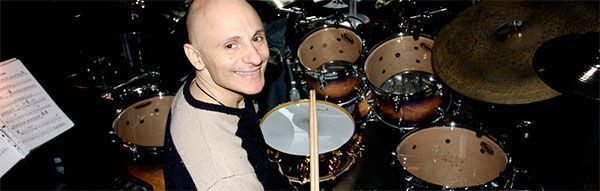
In our drum special, we cover another part of the family that, while it has its own deep-rooted personality, can be considered a “first cousin” of the rhythmic elements that flow from the drumsticks. What better way to learn the ins and outs of percussion than through one of the greats: Ralph Santos.
Without a doubt one of the percussionists richest in the color of his palette of timbres, who also combines mastery with technique. As with all the musicians who trade opinions in our “written roundtables,” we greatly appreciate your time and the experience you've shared with our readers.
Biographical Notes
- Percussionist specializing in Cuban, Brazilian and African percussion. Session and live musician who applies his knowledge to a variety of styles in a multitude of projects for Spanish and international artists. As for his origins, we should mention the group “Equinoccio,” which in the '80s was his experimental outlet when it came to jazz and standards; touring with “Equinoccio” gave him a broad, colorful view of how to approach standards and jazz in general, while allowing him to apply his own tendencies in that field. He has recorded and toured with renowned artists in Spain and abroad
- He has taught at the most prominent schools. He is currently presenting his own project, “Jungle Book”
-
The Interview
- Dear Ralph, it seems clear that to season all the technical knowledge in the family of instruments you master, you need to immerse yourself in the culture, the flavor and the original rhythm. What are your origins, and what led you to percussion in the style you define?
My origins are the curiosity that recordings like Santana's “Abraxas” (1970), “Caravanserai” (1971) and “Borboleta” (1974) stirred in me as a kid; Osibisa's “Heads” (1972) and “Wayaya” (1973); and then I was amazed by the music of Weather Report and Miles Davis, where percussion was always present. I grew up listening to masters like Armando Peraza, Airto Moreira, Chepito Areas, Mingo Lewis, Paulinho da Costa, Mino Cinelu and Ralph MacDonald, and I always listened to the salseros of the Fania All Stars (Ray Barretto, Roberto Roena, Eddie Montalvo, Mongo Santamaría, Johnny Pacheco...). I learned by listening, and later I traveled to the places where the percussion I love can be breathed in and the folklore stays alive through time (Africa, Cuba and Brazil), without forgetting that I grew up in Andalusia, where the flamenco palos were also in the air, surrounding me.
Nationally and internationally, who are your favorite percussionists?
Nationally: I have to highlight Wally Frazza, Danilo Ovale, Luisito Dulzaides, Rubem Dantas, Kalin and María, Beto and Timaná (because they were the first ones making the rounds in Spain, working with the “motley” Iberian fauna). As a Spanish percussionist, I like a cajón player whose last name is Soler, who played with Paco de Lucía at Expo 92; Armando Cuervo and Osvaldo Varona are also tremendous percussionists.
Internationally: “los Muñequitos de Matanzas,” especially Jesús Alfonso and Rafael Navarro Pujadas, and also Freddie Alfonso (Jesús's son and the best improviser I've seen lately) and Diosdado Ramos (choreographer and percussionist-director).
I must also mention Pancho Quinto, José Luis Quintana “Changuito,” Tata Güines, Miguel “Angá” Díaz, Yaroldi Abreu, Trilok Gurtu, Giovanni Hidalgo, Airto Moreira, Pete Escovedo and family, Carl Perazzo, Orestes Vilató, Babakar, Yomar Amador, Eugenio Arango, Modesto Méndez Torres, Alfredo Rodríguez Godínez, etc.As for instruments, could you tell us what your usual tools of the trade are, what you look for in them and what you feel makes them stand out?
 My usual tools of the trade are anything that sounds peculiar and adds a color, a sparkle, a warmth or a mystery (I make my own clay pots, or udus, my chimes and my shakers). Right now I work with Pearl percussion because of its great professionalism, the variety of instruments available when configuring my set, the high quality of materials, manufacturing and finish, and, very important, a balanced quality-to-price ratio. From Pearl I want to highlight the Batá drums, the congas, the Tube Cajons and the djembe. I'd also like to single out Mario Cortéz's cajones, which sound fantastic, and I use them.
What sets a percussionist apart from a drummer, or rather, what makes you prefer the path of percussion over the drum kit?
I love the drum kit and I play it (songo, mozambique, abakuá, guaguancó, funk, samba, jazz...) and everything I like I look for on the drum set so I can apply it in tune with the percussion, for recording and live.
What sets us apart is the way we listen, the way we understand our job, the style we work in, and the greater freedom when playing without having to hold down a groove all the time.
I preferred the path of percussion because I have a lot of fun with the skins, and with my hands I can play more things, more strokes; I know the clave and work with many more rhythms and atmospheres; I get a broader vision of music and I feel freer.
Sit a drummer down to play percussion and a percussionist down to play drums, try it and you'll see that the percussionist holds his own better, because we are always listening to the drummers so that everything fits together, yet few drummers care about learning to play alongside a percussionist, when to me it's all the same and deserves the same respect. In fact, the snare, the bass drum and the hi-hat were played separately until relatively recently, and they're instruments of the percussion family.What advice do you have for musicians who are starting out or “struggling” to grow and learn in the world of percussion?
Don't give up. If they really love it, they'll have the drive to study, to research, to listen to the greats and not get complacent, because here you never stop learning.Focusing on the album “Ralph Santos & The Jungle Band,” what options did you have as a percussionist to compose the whole work, and what is the idea behind the project?
I spent a year and a half composing with my workstation, based on rhythms I know and master, and from good foundations I created melodies and harmonies that had to do with the images Kipling's “The Jungle Book” had suggested to me.
The idea of the project is to defend nature against the continuous aggression of human beings, which endangers the planet and the species that live on it.On the audio professionals' side, which microphones do you think are the most suitable for miking percussion instruments? Do you have any mic preferences?
Neumann, Sennheiser and Shure are my favorites, with Neumann standing out for its quality in recording all kinds of skins and ambiences.I suppose the rapport between a percussionist and a drummer on stage is essential for a polished show. Which drummers would you single out on the current scene?
For me the example of the perfect, complete drummer is a gentleman named Julio César Barreto, with whom I had the privilege of playing at the 7th International Percussion Course in Cocentaina in 2000, and who has already released two CDs (Iyabó and Live & Rhythm). Whoever has ears, listen, because he recorded all the drums and percussion himself before even calling the other musicians.
Also Paco Séry, Karim Ziad, Omar Hakim, Osvaldo Fattoruso, Trilok Gurtu, Osmani Sánchez and Aramis Castellanos. Spanish drummers I'd like to highlight are Pepe Sánchez, Valentín Iturat, Vicente Climent, Miguel Ángel Capets, Jimmy Castro and Teresa Zayas; among the young ones, Pablo Serrano, Ezequiel Navas and Iván Martínez; and among those based in Spain, Fernando Favier, José San Martín, Moisés Porro, Ramón González, Javier Payarola, Carlos Carli, Alex Ico...What are your most imminent live projects?
Ralph Santos & The Jungle Band (the live staging of my CD “Jungle Book”) and Serenghetto (a project with African musicians living in Spain, where we look for Afro-jazz sounds and get people dancing).Finally, here's an open space for you to address all the musicians reading you right now, to openly share your personal recommendations so they can improve and make the right choices when buying instruments.
My recommendation is that before buying, they play the instruments and choose the ones they feel most comfortable with. I didn't have a professional instrument until I was 21, but when I bought a good pair of professional congas they already sounded good to me, because I already had hours of practice on my mom's pressure cooker, which gave me my attack.
Another matter is choosing an instrument that suits our physical size. For example, there are large, medium and small congas to the consumer's taste, and depending on our size and weight, a larger or slightly smaller instrument will suit us better.
Finally, I'd like musicians to keep in mind that there are many brands within our reach that provide a professional sound and comfortable playability without an exorbitant price.
I'd also like to say that, on a personal level, among the musicians I've crossed paths with, the higher the quality, the greater the humility; and that is my experience.Knowing your studio and live work well, and having breathed in the atmosphere your hands create on the percussion instruments, I take this chance to congratulate you on your work, your tenacity and your effort to enrich the music scene with the contribution of your wisdom and feel.
Thanks to Ralph Santos.
Thank you all, and long live music!