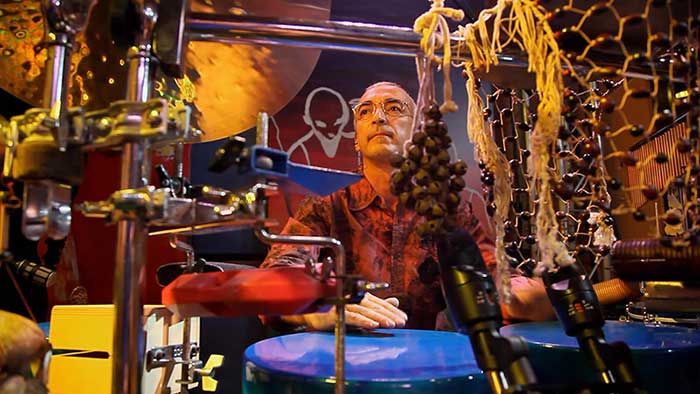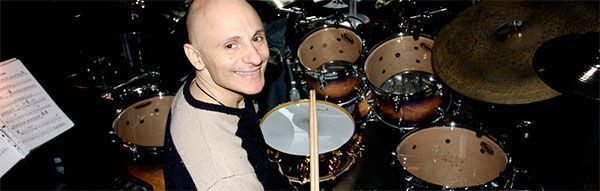
A drum and percussion special wouldn't be complete without the setups, experiences and comments of one of the most distinguished drummers on the Spanish scene. His long career is known to all, and it has taken him to work with a multitude of artists, live and in the studio: Ana Belén, Victor Manuel, Miguel Bosé, Ketama, Alejandro Sánz, Rosendo, Juan Perro, Luz Casal, Duncan Dhu, Cómplices and a long etcetera.
If we add to these ingredients the kindness and courtesy this musician shows us, we're ready to put on record our conversation with Angel Crespo.
Dear Ángel, first of all, and as with all the musicians who take part in our "get-togethers," thank you for your time and kindness. Your brothers gave you a hand to get started, moving from the surface of textbooks to that of a snare drum as percussion elements, but what made you start in this, and why?
For as long as I can remember I've been drawn to music, and although it's true that my first goal was to play guitar, my idea changed after watching a performance by the Mahavishnu Orchestra with Billy Cobham on drums... From that day I discovered that what I really wanted to do was play drums, and as soon as I could I enrolled at the Conservatory.
What do you think of the general level of Spanish drummers? Nationally and internationally, who are your favorite players?
Fortunately, I think that for some time now the level has risen considerably. I suppose the large number of schools and teaching materials now available to everyone makes that possible.
My favorite Spanish drummers are (though I don't want to belittle anyone): Salvador Niebla, Pedro Barceló, Paco García..
Internationally my favorite is Vinnie Colaiuta, but there are endless drummers you can't forget and who constantly leave me open-mouthed, such as Dave Weckl, Tony Williams, Steve Smith, Omar Hakim, Akira Jimbo, Gregg Bissonette, Denis Chambers, Steve Gadd, Simon Phillips, Horacio "el negro" Hernández, etc., etc., etc...
How much does choosing a good kit matter for your style?
Basically I think a good brand (a good manufacturer) guarantees that the kit we choose will sound more than good enough; the rest will depend on us and our ability. I also think the concept of "a certain type of kit for a certain type of music" tends to get lost. Music, fortunately, is fusing more and more, and an "atypical" kit for a style of music can bring sonorities and colors that otherwise might not be achieved. I suppose it's a matter of concepts and (in some cases) prejudices. All in all, anything goes. But it's worth remembering that if we want a kit that sounds deep and big, it might be wiser to choose larger drum sizes, and consequently, if we want a kit that sounds higher-pitched, we should choose smaller sizes...
My choice for toms is usually 10, 12, 14 and 16 inches. The bass drum, depending on the purpose, can be 22 or 18 inches.
What qualities do you look for in a drum kit (toms and bass drum)?
Mainly I care about their projection and definition. In the toms, I also look for depth and clarity in the note they produce.
And in the snare?
Ugh! You've hit me right where it counts. I have a collection of snares (about 17, and I'll keep adding to it little by little...) that I'm quite proud of. Each one (depending on the material, size, etc.) has its own particular characteristics. Sometimes I want an incisive sound, other times a sweeter one. It all depends on what I'm going to play. Obviously live I don't take my whole "arsenal"; I choose the one I consider most suitable for the specific type of music, but in the studio I love bringing several so I can pick the one that suits each song best. The snare, in my opinion, is one of the components of the drum kit that gives it the most sonic identity. Change the snare and it feels like you've changed kits...
As for cymbals, and regardless of the fact that each musician needs the particulars that suit his preferences or needs, what should your cymbal set give you?
In the hi-hats I look for a relatively bright sound with good definition when I play them with the foot; on the ride I like to hear the stick sound but I also like it to have enough "tail," because if they're too dry, when you play with other musicians, you end up hearing only the stick. I like crashes and splashes that open up easily, don't sound harsh and sustain long enough (not too short). In any case, it's very hard for me to express what my ear is looking for when choosing a cymbal. Sorry I can't be more specific.
Speaking of mics, over the years I've come to know the different preferences for capturing the drums. What is the best formula for you to pick up the kit with microphones, and do you have any preference for brands or models?
There are many brands on the market and all of them are of exceptional quality. I admit I love the classic Shure SM57 on the snare (on the top head) and the now-discontinued AKG D12 on the bass drum. But when you record you realize that, depending on the engineer you record with, there are endless possibilities, and that sometimes you use mics that aren't used live. I don't use my own mics, and if I decided to buy microphones for my drums I'd let my brother José Luis advise me, who (and this isn't brotherly love...) strikes me as the best sound engineer I've worked with so far.
What are your current and future projects? Where can we see you live?
Right now (as you rightly say at the beginning of the interview) I'm at the Teatro Calderón in the musical "We Will Rock You." It looks like a project that will be on the bill for a while. Fortunately I can send a sub in case a tour or some especially interesting job comes up. I have a tour in sight for 2004, but since it's not definite yet, I'd rather not say anything that might not pan out.
For the moment I'm not playing at any club or the like, and I'm not touring with anyone right now either. As for seeing me, strictly speaking, you can't even see me playing at the theater because I'm "hidden" in a soundproof booth in the pit (the "cubbyhole," as I call it...). I hope to play in front of an audience soon, on some tour or something like that. We'll see.
In our interviews I always like to leave an open space where you can address all our readers in whatever way you wish, to give them your recommendations and encouragement as they improve, learn and steer their passion toward a professional path with talent and know-how.
I think the only sensible thing that can be said is that in music, in learning an instrument, there are no "shortcuts." Everything comes as a result of work and effort. The more time you devote to it, the better your chances of getting further. Sometimes it's hard and demanding to spend hours and hours on the instrument, but if you manage that discipline, if practicing doesn't become something terrible, the benefits can be very great. Practicing and listening to a lot of music is what I consider most important for keeping up with our instrument. I've suffered firsthand from the prejudices that "others" have about study, but I'm very clear that studying is not bad at all. It's not true that you get cold, or lose your feel, or any of the other nonsense people say to justify their own shortcomings. My advice is: study as much as you can (in a coherent way), because the musicians we admire most, as a rule, despite having an incredible level, keep studying.
Once again, thank you for being here, congratulations on your career, and let us express our satisfaction at your being one of the successful, talented and serious representatives of all the musicians racking their brains to bring creativity to the public, lugging their drum kits from one venue to another and often through the gloomiest dives of the night. It always pleases us, therefore, to see skill recognized where it exists, and for musicians like you to be the ones who "show their face" before all those who wonder: what is a musician?
Thanks to Ángel Crespo
Setup

Drums
Mapex Orion Classic (maple) in ivory:
A. 22x18" or 18x16" bass drum
B. Snare (several*)
C. 10x8" tom
D. 12x9" tom
E. 14x14" floor tom
F. 16x16" floor tom
Mapex bass drum and hi-hat pedals (P980 and H950)
Metal Snares
Mapex Precious Metal Solid Bronze 14x5.5"
. Mapex Precious Metal Phosphor Bronze 14x5.5"
. Mapex Precious Metal Hammered Phosphor Bronze 14x5.5"
. Mapex Precious Metal Hammered Stainless Steel 14x5.5"
. Mapex Precious Metal Stainless Steel 14x5"
. Mapex Black Panther Hammered Brass 14x6.5"
. Mapex Black Panther Brass 14x3.5"
. Mapex Black Panther Aluminum 14x5.5"
. Premier Signia Brass 14x5.5" (with Mapex power hoops)
Wood Snares
. Mapex Black Panther Traditional Maple 14x5.5"
. Mapex Black Panther Traditional Maple 10x5.5"
. Mapex Black Panther Birdseye Maple 14x5"
. Mapex Deep Forest Cherrywood 14x6.5"
. Mapex Deep Forest Walnut 14X6.5" (with Yamaha wood hoops)
. Yamaha Maple Vinnie Colaiuta 14x4"
. Yamaha Maple Akira Jimbo 13x7.5"
. Gretsch Custom Plus Vinnie Colaiuta 14x5"
Cymbals
Meinl Byzance:
1. 10" Splash
2. 14" Heavy Sound Wave Hi-Hat
3. 17" Crash
4. 6" Splash
5. 8" Splash
6. 20" Dark Ride or 22" One of a Kind
7. 15" Crash
8. 18" China
Occasionally another 18" crash and a 7" bell, plus one or two Meinl cowbells (Steelbells) in 4.5" and 8".
Heads
Evans:
Bass drum: EQ1 Coated or EQ3 Clear
Snare: Uno 58 Dry as batter and Hazy 300 as snare-side
Toms: Clear G2 batter and Clear G1 resonant
Sticks
Regal Tip:
5BX with wood tip