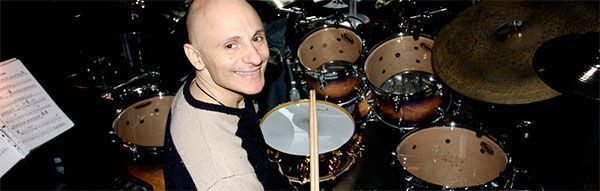
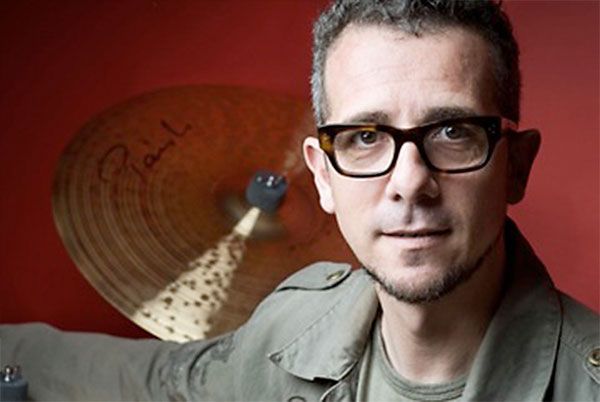
 On our journey through the world of professional drummers, we couldn't leave out another of the greats. It is a pleasure for us to chat with Pedro Barceló and share his chemistry with you. Born in 1959 in Formentera del Segura, Alicante, he has kindly joined our reflections and conversations among musicians.
To mention just a glimpse of his work, Jorge Pardo, Ketama, Joaquín Sabina, Miguel Ríos and a long list of other artists have shared and enjoyed Pedro's know-how.
Setup
Yamaha Maple Custom Absolute and Manu Katché “Junior Kit”
Rack toms: 10"x8", 12"x8" (studio), 10"x9", 12"x9" (live) and 10"x7" (clubs)
Floor toms: 13"x13" (clubs), 14"x14" and 16"x16" (live and studio)
Bass drum: 16"x16" (clubs), 18"x16", 20"x16" and 22"x18" (live and studio)
Wood snares: 14"x5 1/2" Maple Custom Absolute, 13"x5" Maple (Steve Gadd signature), 12" and 10" Wood Shell snares.
Metal snares: 14"x5 1/2" aluminum snare (Dave Weckl signature)
Cymbal set: I'm in the middle of switching brands. I'll be using Zildjian soon, but I haven't picked the models and the setup yet.
Hardware: I use Yamaha's 9 and 8 series for tours and the 7 series (lighter) for studio and clubs.
Heads: Evans (G2 and G1 coated on toms, EQ1 on bass drum)
Sticks: Pro-Orca “Pedro Barceló” and “Pro Jazz.”
Dear Pedro, first of all, our warmest welcome and our thanks for your time and your comments.
What got you started in this, and why?
I felt drawn to music, and to the drums in particular, from a very young age. I started playing in a band in my hometown when I was 11. From the very first time I played, I felt I could be free. As a kid, music gave me the chance to keep playing a game that opened the doors to a fascinating world, which later on, without my planning it, became my profession. Let's say the chance to express yourself, to be yourself, is what hooked me, even though at first I wasn't aware of it, and to me it was really “the perfect toy.”
The music world is complicated, and many musicians give up before realizing that their professional path lies here. What signs made you decide to go pro?
Well, I think at first I never imagined you could make a living playing. To me it was a “hobby” that made me happy. I was going to be an economist, after trying medicine, but during classes I dreamed about playing, I drew drum kits all over my notes, and I was obsessed with the idea of being a professional musician, while at the same time I got depressed picturing my future working in a bank, bald and with a ball and chain. I couldn't stomach it and I put it to my father. There was a family crisis, but I made it happen. It's funny, but right up until he died my father used to tell me: “Pedro, you'd be so well off at the bank, without having to bounce around so much...” The poor man never saw music as a secure profession, even though I earned more than an economist. Well, it was another generation.
Nationally and internationally, who are your favorite players?
If we're talking drummers, in Spain I like many (Tino Di Geraldo, Vicente Climent, Angie, Cristian, Jose Mena and a bunch whose names I can't remember right now). Outside Spain, you know: Steve Jordan, Manu Katché, Steve Gadd, Peter Erskine, Jaco Pastorius (may he rest in peace, he played the drums like the bass)... etc. I think every musician has something good to say, but over time I've learned to value, above all, simplicity and musicality as the main qualities in a drummer, besides “groove” and creativity, of course. Technique, over the years, has stopped interesting me if it doesn't come with these qualities.
How much does choosing a good kit matter for your style?
In general, the instrument should help you get the sound you like. Sizes, woods and so on are decisive factors in getting one sound or another. I use more or less the same sizes on rack toms and floor toms, varying the bass drums depending on the situation. As a professional musician I'm obliged to play just about everything, and I have to be versatile when it comes to finding a sound. In fact, I like a controlled, standard sound just as much as the craziest, most detuned one you can imagine. They all work.
What qualities do you look for in a drum kit (toms and bass drum)?
Versatility, warmth and projection.
And in the snare?
The snare is the most personal part of a drummer's setup. I like having every size and doing crazy things with them. When I record, I really enjoy detuning and using small sizes with low tunings, or the other way around.
As for cymbals, and regardless of the fact that each musician needs the particulars that suit his preferences or needs, what should your cymbal set give you?
With cymbals, I admit I'm very demanding, and I like the strangest, most out-of-the-ordinary stuff. I also like to experiment to get ugly sounds that nonetheless work in the final result. It takes many years to decide which cymbals you like and which work with the way you play. Obviously a cymbal can't be tuned, and until you find your sound on the kit, many models and brands will pass through your hands.
Speaking of mics, over the years I've come to know the different preferences for capturing the drums. What is the best formula for you to pick up the kit with microphones, and do you have any preference for brands or models?
In that sense I've always trusted the engineers and their professionalism. It doesn't depend only on the mic, but on the placement and the engineer's concept when it comes to getting the sound. For me, the ideal engineer is the one who listens to your sound, places his mics and makes the kit sound the way you sound, with almost no EQ.
What are your current and future projects? Where can we see you live?
Right now I'm preparing a record with Ketama, another for Concha Buika, and touring, I don't know, because I've learned that in this business things come up and fall through from one day to the next. I confess I'd love to play with an artist I admire, Jorge Drexler. Maybe someday fate will let me and my wish will come true. Actually I'm very excited about releasing a project of my own next year, and I also enjoy giving clinics and master classes around Spain with Yamaha.
What do you show in your master classes?
I usually talk about the things that are important to me and have helped me understand and enjoy music. Obviously they are concepts closer to creativity, emotion and expression than to pure technique. I think there's plenty of information about technique, but not so much about those other matters.
Are drummers born or made?
I believe the musician is born, and sooner or later he runs into the instrument and it's love at first sight. Still, a musician's growth and development is personal, individual and inevitable; nobody is born knowing. The path you choose doesn't matter (self-taught or not): a musician who feels like a musician will end up finding his place.
In our interviews I always like to leave an open space where you can address all our readers in whatever way you wish, to give them your recommendations and encouragement as they improve, learn and steer their passion toward a professional path with talent and know-how.
I always like to tell young people that if they have a dream, they should fight for it. If they love music and dream of being musicians, they should follow that impulse, no matter how high they may go along the way. Music is not a competition, it's a fulfillment, and we can all find our place. Best of luck.
I don't want to end the interview without congratulating you on all your professional successes, and wishing you a long and prosperous harvest of triumphs, which your talent undoubtedly deserves.
Thanks to Pedro Barceló.