Vocal Recording Techniques. Master Class with Michel Martín
- Escrito por Roger Montejano
- Publicado en ENGLISH
 We attended this master class by Michel Martín on microphone techniques for vocal recording, covering aspects such as correcting timbral problems through microphone selection, choosing the right combination of microphones and preamps, recording and production tricks, serial and parallel processing, etc. ISP is pleased to offer its readers an inside look at this new master class, which, like the previous one, proved extremely interesting.
The perfect take
As was pointed out at the very beginning of the class, vocal recording is often believed to be simple because its technical complexity appears relatively low. A microphone, pop filter, preamp, perhaps a little EQ and gentle compression... and record.
However, every voice is different, each offers a wide range of nuances and details, and few have a balanced timbre. Therefore, the apparent simplicity of the signal chain is more of a limitation than a benefit: with “few” resources, one must tackle the recording of the instrument the human ear is most familiar with.
The word “few” appears in quotation marks because, as became clear throughout the day, there are actually hundreds of small details and techniques that can help achieve the elusive “perfect take”.
Documentation
The handout provided began by covering theoretical aspects that must be taken into account, such as the physiology of the vocal tract, the different human vocal ranges, and the timbral and temporal characteristics of the voice.
It then explored other matters in greater depth, including speech intelligibility and the different parameters that affect it, the types of phonemes that exist (stationary/non-stationary, vowels, voiced consonants, fricatives, etc.), and how vowel formants each occupy two distinct frequency ranges.
It also explained the most common choir arrangements, stereo microphone techniques for capturing these kinds of ensembles, and how some microphones feature different capsules to counteract the high-frequency absorption caused by the relative humidity of the air.
Moving into another area, the documentation reviewed the most common microphone types (moving-coil and ribbon dynamics, and condensers), and how the physical construction of the transducer itself produces a different microphone response, making it better suited to one type of voice or another — or to one production or another.
Building on these ideas, Michel discussed microphone equalisation and why it is preferable to work with different microphone types — both in terms of transducer and polar pattern — and with positioning, in order to achieve the desired timbre directly at the source without the need for EQ.
For example, to capture a somewhat “thin” voice, a tube microphone can be used to add colour in the low end and give it body, or the proximity effect of pressure-gradient microphones can be exploited to achieve a similar result. Conversely, a very “dull” voice can be recorded with a microphone that boosts the high end, adding brightness to the upper frequencies.
Another interesting aspect covered was the correct choice of microphone–preamp pairing. The most common microphone preamplifiers were analysed, and a summary chart was provided in which they were classified according to whether they were bright or dark, and transparent or characterful.
With regard to vocal dynamics processing, the class covered the use of sidechain compression to address sibilance (de-essing), serial compression to deal with wide dynamic ranges (it is better to use two compressors applying a small amount of gain reduction than a single compressor applying a great deal), and parallel compression as a way to benefit from the sound of heavily compressed vocals without losing all their dynamics.
It was also stressed that the shortest signal chain is often preferable — in the sense of using as little processing as possible — but that one should not be afraid of processing during recording, provided one knows what one is doing.
Finally, the class demonstrated how microphone orientation can help achieve a particular timbre or reduce certain problems, such as plosive consonants, something that could be verified in practice during the second half of the master class.
The documentation concluded with a selection of the microphones most commonly found in recording studios, classifying them according to situations involving deep voices, thin voices, sibilance problems, weak voices, etc.
As with the master class on drums, the documentation was already interesting in its own right, and the instructor complemented it with numerous comments, tips and answers to the attendees’ questions.
Hands-on
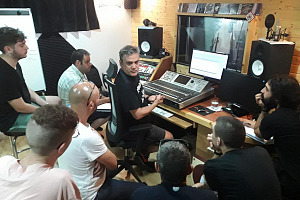
After the well-deserved lunch break, the practical part of the class began in Studio 2 at CATA. There, Santiago Quizhpe, the studio assistant, was waiting for us and took care of positioning the two microphones used for the tests: a Neumann U67 and a Dolly by Violet Design.
The first, a tube microphone, was routed through a solid-state Kahayan preamp, while the second was connected to one of the available Avalon 737 units. Both used the same Apogee A/D conversion, and the DAW was Pro Tools|HD 8, controlled via a Yamaha DM 2000.
Two students from ABC Estudio, the singing school directed by Ángela Carrasco, took part in the tests. Moisés Franco provided the male voice and Geniri Mena the female voice, both of them outstanding students at the school.
During this part of the master class, it became clear how each preamp–microphone combination responded differently depending on the performer’s type of voice, dynamics, distance from the microphone, etc.
The class also discussed how to treat the voice according to its dynamics and how, in quieter passages, boosting the low and high frequencies can help define the voice and give it body; in louder passages, a slight midrange cut can help it sit better in the mix.
The tilt and orientation of the microphone in relation to the singer’s mouth and chest were also discussed, as well as details such as placing the pop filter on a separate stand to help prevent noise from being transmitted to the microphone.
As an example of using processors while recording, each microphone input was duplicated — the Neumann and the Dolly were being recorded simultaneously — and a limiter was inserted on each one to demonstrate how a couple of dB of gain reduction can work wonders on a voice... partly because, if the singer hears that their voice sounds very good, they will probably sing with greater confidence and perform better.
This leads to one of the most interesting points discussed during the class: the psychological aspect of recording. Knowing how to manage the artist in the studio is always important, but when it comes to vocal recording, this aspect becomes even more crucial.
Michel explained that technology should be placed at the service of the artist, allowing them to feel comfortable and give their best performance. The objective is to capture memorable, magical moments in which the listener does not focus on how the voice was recorded, but on the soul it carries and what it conveys.
Moving briefly into the vast field of music production, examples from legendary producers such as Quincy Jones were used to explain how they approach vocal production. Many of these iconic producers not only take the psychological and technical aspects of recording into account; they are also constantly aware of the vocal melody and build the entire instrumentation and arrangement around it.
Conclusions
This concludes our account of a day packed with useful, practical information that was “ready to use”. Owing to the inevitable limitations of space, it is not possible to explore every issue covered in the master class in depth, but we have attempted to show how it addressed a large number of essential aspects.
These ranged from theoretical concepts that provide the foundations for understanding the logic behind certain practices, through numerous “tricks” and techniques that help solve common problems, to aspects of recording which, although less tangible, must undoubtedly be taken into account in order to achieve the perfect take.
About the Instructor
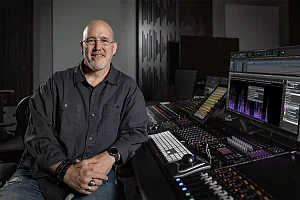
A graduate of the Polytechnic University of Valencia in Audio Systems and Sound Reinforcement — having also studied Electronics, Electroacoustics and Psychoacoustics — Michel Martín has spent more than 25 years in the music industry and has worked with artists of the calibre of B.B. King, Take That, Amaral, La Oreja de Van Gogh, Estopa, Alaska y Dinarama, Los Ronaldos, Los Bravos, Mecano and Marta Sánchez, to name just a few.
Fortunately, all this experience has not remained with him alone, and Michel has been teaching in Spain for many years at several different schools. More than one ISP reader has probably had the opportunity to attend one of his classes.