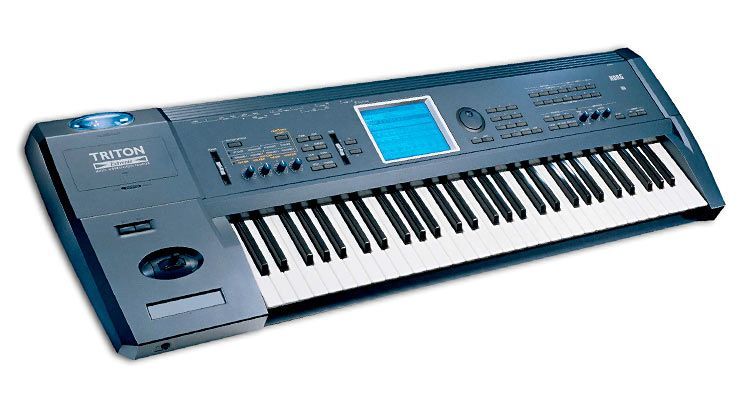
I would say it is one of the most exciting synthesizers ever to pass through my hands, especially because its programming can awaken creativity even in people who have only the slightest wish to feel like a musician. You bring that small spark of interest, lay your fingers on the keyboard, and the TRITON does the rest, processing everything in real time, with impressive power and a truly spectacular sonic result.
The consequence: superb enjoyment. Imagine this: the original model I mentioned, back in "the last century" (1999), contained 32 MB, and now this new EXTREME model brings no less than 160 MB of PCM ROM, with 962 multisamples (sampled sounds) and 1,175 for percussion... Wow...! = EVERYTHING.
A Philosophy in the Way It Works
Everything is right at hand. Besides the musical keyboard, the top panel has a series of controls (rotary and sliding), all closely interrelated, which we soon learn to handle and adapt to. But perhaps the key element sits in the middle, where we can see the results of the internal behavior of its circuits on a large 320 x 240-pixel LCD screen. It is comfortable to view and, being the "touch" type, it can take commands continuously from your fingers when you touch any part of it, offering a huge number of options that appear on it, opening one submenu after another until your wishes are met, but in a fairly intuitive way. It is as if the famous genie of Aladdin's magic lamp lived in there.
It all begins with its circuitry and 60 oscillators which, by combining the different waveforms they generate (sine, sawtooth, etc.), can create polyphony of up to 120 simultaneous notes. Of course we only have ten fingers, but a number that high is useful when we use a pedal (two are optional) that sustains our various keystrokes on the keyboard, and much more so when we are using a sequencer externally, whether from its internal tools or through another device connected to it, such as a computer. In fact we would already have plenty of resources with its own 16-track sequencer, which also has storage capacity for 200,000 notes that we could then dump to different media and reuse in their entirety. That many notes "go a long way..."
Let's say that in practice everything starts from the 128 basic sounds of the well-known "General MIDI," which it mixes and enriches in its own "TRITON style," achieving sounds ("PROG sounds") that often resemble genuine analog ones played by good musicians. Others are interwoven with effects, reverbs, filters and atonal segments that make them very original or strange but captivatingly attractive, from the most velvety to the most aggressive. You can get lost in them, however demanding you want to be and whatever the occasion. We could combine them endlessly, over and over, thousands of times, until we run out of our available leisure time and of course our time for making music, with the TRITON delivering a great pleasure of endless sensations.
But if we want more immediate results from those possible combinations, TRITON already offers 1,344 quick-access programs, forming the so-called "PROG BANK" (which we could consider the "TRITON basics"), in numbered series from 1 to 127, each assigned to the keys that appear on the right with letters from A to N. And we can instantly alter any of them, part by part, if we feel like it, by touching different areas of the LCD touch screen, which even shows graphs of the effects applied in its many parameters and options, such as the force and effect of the notes pressed on the keyboard at the start, during the sustain, and when released. But we can make those parameter adjustments just as easily by moving the sliders and rotary controls that are very accessible on the top panel of the TRITON, right after the keyboard. Everything is combined very intelligently. What seems a bit confusing at first will seem far more intuitive after a few hours of trying, not nearly as complicated, even "logical." It is a way of working unique to TRITON, of great capacity and intelligently necessary development, comfortable and accessible. Unfortunately, we won't find the same working philosophy in other competing keyboard instruments (which, incidentally... are those that came after this one really so necessary?).
It also has 1,536 program combinations (1,280 of them pre-recorded), along with 50 very spectacular rhythm patterns that sound quite real, and samplers compatible with AKAI, with which we can in turn generate various file types such as wav, aiff, etc., all compatible with the MIDI system.
I have spent hours and hours trying to hear "what on earth combinations they programmed!" on the unit that came into my hands and, believe it or not..., it literally robbed me of a lot of sleep, because the subject is so exciting that it is hard to break the curiosity and postpone the experience. And then each of those sounds inspires you to play melodies from your repertoire on its keyboard that now sound new, spectacular and grander, knowing that at any moment you can tweak their parameters in detail to be even more expressive with our intentions, until you find new paths that we couldn't reach before with other machines. I assure you that for almost a week I've been sleeping less than four hours because of it... wow!...
Three Triton Extreme Models
We can choose it with 61, 76 or 88 keys; the rest of the internal machinery is similar in all three. I have experimented with the 61-key (five-octave) model, the smallest, and it seems more than enough for the pleasure of playing around with and immersing yourself in this machine, since on the left side it has switches that let us shift the octave up or down at any moment, depending on the timbre of the tone we are using. This "short" model never felt short to me at all, and it's nice to see so much "condensed" into that "sufficient" space.
* The launch list prices were: 2,850, 3,150 and 3,650 euros (VAT included).
Its keys, of "normal" width, are similar to those we might find on a conventional piano. To my mind they are somewhat soft to the touch, which undoubtedly makes for more agile, virtuosic playing. The height of each key is not excessive but is enough to program different acoustic feels into many of its sounds depending on the pressure of our fingers. For example, in the brass-type instrument sounds I hear, such as saxophones, trumpets and concert flutes, if we press the key gently it seems we are "playing that instrument" in a velvety way, and the sound becomes "more aggressive" if we press harder, just as would happen in reality if, instead of using a keyboard, we played those "analog" instruments we are trying to imitate. At other times, with gentle pressure one type of instrument sounds, and if we play harder, others "enter the scene" (strings, brass, etc.), helping to emphasize the events or melodies that we thereby enrich with content and grandeur.
Most of the stored programs have different keyboard zones spread across different instruments, which we hear as we jump from one zone to another. Naturally, the 88-note model has more of an advantage there, and also if we want to "turn it into a concert grand piano": if we closed our eyes, we would think we had one right in front of us. How we amplify its output signal will matter, depending on the room where it is to be heard, but if that signal is sent directly to a mixing console, the "confusion" is TOTAL...
So Many Excellent Details
I will miss many of them in the few pages of this modest article, while the keyboard comes with four "big books" full of possibilities and very intuitive instructions, full of easy-to-understand drawings, although they make you read them in English, but quite understandable English; as I would put it, "English for dummies," which in the age of the internet will hardly surprise anyone. The distributors assure me that a CD-ROM with instructions in Spanish is included, but the one I saw contained them in English and Japanese in its box; in Spanish, as far as I can tell, there is only a one-page introduction.
Once we've lined up, one by one, the sounds we like best, we can independently assign them to different arpeggiator styles and a wide variety of effects. For example, with a guitar, using just three fingers of one hand on the keyboard, it will seem as if we are strumming it or "completing" the performance with different arpeggios, as if we were playing the guitar itself with both hands, without it seeming that we are doing it from a piano-shaped keyboard... Likewise, using the arpeggiator tools for percussion sounds, we create different rhythms that sound quite "real," and the same goes for bass, which is very welcome when we try to get jazz, rock or funk rhythms, among many others.
It even has very convincing Scottish bagpipe sounds, lots of electric pianos (including some Rhodes-type ones that fascinate me), strings in every style, some very grand and with a multitude of effects (bowed in many styles, pizzicato, etc.), harps, assorted effects and many, many spectacular sounds to fit the flashiest styles you usually hear in nearly every club today ("disco," "pop," "house," "acid," "hip hop," etc.). With this machine they can be achieved with considerably more "class" than with the "little toys with buttons that play by themselves" that proliferate, cheap, in many stores. This is more professional... depending on who likes these styles more. Personally, I tend to be more demanding about the harmony of the music and even about the silences, which I also think should be an important part of good scores that become timeless after a certain time. Nevertheless, I don't set aside any style in my life, and of course not the avant-garde ones. Proof of that is that three months ago, from this very platform, I published another test on the PC program called "LIVE-3" (version 4 has just come out) from www.ableton.com, one of the most complete for generating those kinds of events in the most spectacular way. TRITON, which follows all lines of taste, also helps by providing a profusion of tools and even a demo for enthusiasts of generating these very novel styles, without setting aside any other musical style we may want to develop. I'd say it's IMPOSSIBLE not to find your style with this machine, however odd you may feel, and if you are more broad-minded, all the better for you, because you won't know when to turn the machine off...
I went to the trouble of listening to each of the styles programmed as "basic" (all their parameters adjustable at will), which took me about a week of overtime..., but I noted down those that caught my attention most, to return to them at any time. My list of the "out of the ordinary" ones, the ones I feel I can develop "great things" with (new music of my own), counts FIFTY-SEVEN EXTRAORDINARY, TOP-GRADE ONES... There are all kinds of combinations, to which they assign arbitrary names. For example, one called JAM WITH ME! plays a funky rhythm (of course the tempo, among very many other parameters, can be changed instantly) in which the "drums" and bass play as if waiting for your commands at every instant, with the bass in particular generating harmonic arpeggios "in agreement" with the melodies produced when you lay your fingers on the keyboard with an electric piano sound. It is as if your playing ability were suddenly multiplied by FOUR, and you feel astoundingly comfortable and creative with that rhythm. Another, called DREAM OF ME, "gathers" under your fingers "a group of musicians" with seemingly "natural" Latin percussion, a bass that is "devoted and very much in tune with your harmonies," electric piano and even guitar. Immediately your whole body moves, you "let loose" and even end up dancing... in an enchanting, contagious rhythm. With just a little improvising with your fingers on the keyboard, the machine does the rest and... time to record... But there are others with effects that are not so rhythmic, such as the one called DEEPIN SPACE, where chiming bells or rhythmic, mysterious delays (echoes) emerge under your fingers, intoxicating you in an atmosphere of mystery and relaxing sweetness. Other formats (many) have the typical instruments of "grandiose movies": a big orchestra, big timpani, horns and trumpets, trombones, strings, snare drums rolling, triangles in time, harps on top... There is a huge amount to choose from for every occasion. Mind-blowing!... above all for how "real" those sounds feel, as if they were performances by orchestral instruments "of old," easily "under your baton..."
We can easily connect the TRITON to a computer via USB or optical connections. From that moment the TRITON will be your main work tool, and even in live performances you may do without the rest of the extras...
Its Tools Are Very Precise
When you get used to working (in a short time) with the controls on the TRITON, you realize how effective they are and how interrelated they are. On the central screen you see at all times what is happening, and from it you can quickly tweak a great many functions. But if you need to change any parameter to a "high" value (say, raising a volume from 3 to 85), a slider on the left called "VALUE" helps enormously in getting quickly to that value, and another wheel to the right of the same screen serves the same purpose, giving immediate and accurate precision without wasting much time fiddling with the access mechanisms for each function. Changing one sound for another, an effect, or an arpeggio type with which to instantly vary the way a given instrument is played will soon become something unusually predictable, easy and comfortable, which is much appreciated.
On the back it has inputs for a microphone or an external sound line that we want to add to the tracks recorded inside the TRITON, in addition to the other tools we explained earlier regarding its connection to an external computer.
Likewise, besides the mono or stereo outputs from the TRITON to other equipment and the optical outputs mentioned, it has four other independent outputs through which we can deliver four different sounds emanating from a single musical performance on the keyboard, for example when we are using one of its programmed combinations. That way, drums on one, bass on another, guitar on another, piano on another, even though we "played it all at once," come out independently through those four outputs. If we then assign them to four tracks of our external sequencer program installed on our computer, we can remix them differently from how we "originally" did it on the TRITON.
Of course, it also has every kind of MIDI input and output, a system with which it is highly compatible and complementary. Whatever way of working you can think of, the TRITON will likely answer yes, it can be done with it, or even "and much more..."
And although this is a machine "built to last," it still has possible future expansions, for example those compatible with COMPACT FLASH, USB types A and B, and S/PDIF optical input and output connections.
Differences between the EXTREME and its more basic predecessor
With this EXTREME model you no longer have to spend an extra budget on buying the sound expansions that the original TRITON needed to enrich it in line with new musical trends. Now it has them all built in, perfectly accessible and organized for comfortable, immediate use.
It has more connectivity and efficiency when connecting and working together with a computer, for example through its USB connections, which didn't exist in the past, or through fiber optic.
The EXTREME has gained a spectacular and noticeable feature that we can see on its case: a bright blue "tube," which is said to give a warmer sound in the style of analog instruments, removing the classic machine-like character that usually shows up in digital sound generators; in other words, it has been "humanized." Its effect is noticeable with some sounds more than others, but it undoubtedly answers the requests of the musicians who use them, and the designers are apparently ready to keep "tying up loose ends" so that nothing escapes them.
It undoubtedly has far more internal memory and greater polyphony, which is naturally welcome for working more comfortably on sequencing its sounds, both within the machine and when controlled from outside it. In essence, then, it is AN UPDATED TRITON.
It Must Have Something Wrong With It...!
If not wrong... perhaps improvable. For example, when sequencing its events, it is still more comfortable to work from a PC than through the sequencer controlled with the TRITON's touch screen. Magnificent as it is, it can't compare with the graphic conveniences of the many programs that can complement the TRITON inside a connected computer, although it is also true that once the work is finished in the computer, it can be transferred back to the TRITON, even to refine and correct other specific details, as suits us.
Using the TRITON as a multitrack recorder, it perhaps should have more inputs for a larger number of mics plugged into it to work simultaneously from different sources. Perhaps, instead of one central screen, it could have two with separate functions, one for sound processing and one for distributing sounds in its multitrack sequencer, watching both at once.
KORG makes other types of keyboards that are not like the TRITON, since this is a very specific style, aimed at a discerning audience with a particular way of working. It has developed other styles of synthesizers that do things differently. If KORG made only keyboards in the TRITON range, it would seem we should reproach it for not making more drastic changes in a more modern version, when in reality the EXTREME is already a device aimed at a great many fairly demanding musicians. Extreme is therefore simply an update of the TRITON.