I never imagined that, after trying so many keyboard models, Yamaha would suddenly surprise me with something like this, keeping me busy for an entire Sunday afternoon and the days after, until the early hours of the morning, thrilled by so many new tools, the way it plays, and its surprising, novel, “real” sounds.
When I open the box and take in its “so space-age” design and start counting the buttons and knobs on its casing (not counting the keyboard and the rear connections) and reach the number “172”..., I look for the instruction manual (which normally comes in the box, but which they forgot to include for me), and I start getting “a bit nervous,” until I discover online (just by searching Google for “Tyros2 Yamaha”) that not only are all its instructions there (about 240 pages), with good, intuitive illustrations, but also in perfect Spanish. What’s more, there are also plenty of audio and video demos showing the excellent qualities of its timbres and combinations of musical sounds, at first hard to believe, or thought to be “rigged” given how realistic they are compared with genuine natural sounds, like those of saxophones, acoustic guitars, or violin, which are among the best I’ve heard so far in synthesized sampling from supposedly similar keyboards.
That immediately invited me to plug it in and get my hands on it. At a glance, I could clearly see that the different sounds can be changed with the controls on the right side and the combination of rhythms on the left. Right from the start it’s set up with a “classic” piano and rhythms with “real drum” sounds, but as I pressed more buttons little by little, variations and accompaniments from other “very real” instruments appeared, as if some (very clever electronic) musicians were beside me waiting for me to play something on the keyboard so “they could accompany me” (with brass, percussion, guitars, and so on that seem very authentic) in a very intuitive way and in real time.
Of course, I had never seen this model before opening that box, nor had anyone explained anything about it to me before I was surprised to see how spectacular it was and how new it looked.
As soon as I plugged it in and kept trying it out, it was as if I got drunk on the experience. I found it quite intuitive, since without having leafed through a single page of the manual, I was soon able to learn to pull out several features that seemed new to me; I stayed intrigued and so thrilled with “the new toy” that I didn’t notice about 5 hours had gone by without leaving it...
And the next day was when I went online and began to realize that it was “a little big monster,” capable of things I couldn’t even have imagined before. It seems unbelievable that at this stage, after everything that has already been developed technically, Yamaha now appears achieving “a new stature,” with genuine innovations in playability and, above all, with surprising sounds that are even more real, or closer to those produced by good musicians on their different “natural instruments” of the orchestra. In the following days I haven’t stopped delighting in this machine...
What Was New About This Model?
What a difficult question...! A WHOLE LOT!!! It seems incredible to me that so many things can still be developed and appear new. But of course... YAMAHA is YAMAHA!... and it doesn’t rest on its laurels.
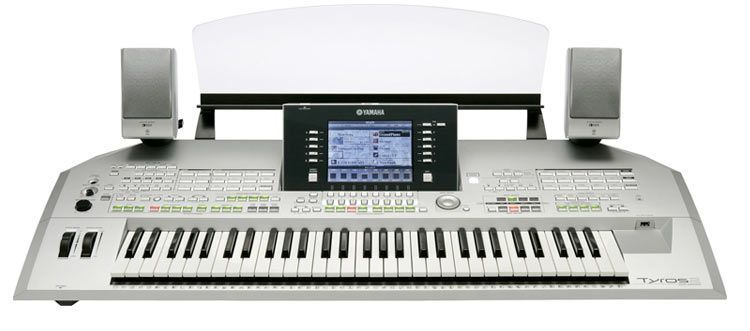
First off, the spectacular silver design, very space-age, with rounded corners. If we pick it up from side to side to move it with both hands (left/right), the underside has a different shape from almost all known models, which makes that action much easier. This is just one of the many details that seem unimportant but have been taken extreme care with to bring new things that are really effective and welcome.
In the middle there is a really highly visible backlit color display, whose height can be adjusted for the comfort of whoever uses it and according to each circumstance, as well as its brightness. This screen displays a great many of the options to combine within the machine: the different sounds, the playing of so many possible rhythms or styles, song lyrics when running karaoke, musical scores, settings of the various sound mixers depending on the case, adjustments to the quality or modifications to the timbre of each sound, and so on. The change commands we see take place on this screen (which is not a touchscreen) are carried out mainly with the buttons on either side of it, as well as by turning a small dial located to the right and below this screen, but it can also change when we use the rest of the buttons located all over the casing. So, for example, if we press the button on the right for one of the types of musical instruments, the screen shows many more instruments of that type, multiplying the possibilities or giving finer definition. For example, if it’s “saxophones,” many different types of them open up on the main screen, with the results influenced not only by the pressure we put on the keys but also by the way we do it, much as a musician expresses himself by blowing into his sax with different intentions.
Sometimes, given how the musical styles come together (where it seems that “electronic musicians with real sounds inside this machine are accompanying you”), you might think it is “a sophisticated musical toy” like the ones we all have in mind that were even sold in supermarkets in the toy section..., but not by a long shot! It is a great help to the composer or musician who doesn’t have enough technique to skillfully handle other “natural” instruments that aren’t keyboards and that this TYROS2 emulates; you don’t even need great knowledge as a pianist. It’s as if the machine said to you: “Let’s see what you can do, and we’ll accompany you with whatever instruments you like, master...,” as if a few robot musicians at your service were waiting for you to press the keys with whatever occurs to you, while “they” complement your performance in a more professional way, starting with the percussion and accompanying you with, for example, guitar chords and brass or string phrases that you don’t play but that fit perfectly to give more richness to your idea, once you’ve chosen that style of playing from a list of about 400 different ones, as well as from among more than 500 different instrument sounds of surprising quality (many of them almost incredible to think they came out of a synthesizer keyboard).
And almost without taking your hands off your keyboard, you can “jump” to other sound combinations previously set (by you or by the machine itself) that match what you’re doing, including the possibility of “cuts” or “breaks” (embellished with well-chosen drum fills and even other musical instruments in harmony with what is already playing). With a single press of one of its dedicated buttons, you can bring in other phrases with more instruments or their variations, in keeping with the harmonies you’re proposing, as well as adding at will “intros or endings” of musical phrases that embellish your whole piece and that would be harder for you to play than how they’ve been programmed at YAMAHA, so that everything ends up sounding as if it came from a commercial record of astonishing musical reality.
The Better a Musician You Are, the Better the Resources
It multiplies by a lot the playing abilities you can pull off on this keyboard, but it “rewards” your greater knowledge, because the more you know about using a musical keyboard, the more of a reference the machine takes from you and the better it configures its final results.
But if what you need is to improve the playing skills you should have on a musical keyboard, this very machine helps you get there, through other special tools that work as a “teacher,” pointing out your mistakes and how to improve your musical training little by little. That’s why it is not at all a toy, although at times it may seem like one, but a valuable aid as a musician, as a composer, and even as a performer of those “natural” instruments from which you have no idea how to get a single sound, such as a trumpet, sax, violin, guitar, flute, and so on, or the result of combining several of them. And the TYROS2 does all of this in a very personal way, different from how many other keyboards try something similar. Without a doubt YAMAHA has given this instrument a lot of personality, and it is going to become a new benchmark.
More Things?
Of course! There is much more than what I’ve described so far (and that’s not little...). It can be used as a conventional keyboard across all the notes of its keyboard, with more than a thousand sounds, because we can still make variations to its more than 500 built-in voices at the “push of a button” almost instantly. When it uses accompaniment modes, it reserves a part of the keyboard on the left for your corresponding hand, from which the machine receives commands about your harmonies, even if you only press with one finger on that hand, while the machine works out harmonies and matching patterns according to the chosen styles. The sounds in the right hand can be changed at will and even preprogrammed in groups of four (the same goes for the left-hand styles) so you can jump from one to another while playing a piece, barely touching any of the buttons provided for that purpose, as well as include “breaks” whenever we feel like it or other appropriate musical phrasing.
And It Records Too...!
It’s not that one has forgotten this very important feature, which of course this machine does masterfully (also to hard disk), both with “final” sounds and as MIDI (of the performance, so that we can later change the sounds that “finish it off,” assigning them afterward). In addition, on the back it has all kinds of connections to link it to a PC, and not only through the two independent USB connections it incorporates (one at the back and one at the front) or through 2 separate MIDI IN/OUT systems A and B, which are likewise next to a more precise, professional RGB connector for hooking it up to a computer (Mac too). Likewise it has an output to another video screen, selectable between PAL or NTSC (the system used in the US), to see, for example, the staves of our compositions made with this keyboard, the karaoke lyrics, or any of the many other functions this machine launches from within.
It can record on 16 independent channels, each of which we can adjust very specifically to our taste, turning the screen at times into an authentic “mixing console” with the appropriate, specific tools to get the best options.
But without needing computers, this machine can be linked to the internet, where YAMAHA has reserved additional tools and hundreds of songs that we can use specifically with this model, which we can devote many “24 hours a day” to if we want, creating a real passion, although with a little intuition we can start doing things with it almost from the first moment we install it in our studio and press the power button.
No Built-In Speakers
But it does have an independent output on each side for two of them, which would simply be added to the machine, although of course it has line outputs to route its signal to our audio system or external recording gear. It also has a headphone output on the front which, if we plug in headphones, sounds perfect and isolates you from the outside world.
With Mic Input
That’s not all: using your voice while you press notes on the keyboard with your fingers, it becomes a “vocoder,” that is, if you set “choir or human voice” sounds, they will seem to be singing “backing vocals” for you that follow your voice’s performance perfectly. As karaoke, you can use many of this machine’s tools to improve the quality of the voice coming in through the mic connection and mix it with songs already prepared, or ones that may come up. In real time, you can vary the respective volumes, make “breaks,” change styles “on the fly,” do duets, add special effects, and so on.
There’s Still More...
I think this space is insufficient to describe so many of the things this machine can do that I haven’t even mentioned yet... for example its “digital music notebook,” through which we can digitally load into memory almost any kind of commercial or instructional score.
In some of its sounds, for example the sax (there are many types of saxes to choose from), you can perfectly hear the “breathing” of “its player” at the end of a musical phrase, as if taking a breath to play the next phrase, just as happens in reality, which is disconcerting when listening from outside as to whether it was played by a musician or from a keyboard; it’s incredible... The same thing happens with its “acoustic guitars,” where when changing notes you can hear (as happens in “reality”) the “squeak” of fingers sliding over the wound strings. Details like these are carefully handled, specifically for each musical instrument you choose, giving a realism that surprises even the most seasoned professionals, who end up with that worn-out phrase: “where are we going to end up...!”
It has many kinds of effects, from a great many echoes and reverbs to pitch changes, “Auto-Wah,” and distortion. Changing key at any moment is quick, using 2 dedicated keys on the main casing. Likewise, changing octave on the keyboard is simple and instantaneous. The keyboard has 61 notes (C1 to C6) with a width like a “conventional” piano; I would say with a semi-soft touch that makes virtuosity easier and is specially designed for sensitivity to that pressure, out of the ordinary in terms of the sounds you then hear, which are very differentiated depending on how we attack each note with our fingers.
- Its 16-track sequencer lets you record on these tracks note by note or together, as we choose. Within the song in question, we can easily record more specific sequences between its tracks (“Punch”). We can also add to its tracks sounds “injected” by line signal from other musical instruments, or voices and sounds that were not born inside the Tyros2.
- Its polyphony allows up to 128 notes to sound simultaneously.
Compared with other synthesizers, its sax, acoustic and electric guitar, some upright bass, flute, and solo violin sounds stand out as spectacular achievements. It has practically everything. Less successful in my judgment are sounds like the harmonica or human voices, which in any case can be modified. The percussion is often spectacular.
- The microphone signal input has a background-noise gate/limiter, a compressor, and a 3-band equalizer.
- There is a metronome that can be activated if we don’t want to count the bars with other percussion effects.
- The keyboard’s overall tuning can be adjusted from A at 414.8 Hz at 400 Hz up to 466.8 Hz.
- The on-screen instructions can be set to 5 languages, including Spanish.
- It weighs 14.5 kg and measures 114 cm wide, 45 cm deep (seems a little more than usual compared with others) and only 13.7 cm high (in addition to however much we raise the control display, which can be lying totally “flat”).
- A music stand for sheet music is supplied with the machine, easily adjustable at will.
- It accepts three different types of pedals on the back for better control with our feet.
I’ve spent enthusiastic hours with it. Truly, truly, it’s one heck of a Tyros!... Try it... and you’ll see...!