There are now many homes where, for one reason or another, musicians lack the space their hobby or their work demands as they strive to rehearse what they need on their favorite instrument. An added problem is the feeling of "torture" inflicted on the neighbors, who have to put up with the constant mistakes made while learning, or with the same pieces, however good they may be, heard over and over again against their will until they "end up setting your teeth on edge..."
In 1927 KAWAI made its first "small contribution" to musicians who needed keyboards. Today it is a huge industry, highly prestigious around the world, with a wide variety of models and finishes.
They started out building wooden pianos in the most classic style, because electronics for them did not yet exist, eventually managing to manufacture every single part or component themselves and ultimately achieving excellent results not only in sound but also in their impeccable finish, with competitive pricing that has now lasted for many decades. They have perfected them, and today they are still among the leaders in Spanish music stores.
How the ES-3 solves that problem
With the arrival of the electronic era, KAWAI created a new line of work without ceasing to perfect the rest of its products and, especially since the 1970s, its developments have been widely imitated, always cutting-edge and timely, designing an enormous number of new models of electric pianos, synthesizers, sound modules and all kinds of electronic devices for making music or processing sound in the most professional and affordable way for musicians.
At its launch, the ES-3 was aimed at a specific segment whose needs it had to meet effectively, at the right price and with quality. And I understand that this "segment" might be the music student or professional who doesn't have much room at home or in the studio for one of those wooden pianos, but who at the same time needs an 88-note instrument that resembles playing one of them as closely as possible, in several respects: the width of each key and weighted keys in the style of "wooden pianos," with the same feeling of pressure, firmness and key travel when pressing each key, and a sense of acoustic force similar to the response you get when pressing with different muscular intensities and the action of our hands and fingers on them.
It should also sound clear enough and similar to playing one of those models, without necessarily having to amplify it electrically by other means. Taking up little space will be essential (within reason) if it has 88 "professional" keys; even better if it also has a built-in metronome to keep time and, "to top it all off...", if when needed only we can hear it through headphones, without anyone around us noticing and without losing any of the sensations above; if besides a "normal piano" it offers some other pleasant sounds; and "while we're at it," if it can serve as a master keyboard to enter musical data into a program installed on our computer, or to play sounds from an external sound module connected to it via MIDI. And also that we don't have to keep calling the tuner to keep it always in tune...
OK!... well, all of that was achieved with this model, for which some musicians will surely find other uses not yet suggested here (triggering sequences via MIDI, complementing sounds played at the same time from another similar keyboard nearby or next to it, etc.).
Testing the ES-3
It's surprising how, with speakers hidden beneath the key mechanism, playing it gives a feeling of "natural liveliness" that usually doesn't happen with other competing electronic keyboards, even considerably larger ones. Nevertheless, I hooked a cable from its rear line audio output to a larger system to listen to each of its sounds more carefully, and the truth is that the "normal" piano, which will surely be the one we use most, gains only a little "space," and the feel when pressing its keys remains "similar" to when we used it without external amplification. This audio connection would perhaps be more useful if we wanted to record its sound to some other external device.
Of course, I wasn't content to keep using only that fine "classical piano" sound; I spent time pressing the buttons that switch between the different voices offering other possible sounds, such as organ, harpsichord, electric piano, etc., and found them very well chosen. Admittedly, for my taste they are not overly plentiful, but they are one hundred percent recognizable, even in combinations of two sounds together, such as piano and strings. It's also true that anyone wanting to play around with many more sounds through this keyboard can always connect it to a dedicated external module, of which there are now plenty and cheap ones, even brand new. The ES-3 is THE FOUNDATION; "the rest" is just "sonic decoration."
Of course, when you don't want to use it, it doesn't need to stay horizontal as when you're playing it. In a vertical position (switched off) it takes up a minimum of space and can be stored, for example, inside a closet, so nobody will be bothered by seeing it. How could we "hide" a classic wooden piano in any room when we can't use it? Bear in mind that in many cases this ES-3 will serve the same purpose of rehearsing or learning our most cherished pieces, much as one of those wooden ones would... For better or worse, "practicality" is winning out, and it may even be more affordable for us. And the ES-3 does achieve this timely electronic formula: price / quality / effectiveness.
More ES-3 details
Its polyphony is 64 notes, quite acceptable for the vast majority of uses we will give it, even more than enough for live performances, because although we only have ten fingers, the number of simultaneous notes increases when we use a pedal that sustains them (to achieve grander expression in our performances), and above all when we use it to enter data into an external sequencer.
- With its 21 different voices, I think it's more than enough for the purposes this keyboard was designed for, since realistically the one we'll use most is the "normal acoustic piano" (3 different ones) and at most, with added strings, an electric piano (4), organ sounds, harpsichord; there are also strings, basses, choirs, etc. It also includes other effects: reverbs (3), tremolo, "Chorus," "Rotary" (2), transpose, tuning control, volume controls, EQ (3), resonance, etc.
- It has two tracks for occasional recordings of up to four songs (which can then be transferred to external devices if you want to keep them, freeing up these memories for later reuse).
- It has outputs for two pairs of headphones and selectable mono or stereo audio outputs
- A pedal is included as standard (plus another optional one) to give greater emphasis to our musical expression.
The internal amplifier that drives its speakers (2 of 8x12 cm) is 14 watts, which is why its corresponding power supply is also included as standard.
- Its instructions are easy to understand, full of drawings and diagrams, and in any case, mechanically this is one of the least complicated devices of its kind, so we won't have any trouble quickly mastering nearly all of its operating features and possible connections.
- Dimensions. It is 136.2 cm long, 13.8 cm high and 32.1 cm deep, and it weighs 19.5 kilos.
- Its launch price (in 2013) was 1,600 euros including VAT, in both black and silver.
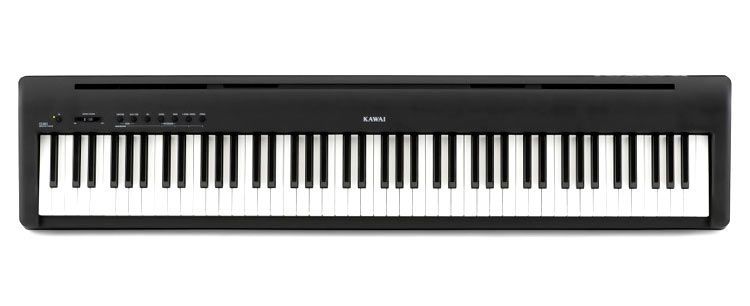
- The header photo shows the ES100 model
This is specifically a keyboard and, although it may not look like it, a "serious" one, for a keyboard player who truly wants to work on music and learn to perform it without needing a large space or even a large traditional wooden piano, which it replaces PERFECTLY for that purpose. Its tools, many of them for fun, come as an EXTRA. And for other "gimmicks," we can always add external modules or sequencing via MIDI, even with a USB connection to computers, which it is also ready for.