*We're using this video of the DF524 as an example because it shows the tonal versatility we're talking about in the DF64RB range.
By now, it's hard to try an instrument you don't know and be amazed by it. If you're used to playing guitar, a new product in your hands may feel rewarding, accurate, with good tone, intonation and so on, but it's rare for it to step outside the general lines (the root designs) we all know. Parker is no stranger to me. It has been established in the market for a long time, in the spot it deserves.
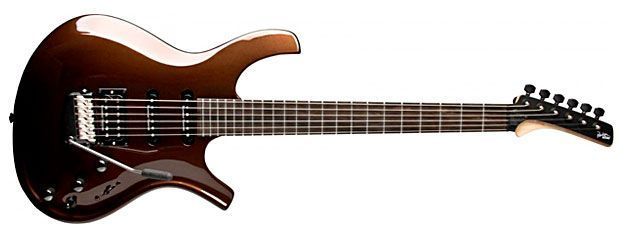
I had tried a few before, but never in so much detail. This time, I have dissected every corner of its arsenal for ISP Música. What surprised me most is the brand's boldness in offering innovation in every sense, from the designs (clearly recognizable by now) down to the smallest technical detail. The result, on the instrument I tested, is brutal quality. Let's take it piece by piece.
On this instrument, I found the best of what I'd found in other brands separately, all in one. For example, the attack and punchy character of some Ibanez® models, or their sharpness and playing comfort. I also felt well supplied with dynamic, punchy, Fender®-style flavor in natural and lightly overdriven sounds. After confirming this power in cleans and crunch, the same question came to mind that you're probably asking: what about heavy Gibson®-style saturation, how will that go? Frankly, portentous sustain and creamy or thick tones when you want them. Add the smooth feel I mentioned, which makes fingering easier, and we have one hell of a machine, a real jaw-dropper.
Step by Step
Saying all this in the abstract may seem entirely subjective, so we'll try to be more specific to show clearly how well the instrument performs.
About the “Radial MaxxFly” Models
This Parker series is equipped with most of the brand's great features. It has a carefully crafted ergonomic design, with a light, sleek and manageable profile. It has a 22-fret fretboard. As for pickups, it has an HSS configuration, which provides a more-than-extensive tonal palette, that is, versatility.
The designers of the Radial Neck Joint system say that, thanks to it, they have improved the transfer of vibration (and tone) from the neck to the body, with a precise fit and no movement or shifting of the assembled parts over time.
Impressions of the Brand Before Trying the Guitars
Besides having seen various models from the company in the hands of renowned guitarists such as Vernon Reid and Adrian Belew (both of whom have signature models), Jim Adams, Steve Dimarchi, Dave Martone and many others, I've confirmed the brand's presence in plenty of studios, as well as among the working tools of a multitude of professional guitarists. That has always made me think that, obviously, the guitars must deliver powerful performance.
Other thoughts that crossed my mind about this brand centered on the maker's boldness in design, aesthetics, the practicality of the body and so on: competitive differences, ergonomics?
Test Results
As usual, I tried the gear before knowing the prices. Specifically, I had three Parker guitars in my hands, and we will be publishing reviews of them progressively. I like to try out gear before I know the price so I can draw my own conclusions. I even try to guess what price range each beast I test will fall into. Right from the start, I realized it was high-end. One hell of a guitar.
Body
Built from carved alder with a glossy brown finish, discreet and personal in appearance, it shows much more development in its conception than it seems at first glance. I began the previous paragraph by saying I wondered whether the look of the Parker Fly came from a clearly differentiating bet against the two “old-guard” brands. A new, clearly bold bet. After looking at the instrument slowly, I think it's quite possible they went for a radically personal image, but now I add to my opinion that every detail of the body design has a reason. Everything is meticulously cared for. The body has countless curves, something that undoubtedly makes manufacturing more expensive and complicated. All these shapes answer a search for perfect ergonomics. Each curve conforms to the part of the body it touches. Add its light weight, and you get a guitar that is really comfortable and pleasant to play, whether standing or sitting.
Materials and Construction
One of the standout features of this series is the way the neck joins the body. If you do your homework, you'll see that the Radial Neck Joint system is the product of elaborate engineering. It seeks, and achieves, better vibration transmission, longer sustain and a stable joint (avoiding warping and future intonation or buzzing problems, etc.)
The number and layout of the screws on the back convey sturdiness and reliability.
Hardware and Electronics
All the hardware caught my attention. From its precise aluminum tremolo system to the locking string system, the Sperzel® Trim-Lok™ tuners, the result is crushing tuning stability and a truly precise tremolo response. I also liked the foam detail on the vibrato arm; it adds to the “comfortable playing” feel I mentioned earlier.
The strings are so well mounted and balanced that you can get harmonics even with the locking nut clamps closed. You know what I mean...
As for the circuitry, we have three pickups: two single coils and a humbucker, arranged as follows: Seymour Duncan SSL6 in the neck and middle positions, and a TB14 in the bridge, with neck, middle and bridge selections. But it doesn't end there. We also have to add the Fishman Custom piezos, stereo with dual preamps and a whole arsenal of pots. Let me explain.
The middle pickup has a switch that lets us change its polarity. In all, we get up to four distinctly different sounds thanks to a three-position switch, plus a push-pull on one of its three pots. Then add the possibilities from the conventional pickup selector, in this case a five-position one.
Do the math: single-coil and double-coil pickups, piezos, push-pull, two switches with three and five positions... You get an idea of the enormous number of sounds you can find, right? I think almost anything you look for. And best of all, with truly spectacular quality, in intonation, attack, blend, punch, dynamics, brightness, darkness (if you want it) and more.
The Sound
We all know that each guitar generally excels in a range of frequencies or “colors.” Some instruments are especially crystalline, others have a lot of attack, or belong to the heavyweight family of creamy, sustained tones. It's difficult, though not impossible, to find a guitar that offers the whole range with surprising quality, and in my opinion this Parker does.
Conclusions
The price is not for beginners. You'll have to save up quite a bit to get one. That said, within this price range, and even considering there are various interesting alternatives for this kind of investment, this guitar is a real bombshell. However you look at it: feel, comfort, versatility, tuning, sound, weight... I've fallen in love. Wow.


