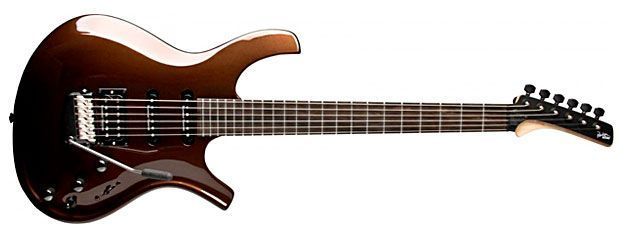
A new encounter with Fernandes, guitars I had already had the chance to hear in rehearsal rooms and on the test bench, through the "Vertigo" model. Today I have in my hands the Monterey Pro, which is played, among other guitarists, by Robert Fripp of King Crimson.
All my experiences with Fernandes have steered me toward the heavy stuff, since its exclusive sustainer has very specific characteristics that make for powerful playing. This time, I have been experimenting with types of effects other than distortion (which is what it initially lends itself to), which I’ll tell you about in the "its sound" section.
The Body
Its spec sheet speaks of premium woods: mahogany, maple or rosewood. The cut of the design seems to take the Les Paul as a reference, with personal variations that give it that edgier look: sharper horns, a stylized upper edge and changed proportions (compared with the classic Les Paul cut). Visually they make this Fernandes Monterey an aggressive yet elegant guitar. The blood-red finish (my own name for it, not the manufacturer’s), semi-transparent so the grain shows through, is very pleasing to my taste.
I think this is the perfect look for a hard-hitting, personal guitar that doesn’t give up comfort of play. A distinguishing touch on the Fernandes Monterey, shaping its more aggressive personality while being based at the same time on the classic feel.
As an observation, I’d add that the instrument is lightweight, which is welcome in long sessions with the guitar hanging from your shoulder, as well as when transporting it.
The Electronics
Without a doubt this is the part that best defines this company’s stamp. The instrument has a high-output humbucker pickup in the bridge position (by Fernandes) and the by-now well-known Fernandes Sustainer.
The chrome controls are located on the lower part, with three pots from which we handle the volume, tone and coloration of the humbucker. One of the controls, besides turning, works as a switch (push-pull), meaning that by pulling it we get a second function.
On either side of the pots are the three-position pickup selector on one side and, lacquered in black on the other, the sustainer on/off switch.
I opened the electronics section by saying it is the part of this instrument that differs most from others. The inclusion of the Fernandes sustainer in this model (as in others from the company) gives the brand a totally personal touch.
Its Sound
First I ran a test of the Monterey’s general sound, moving the pickup selector from its treble position through the middle to the bass position. At the same time I made various tonal variations using the pot controls. My intention was to try the guitar as such, without the sustainer. The sound is quite powerful, very rich in highs and mids. It seems suitable to me for blues, heavy and rock playing (and a great many other things). The low-end section seems somewhat less forceful, and I see a more interesting use in all its sharper edges, but now comes the best part...
Once the efficiency of this Fernandes’ verve was confirmed, we let the sustainer work. My head directly asked for full-on saturation/distortion, and that’s what I did. I added effects to the test in a mix of tubes, "brutal" distortion and a touch of reverb. It is without doubt a great experience, because the sustain holding the note indefinitely (until you release the string) makes us feel like "gods." I kept varying the effects, including different distortions and touches of octaving, adding octaves, fifths and thirds in the highs, depending on the case. I really like the sustainer sensation, because each effect "catches" a different feedback point and you gain in expressiveness. With the octaving, I was looking for simultaneous feedback points.
Out of curiosity, I also tried the sustainer's action on a much less aggressive sound. A blues lick with saturated British tone. If you leave your finger on the fret, the note keeps sounding (it even gets louder as it decays), but what I enjoy most are all the feedback points and harmonics that come out as you play and hold.
Bridge, Neck and Headstock
Little to say about these elements. A simple fixed (adjustable) bridge holds the strings, which run, as you would expect, to their tuners—in this case Grover. The headstock is lacquered in black and makes a stylish combination with the red grain.
Conclusions
As always, my first parameter is what Fernandes offers in relation to the price: 881.57 euros. I think we should highlight as positive the effort in an aggressive but careful design, its nice finish and, undoubtedly, the sustainer, which gives the instrument its defining touch. The part I liked least was the feel of the strings.. While everything is correct and of sufficient quality, to my taste the action is a bit high. I missed a floating tremolo bridge to fully squeeze the juice out of the sustainer. In any case, I conclude that it is a personal guitar, with interesting sounds and with something the others don’t have built in that sets it apart.