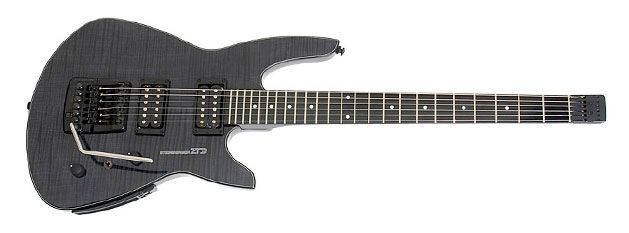
Under the motto “advanced concepts by Gary Levison – Switzerland,” Blade has built this new guitar model with a 24 ¾" scale. I found notable differences compared with other Blade guitars that have gone through our test bench. Of those we've seen at ISP, my favorite has undoubtedly been the Blade Texas Standard. Clearly Stratocaster-inspired, both in its body and its sound, it showed a powerful thickness in its notes, plus definition and punch. With that guitar, Switzerland demonstrated its prowess in instrument building.
Introduction
With the taste of the Texas Standard still in our mouths, we approach this test with some surprise, since the guitar at hand today is completely different from its predecessor. Let's go through its details piece by piece.
Body and Construction
With the quality and nobility lent by the woods it's built from (mahogany body, maple top), we find a design reminiscent of Paul Reed Smith (PRS). A more streamlined, lighter look that breaks away from the classic models. The instrument's overall concept seems to be heading in this direction as well.
It's a light guitar that sits well against the torso and has a modern face, without bordering on the flashy or “aggressive.” As for woods, many manufacturers nowadays seem to be opting for mahogany as the raw material for mid-range or mid/upper-range guitars; this is the case, among others, with Gibson's Faded or Special series.
The final look (and a few other things) also reminded me quite a bit of a Peavey model, specifically the HP Signature HP Tigre Eye, probably because that one also gave off PRS vibes, in both sound and appearance. I'd sum it up as a Paul Reed Smith philosophy. Although the latter brand also shows different models (with notable particularities and differences), its most emblematic models are perhaps those conceived under this design, with double-coil (humbucker) pickups with a rather muted, sustaining sound, as well as an effective construction concept for playing comfortably and fast.
Electronics and Sound
Before focusing on the sound, we should talk about its electronics. The Durango Deluxe comes in two versions:
a) Durango Deluxe DD-1. Passive, without the VSC circuit, priced at 850 €
b) Durango Deluxe DD-2. Includes the VSC system and is priced at 999 €
The active circuit is presented as an added tool for seeking timbres, colors, and emphasis in the instrument's sounds. We find a selector (separate from the pickup selector, logically) that activates and controls it. Before engaging the VSC, we get a sound along the lines I described a bit earlier. Dense, rather muted, sustaining, and thick. Just as the color of the mids on the Peavey HP Signature caught my attention back then, these frequencies have captured my senses on the Durango Deluxe. It has a particular timbre that is especially appealing (this is personal taste) in dry, muted distortion. As you can imagine, the variations in sound configuration are very extensive when we swap pickups, tweak the tone, and even more so when we engage the VSC system, which acts (among other things) as a signal and gain enhancer.
Finish and Feel
Along with its lightness and streamlined shape, giving the guitarist a pleasant, comfortable feel seems to have been one of Blade's concerns in conceiving this guitar. An instrument that's manageable in weight, in the curves of its body, and in the reasonable flexibility of its strings. To close this section, the finishes are impeccable, from the body to the headstock (a sort of “from head to toe”).
Conclusions
First, we must consider that there's no accounting for taste. So, as always, the best thing is to try the instrument and draw your own conclusions. As for my preferences, I confess that the vibe of the Texas Standard, tested at ISP some time ago, still captivates me more, although I insist that they're completely different in practically every respect. If you're looking for a rowdier guitar with a thick sound, this may be one of the options, thanks to its humbucker configuration, VSC system, and modern look (in body design). It runs around 999 euros, which puts it in a price range where it has to fight with other interesting offerings. It seems reasonable that the final price is affected by details such as its maple top, the careful electronics, and so on.
Blade is a brand that has shown us boldness and power from its beginnings. These are well-built guitars that have earned their place among us guitarists for what they've offered us up to now. What we do need to consider is that for nearly 1,000 euros we have quite a few options, such as Gibson USA (in the Faded and Special series) and the mid and mid/upper ranges of almost every guitar company. All that's left is for you to try it and fall in love; it certainly isn't lacking in appeal.