Talking about Fender on the test bench means talking about a legend. One of the greats. Decades of history generating dreams, instruments and, I'd even venture to say, a style of understanding how to play. There is so much literature, so many models and so many comments (documented and undocumented) that users are sometimes left quite confused. There's ignorance among detractors and defenders alike. So it's a pleasure for me to have had the instrument in my hands, to really try it out and tell you about the experience without any strange baggage conditioning me. Guitar and guitarist, face to face, nothing more.
We're looking at a real axe, to start with a term that sums up the general idea. It combines several features that make it a truly attractive piece for many players. In trying this guitar I had the chance to run various interesting tests.
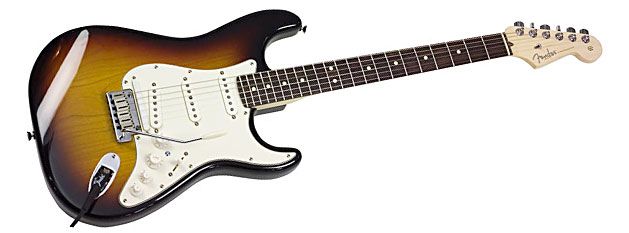
On one hand, we're testing a U.S.A. Fender Stratocaster. In fact, it comes with several U.S.A. stickers and the inscription “Corona, California” on the neck plate. On the other hand, we analyze the concept of the union between Fender and Roland. On paper, those two brands together are promising. Let's see what happened.
What Is the VG Strat?
We're talking about a Stratocaster in every sense of the word, one that offers the instrument's characteristic, legendary sound. Not just the sound, but also all its “flavors” in the cut, weight, feel, intonation, electronics... in other words, everything. On top of this, which is no small thing, since for many players it's a goal to reach, Fender introduced with the VG an instrument capable of offering various modeled sounds, thanks to its merger with Roland for that purpose.
When choosing the models Fender should include in the VG, decisions had to be made, since there are many models and types of sounds from the company. The choice of modeled sounds was based on offering the company's most representative ones in a single instrument.
Control Layout and Appearance
Behind a completely standard Stratocaster body shape and its three standard Strat pickups, we find several peculiarities. In addition to the five-way pickup selector (which works in the traditional way) and the corresponding tone and volume pots (also classic style), the VG adds a tuning selector and a modeling selector. We also see two more elements specific to the VG: a blue LED indicating battery status, and a fourth pickup located between the bridge and the bridge single-coil magnetic pickup. This is the Roland GK. Regarding the battery and the modeling/tuning electronic circuit, it's worth noting that if we run out of batteries (power), the guitar works like a conventional Strat.
At first, so many pickups and selectors make your head spin a little. That feeling is a pleasant one, since you wonder what this Fender will be capable of, besides playing its conventional role.
Our first tests focused on getting to know the guitar's output “bare,” without frills or modern touches. We wanted to know the pure sound, the feel, the tuning accuracy, the intonation and the magic of its three single-coil magnetic pickups. I also had a Japan-made Fender Stratocaster from around '89. I especially wanted to compare them.
Working as a Classic Stratocaster
Without hiding my preference for Fender, and without implying I don't feel passion for other brands (I do), I particularly enjoyed the tests. The feeling of having a well-made instrument in my hands ran through me. I know the sound of this family of guitars well and had no big surprises there. Attack, bright spirit, lots of body in every note and the emblematic Stratocaster sound. I noticed differences compared with the '89 Japan model, especially in intonation, feel and the sense of tuning reliability, and also in a slightly creamier, smoother overall sound for the VG, within a clear common denominator between the two in their general sound characteristics.
The guitar is solid, honorable and precise in every respect.
Working with Its Additional Features
TUNINGS
Incredible but true, the VG can run through various tunings with just the touch of a little knob. It's a real joy, especially if you like using slide, alternate tunings or (drumroll of excitement) turning your guitar into a baritone without any hassle.
The versatility and, above all, the incredible convenience that this speed and accuracy of tuning changes gives us are impressive. Using the circular tuning selector, we'll find the following options (which work beautifully, instantly and perfectly).
NORMAL. Standard tuning E A D G B E.
DROP D. This lowers our low E sixth string, giving an interesting D A D G B E.
OPEN G. Open G tuning D G D G B D.
MODAL D. D A D G A D.
BARITONE. The crushing power of the low end. B E A D F# B.
12-STRING. Running through acoustic/electric 12-string models.
I suppose I needn't tell you more. Except that it's a joy to change tunings in a second and go back to the original whenever we like, without the guitar suffering any changes in tension, inaccuracies or any kind of awkward “hassle.”
MODELS
Now let's go to the circular modeling selector. We'll run through it with an accuracy and realism that is interesting even for the most hardcore purists, in these versions:
N. Normal. Classic Stratocaster sound with no modeling of any kind.
S. Modeled Stratocaster. We get a slightly different sound with the ability to run through different tunings, 12-string modeling, etc.
T. Telecaster. In this mode we get a genuine TELECASTER sound. Really versatile in the studio or live for going from a Strat to a twangier rhythm Telecaster sound. I love it!
H. Humbuckers. It's like swapping the pickups on our Strat. Now they're three top-quality humbuckers. We get a radical change in texture, tone and sound qualities.
A. Acoustic. I've never been a big fan of these acoustic simulations, but I have to confess that in this case they're striking. Their versatility in the studio is overwhelming, from the warmth of a dreadnought to the bright sound of a twangy resonator.
The models, moreover, combine variations with the tunings and with changes on our pickup selector, running through a truly impressive range of tonal possibilities.
It should be added that the tone pot acts as a reverb control when we're working in “acoustic modeling” mode.
Conclusions
I must stress that the guitar's behavior in the tests was impeccable. Nothing odd. As for the modeling: no lag, no noise and no strange crossed sounds. As you'd expect from Fender + Roland, there are no surprises of malfunction anywhere. I say so with confidence about the instrument we tested. I can vouch for it.
For purists and vintage lovers, this modeling business may sound aggressive. Well, I think it would be worth stopping to think. Getting a reliable guitar that tunes well, intonates perfectly (without driving us up the wall) and has the “character” of a U.S.A. Stratocaster is no small feat (pardon the expression). Once we have that feel and great playing comfort (for lovers of classic body shapes), what could be better than being able to energize or add flexibility to the possibilities of this great instrument? Just yesterday I was in the studio, sketching a rhythm part for an already recorded song. I felt very comfortable with the VG's feel and tuning stability, but it sounded very thick (without touching the EQ) for what I intended in that song. I needed a sharper track, and in Strat mode, even in its brightest setting, it still came out a little dull. Adding more highs in the mix might have gotten us there, but there was no need. I decided to look for a brighter Telecaster sound with low gain. I was after a high, sharp tone that wouldn't be annoying, something a bit raw that you could hear perfectly without having to be “loud.” So I turn the modeling knob, select Telecaster, find the pickup and tone I want, play the song through and... That's what I wanted, perfect. Getting this without taking the guitar off my lap, or changing cables, jacks or pedals, in short without moving from my seat, was a pleasant experience. If we also consider the cost of owning four or five guitars of this quality, we find even more reasons to be fond of the VG.
I can imagine what you're thinking. It's not a cheap instrument, although that term is so relative... it is without a doubt a professional instrument that combines the best of the classic and, at the same time, brings the most effective modeling within reach.
I picked it up for the first time with some wariness, thinking: modeling? How scary... But my opinion changed once I played it. It's a cannon that lets you roam from heavy, baritone-tuned heavy metal to “Telecaster-style” British pop, slide parts with a variety of tunings, or the most legendary nuances of a classic Strat. I only mention a few examples so you get an idea of its versatility.
You have to spend some money, but once the guitar is in your hands, I'm sure it will become one of your jewels, guarded with your utmost care and affection. What a guitar.