After testing this instrument, I remembered exactly what we mean when we talk about a real axe. Impeccable in practically every respect. However you look at it, it stands out. Below we detail its secrets, some well known and others truly new. A bridge that can transpose our instrument to five alternate tunings...?
A Little History
We're talking about Steinberger, a Gibson subsidiary specializing in electric basses and guitars. Famous for its innovations, it created the first headless electric bass (no headstock). Not everyone has always welcomed the radical nature of its designs, but in general all its revolutions, and there are quite a few, tend to be highly prized by luthiers and collectors. The secret of its success is a good team of craftsmen and technicians who build instruments with musicians' wishes in mind.
Its story is a perfect example of how, when things are done right and you stick with it, success comes sooner or later. The brand's founder and owner, Ned Steinberger, had studied art and industrial design. In the mid-1970s, while working for a furniture manufacturer in Brooklyn, he met bass luthier Stuart Spector. For him, he designed, as a test, a first electric bass model that would become an almost legendary instrument: the Spector NS (for Ned Steinberger). Ned kept at it and, after experimenting with lightweight woods (whose sound didn't convince him), began using materials such as fiberglass and graphite. In 1977, Steinberger produced his first complete instrument, a headless prototype made of reinforced granite, which he offered to bassist Stanley Clarke. However, he couldn't find any company interested in distributing his bass, so he decided to found “Steinberger Sound” with Bob Young so he could distribute his own products.
Among the first Steinberger bass models were the H1 and H2 series, with one and two high-impedance DiMarzio pickups. The far better-known L1 and L2 series replaced the DiMarzio pickups with low-impedance EMGs, which gives a much more aggressive sound. At first, acceptance of the models was very slow because of their unusual look, but they soon became popular after being adopted by players such as John Entwistle (The Who), Tony Levin (King Crimson) and Andy West (The Dregs). In 1981, at Musikmesse in Frankfurt, the L2 bass stunned the music world with its design. Three years later, the L2 was replaced by the XL2, which brings together the brand's most defining features: headless, with two active EMG pickups, a one-piece rectangular graphite body and a devastating sound. The GM series later appeared, inspired by Mike Rutherford, Roger Griffin and Geoff Banks. In it, the classic maple body has a double cutaway. In 1986, Ned sold his company to Gibson.
The 1990s saw the birth of the “Spirit by Steinberger” line. While Steinbergers typically have a graphite neck, Spirit by Steinbergers are made of three pieces of maple, in through-neck construction (GT and XT series) or maple in bolt-neck construction (GU and XZ series), which makes them much more affordable.
The model we're reviewing in this issue first appeared just two years ago: the ZT3. At the heart of this guitar is the latest version of the TransTrem tremolo system (which we discuss in detail below). But the ZT3 is not just TransTrem. This new “Z” design by Ned Steinberger is a hybrid instrument that combines the strength, rigidity and clarity of graphite with the warmth and beauty of wood.
Put to the Test at ISP
Although we already knew the brand, we hadn't yet had the chance to try one. I was already intrigued about trying out this little gem, and my excitement grew when I read that our cover artist this month, Andy McKee, chose Steinberger® for his electric work and has one in his personal collection. He hasn't yet been seen on the internet playing a solid body, but the acoustics he shows in his famous YouTube® videos are always notable for exquisite tuning, intonation and thrilling sustain.
Body and First Impressions
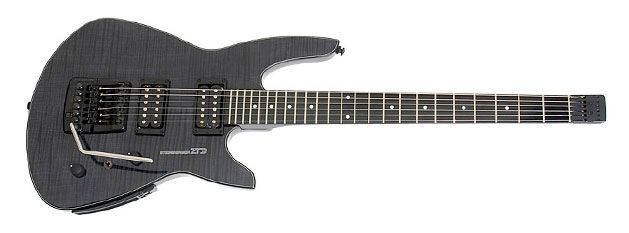
As you'll have noticed in the photos, the brand's trademark absence of a headstock stands out. The look is sleek, ergonomic and feisty, yet understated. That maple grain on its top, in translucent black, already hinted at certain positives, both in the quality of its construction materials, and therefore the “high-end” concept, and in the particularities of its sound, which we did indeed find in the guitar later on.
Speaking of ergonomics, two things stand out. First, its curves: unconventional and perfectly designed to fit the instrument to our body. There's also a small piece at the bottom that lets you (if you wish) raise the guitar up on your leg. That's really comfortable when playing seated, in the studio, for example. The guitar sits in an ideal playing position and doesn't slip.
Now for quality: a maple body with a maple top, joined to a CybroSonic graphite neck and three pieces of wood, also maple. The body and neck are joined with a four-screw bolt-on system.
The Electronics
The ZT3 TransTrem comes loaded with powerful, versatile firepower. We find two humbucker pickups: a USA Gibson custom voiced 90R in the neck position, and a USA Gibson custom voiced 91T for the double coil next to the bridge. Both the tone and volume controls are push-pull, which means that in addition to working as potentiometers, they can be pulled up: position A and B on tone plus position A and B on volume. The push-pull changes the circuitry between series and parallel modes. We've included a chart showing the various pickup combinations in active and passive modes.
Add to that the traditional three-position selector, which goes from the bridge position to both pickups together, and on to the neck selection in its last position. Do the math: three pickup combinations plus volume push-pull mode A or B and tone push-pull mode A or B. This sum of possibilities translates into an especially wide tonal spectrum. In short, the instrument shows tremendous versatility when it comes to electronics and tonal colors.
The Hardware
This is most likely the most spectacular part of the ZT3. The headless neck cut is, obviously, the first surprise. And that in turn is tied to the way we anchor the strings and the way we tune from the bridge.
The tremolo, for its part, is the guitar's most spectacular and novel component. It's a system capable of transposing the instrument's pitch through its five positions. It's something like what an “electronic” guitar does, tuning through simulation, except that here the transposition is real, since what changes is the string tension. And all of it through one simple movement of the tremolo arm.
Reading about these innovations, you have to wonder about tuning stability. I have the guitar in my hands, and I'm telling you based on tangible reality. I subjected it to the wildest stresses, committing every kind of atrocity to see how it responded. I can confirm that it is one of the most accurate and stable guitars I've tried in recent times in terms of intonation and tuning. Its revolutionary systems don't just work, they work beautifully and with absolute precision.
The Sound
So far, we've analyzed the design, the construction materials, the electronics and the hardware. Every one of those areas has passed ISP Música's tests and evaluations with flying colors. But now comes the moment of truth: how does it sound? It would be nearly impossible for a maple guitar with a perfect tuning system and Gibson USA Custom Voice pickups to sound bad, wouldn't you say? Indeed, the guitar is frankly impeccable.
We tested clean, overdriven and distorted tones. Although the humbucker look may suggest a fat, thick sound, you should know that the ZT3 has crystal-clear highs. Brightness with body and extreme attack if we ask for it. It has nothing to envy from the most piercing tones you know.
As for overdrive, you can handle any territory that comes your way. However, the range where I found it most powerful, in the feisty department, is extreme distortion. It has a brightness paired with the thickness of the double coil that is truly magnificent. The amount of harmonics and subtleties you can draw from its notes is the stuff of top-of-the-line instruments. Sustain also plays an important role in its hardest-hitting tones.
Conclusions
It's feisty, very much so, but its clean tones leave nothing to be desired, with spirit, attack and bite. On the other hand, considering the harmonics, the clarity of execution, the mathematically precise tremolo, its richness of nuance and its comfortable feel, I'd venture to say it's one of the most powerful guitars on the market in the realm of heavy overdrive and sleek, stylized instruments.
The hardware, as I mentioned, is revolutionary and extremely effective. Great feel, great tuning, lots of versatility and extraordinary sound. What's missing? Being able to afford it. If you're not after a vintage British-garage vibe but rather a precise, clear and punchy guitar, and your budget is around 1,000 €, which is roughly what you could get it for, I highly recommend you try it. It's a different and very appealing guitar.
Given its precision, harmonics, sustain and fantastic build, I now understand why McKee chose the brand as his electric companion.

