There is little to say about Yamaha. We have all known for a long time its presence in the market as a reliable organization that develops an enormous variety of musical instruments, spanning drums, keyboards, multi-effects, guitars, basses and more... On other occasions I had tried instruments from the company, though one of the times I was most surprised, along with the experience of this test, was the day I had the chance to enjoy the presentation of Javier Vargas's latest album, where he played all his pieces on a Yamaha Pacifica, and the instrument really let Javier take it wherever he wanted, perfectly.
I said along with the experience of this test because the instrument aroused great interest in me after the first trials, and it really does have powerful charms that I will describe below.
The Body, Construction and Finish
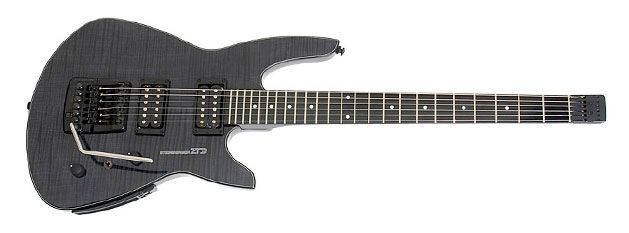
In terms of looks, as you can see, it mixes classic elements derived from the Les Paul but adds personal touches that give it its own personality. For example, the shape of the body on the front, with that bevel running around the perimeter, the way the strings are anchored behind the bridge, or its chrome pots sunk into the body itself. They don't sit on top; the body is worked in such a way that the volume and tone controls are "submerged."
The overall look of the guitar is aggressive. Those touches I mentioned, the silver finishes and the sight of the powerful pickup artillery will surely whet the visual appetite of the heavier players.
Mahogany and maple in the body and neck. Tonewoods that suit the AES 620 perfectly. Its powerful pickups, which we'll discuss later, are perfectly matched by the concept of this solid body in an excellent wood. Why? Simple: the resonance and sustain of the notes is very good, especially for heavy, distorted passages.
To wrap up this section, I conclude that the construction materials are good, the finish satisfactory, and its look has certain personal touches without losing the classic thread.
Hardware and Pickups
A Seymour Duncan and a Custom Alnico Humbucker are responsible for the "armament" of this Yamaha. Two extremely powerful dual-coil pickups. We've talked on other occasions about the characteristics of this type of pickup, and in this case the "humbucker color" is total on this guitar. We'll hear it in the sound.
All the hardware is silver, including the original Yamaha bridge, the plates that hold the strings, the pots (curious, as we described earlier) and its Grover tuning machines. Speaking of the tuners, I'll take the chance to say that I liked them, and the reason is that I always look in tuning pegs for that in-between feel (neither too stiff nor too loose), a sensitivity that helps me tune each string precisely. Since we're on the subject of tuning, I think the guitar had already been tried out (that's an impression, mostly from the condition of the strings, which were good but showed signs of previous use), and this helped me confirm that even with a somewhat used set of strings, the tuning and intonation are quite good.
Another curious thing are the strap "pivots." Normally a guitar has two, one by the neck and another near the bridge (on the sides, obviously). Well, this guitar has three: one up top, near the neck, and two at the bottom.
The Sound
I confess, the guitar kept seducing me as I ran the tests. I had it ready, along with other guitars, for the test bench, and, well, initially it was not one of my favorite candidates, but when I plugged it in, its energy took hold of my veins and it became one of my favorites among the unknowns that came to introduce themselves.
The moment I saw it and plugged in the cable, I added a powerful distortion to start. "Wow..." good grief, this thing has some bite!!! The guitar raised my heart rate, and what began as a test to tell you about the experience turned into an adrenaline rush that I enjoyed immensely. The distorted sound is total, showing off that outright power of the humbuckers: a thick, dark, bass-rich, "extra-heavy" sound. At the same time, even the most superficial intentions were wrapped in harmonics coming out everywhere; I'm remembering that moment, and I promise you my heart starts racing again.
To conclude the distorted sounds, I want to stress that the guitar seems perfect to me for all-out war, dark tones in the vein of Brian May or Gary Moore, among many others.
I figured, at this point in the test, that the guitar would have "problems" with cleaner sounds but, to my surprise, it sounds good in this area too. I left the same base I had been using for distorted solos and changed the effects to get a much cleaner sound, with a bit of saturation and reverb. The sound struck me as a touch too dark (to my taste, of course), so, without leaving the lowest position of the selector (since that was the one giving me that very solid body), I adjusted the EQ, raising the mids and highs a little. Once again the guitar synced with me perfectly, delivering a good range of sounds with good attack, definition and "vigor."
Conclusions
I think the value for money of this instrument is very good. I've tried other guitars at similar prices, and this AES 620 (in battle mode) gives many of them a run for their money. In my view, it's hard to achieve a balance between looks, electronics, sound and good tuning. Many guitars manage to stand out in one of these aspects but drop considerably in others. In the case of the Yamaha 620, I sincerely believe the balance is very good, comfortably meeting all expectations.
Although the guitar seems to have been conceived for the more rock-oriented, I think it has enough versatility to be used in different styles. Sometimes I come across guitars that are supposedly designed for "heavy players," and when it comes down to it, that amounts to a "showy" design; this AES 620 has no excessive frills in its design, but it makes itself felt, and a lot, when you play it. Congratulations to the future owners; this guitar is a cannon.