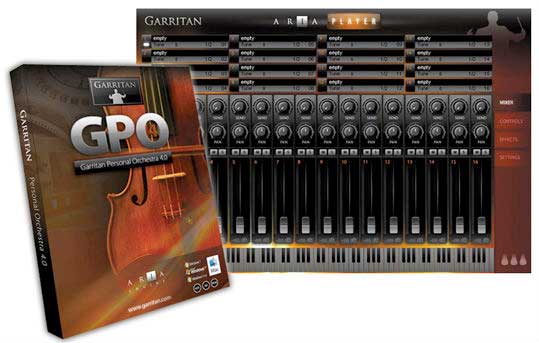
Libraries such as the Steinway Concert Grand Piano, Stradivarius violin, Wurlitzer and Venus harps, Haynes flutes, Heckel oboe, Mustel celesta, Rudolf von Beckerath organ and many more. Once again we find ourselves immersed in the advances of music technology. By now almost everyone knows the possibilities virtual instruments offer us. This time, on the test bench we have a virtual instrument that lets you load, locate, organize and manipulate a very extensive collection of samples of classical instruments.
Despite a clearly symphonic, orchestral or classical focus, I sincerely believe most of the library can be used for a multitude of musical styles.
Who Is It For?
Classically trained musicians accustomed to listening to real instruments, played "by hand" by instrumentalists, may find certain shortcomings or a lack of liveliness. Not because of the quality, which is generally good, but rather because of the exacting standards they tend to show when identifying the acoustic accuracy of each instrument. In any case, I think that even for the most demanding, this tool can be perfect for composition, arranging and orchestration, even if the work is later transferred to real instruments, if that's the case.
For those with a home studio, used to working with sampler libraries, Personal Orchestra offers an intense collection of acoustic instruments, which I'll detail a bit further down. We tried plenty of sources taken from these CDs, with very satisfying results. You can listen to the demos here:
Even considering that the libraries are perfectly valid for creating and performing classical pieces, personally I enjoyed more the use of the classical instruments on the CDs in styles completely different from classical. For example, using its brass sounds, trumpets, tubas or trombones as horn sections in blues pieces, pianos combined in any musical style, even contrasting "electronic stuff" with real acoustic piano sounds, or the whispers of the violins, violas and so on in pop settings... to cite a few examples.
That way, when the classical sounds are wrapped in other electric (or otherwise) surroundings, the naturalness of the samples shines and they sound even more realistic than when used as the sole element of an orchestra.
Its Sound Bank
Four CDs are responsible for this rich collection of samples. The libraries are organized by sections or types of instruments:
a) Pianos (several types of Steinway piano), harpsichord and celesta
b) Brass: trumpets, tubas, trombones, French horns..
c) Percussion. Including all kinds of classical percussion instruments
d) Harps.
e) Organs.
f) Woodwinds: flutes, oboes, clarinets, bassoons
g) Strings. Violins, violas, cellos, basses
The libraries are not limited to one sound per instrument. Each instrument family offers plenty of loading options. Different types of instruments within each one, different playing techniques, duos, trios, ensembles and, of course, solo instruments.
Practical Loading System
The instrument can be loaded as a virtual instrument inside your usual sequencer (in our case we tested it under CUBASE SX3). Kontakt is the name of the instrument that lets you handle all of Personal Orchestra's sample sets (included in the package).
It lets you load eight libraries on different MIDI tracks, which are selected in an orderly, agile and quick way. Afterward you can, of course, assign the corresponding MIDI channel and edit certain parameters of each one.
For loading, you have a menu with a general "tree":
a) Dry
b) Wet
c) Multis
Within each of these three sections, we select the library to load for each track, on which we can also adjust reverb and acoustic ambience.
The multis section serves as an extremely quick way to load several (or all) tracks at once, depending on exactly which group of instruments we want. For example, we find multi loads such as:
a) Flute and piano
b) Full brass sections
c) Piano trios or duos
d) Cello and bass sections
e) String sections
And a long etcetera of useful combinations for fast loading.
It should be noted here that the amount of memory required for a full multi-library is generous, and a machine with limitations can freeze up for lack of space. Looking on the bright side, this means the samples are abundant and of good sampling quality.
Sound Control and Virtual Keyboard
Through Kontakt, Personal Orchestra lets you define parameters such as portamento, pitch, mod, octave, keyboard range, reverb, various variations, pan, velocity, tone and volume.
As with other virtual instruments, we have an equally virtual keyboard, with which we can trigger the sounds using the mouse. I think that without an external master keyboard, that "mini keyboard" doesn't solve much, although as an additional element it can help locate the part of the keyboard where each track's samples have been loaded, or quickly try out a sound.
Our Conclusions
As I said at the start of these pages, I think this is a "tempting" tool for classical lovers. You won't lack instruments to orchestrate on a grand scale any piece that comes into your head. The sounds (well played and well chosen for each track) are realistic, and the ambience options make good results possible. For the "non-classical" crowd, it's a fine arsenal of instruments to add to your libraries, which will surely be usable on many occasions, regardless of style. Perhaps the designer of the virtual instrument will throw up his hands if he gets the chance to hear the demos we've prepared (smile), at www.ispmusica.com The idea was to make a small showcase of the possibilities for using these libraries, both in classical settings, for which we sequenced a couple of excerpts from well-known classical pieces, showcasing the strings and piano, and in a sample that goes completely outside those settings to explore the results of these libraries on things that have nothing to do with classical music. Specifically, we recorded a backing track in the purest BB King style, using drum libraries, an electric bass, organ, rhythm guitars and a Personal Orchestra horn section. Over this track we improvised a blues solo in honor of the master BB King. As a result, you'll see that the library's style doesn't define your playing; it's your head that steers where to take the instrument sounds.
Although it's nice to be able to work entirely with pan, volume, library loading and so on from within Kontakt itself, we noticed a certain "disobedience" of the Cubase mixer controls with regard to Personal Orchestra's pan, volume and so on, which makes the final mix awkward, since you have to open both the Cubase mixer (or whatever program you use) for the additional tracks and, in parallel, Personal Orchestra to tweak the mix coming from these libraries.
All in all, 249 € that go a long way. Get your hard drive ready and reload it with dozens of new sounds. You'll find it inspiring, and it will also enrich your classical productions and... forgive the audacity of bringing classical sound to the blues...