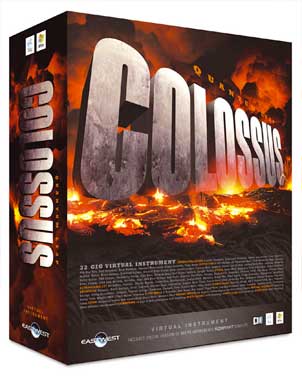
 A huge rompler workstation packed with 32GB of instruments from every musical genre, designed along the lines of a workstation keyboard but with a larger, higher-quality instrument library. Once again, we are looking at a tool based on music computing, under the Native Instruments, EastWest, Kompakt Instrument label.
There is little to say about the evolution of this kind of software, since everyone knows how far it has come and how powerful it is as support for producing demos and sketching out our ideas. I would even say that if you work well, that is, if you put in the hours, the results can be more than interesting. The downside is that these virtual instruments are becoming more demanding on our computer's resources every day. A machine without good speed, a decent sound card and plenty of RAM won't be able to handle many of these instruments. On top of that, we have to add the memory management problem of Windows XP. According to computer experts, XP is not able to handle large amounts of RAM (for example 2 GB). I even find it misleading, because when they sell you the machine (computer), they tell you it has 4 memory expansion slots so you can expand it as you like. It turns out that when you decide to buy 1 GB to add to your memory, some libraries still get stuck, at which point the store staff tell you that Windows XP gets confused and probably doesn't recognize it, even though your machine's BIOS does count it. Curious, isn't it?
I will look into this matter to keep you informed, but if any of you readers have suffered and/or solved the RAM problem with XP, I suggest you visit the ISP FORUM (www.ispmusica.com) to contribute your knowledge and information on the subject.
KOMPAKT INSTRUMENT: COLOSSUS
We ran the test on a PC with WIN XP and 3 gigs of RAM, although one of the slots was not recognized by the system (for the reasons I mentioned). We tested it as a VST instrument in Cubase SX3.
The installation is hefty and takes its time, since the number of samples in the libraries is immense. The truth is that I was already "drooling" while installing it, because seeing so many DVDs, I suspected it would be quite complete. The process was relatively simple, except for the detail that the manual reached us in English. I insist: we are in Spain, and having to receive manuals in other languages is not how it should be. It makes learning the software harder, especially for those who have no contact with the language, since it is quite difficult to read the important details described in the manual.
Another matter is the blasted registration on the Native Instruments website. In English, for a change. I think it is perfectly fine that only original programs are used and that piracy is prevented. I understand that the products are developed to be sold, the people who work on these programs day after day get paid, and licensed software needs to be controlled. But why are we, the loyal customers, punished, and why do we have to spend time jumping through hoops to enter codes, copy keys or fill out registrations? Honestly, it seems a rather arduous system for someone who buys a product. This work should already be done, or better yet, the usage system should change. Forcing buyers to spend time on the manufacturer's website, leaving their e-mail and personal data, seems to me even in poor taste. You have already paid to use the product, and if you don't do it, the product stays inoperative.
THE INSTRUMENT'S ARCHITECTURE
Now it is time to congratulate the software engineers who developed the program. Library selection is convenient, fast and very intuitive. You have all the control parameters in a single window, and loading the different samples is really convenient. With the same speed, you assign the appropriate MIDI channel.
We were already familiar with this layout under the Kompakt label. You have 8 channels in which to load instruments. It works with submenus. When you click on an empty slot, a list of options appears, sorted by instrument family. Once the family is selected, another menu appears with the available sound options. It is as simple as clicking and waiting a few seconds for the library to load.
A SUBSTANTIAL IMPROVEMENT IN SAMPLE QUALITY
The newest and most striking thing about Colossus is its great variety of instrument families. It is true that we already knew some similar products in terms of variety, but they were a long way off in quality compared to this one.
We recorded several pieces with different loads. I would highlight the quality of the samples in the acoustic drum sets. The samples are multisamples. You probably know what this means, but in any case I will summarize it for the less savvy. It means different samples assigned to the same key (or note of the virtual instrument being used). Depending on the velocity (intensity) with which the note is played, the sound you hear will come from different samples. This is especially useful for creating realism and filling our performance with nuance. It applies, I would say, to every instrument. For example, if we are playing a snare break and have only one sound at different volumes to shape the accents, the result is pretty awful and certainly far from reality. If you listen to a snare break by a good drummer, you will be amazed at the wide range of sounds and nuances he or she gets out of the same drum. Well, albeit with certain limitations, the samples in this instrument let you create sequences that convey feeling, that take us away from a flat sound and flood us with realism.
THE VARIETY OF INSTRUMENTS
Acoustic drums
Fantastic sounds, with the funk and jazz kits standing out. Among the things I liked most.
Acoustic strings
Guitars, banjo, ukulele, etc. Quite faithful and realistic sounds.
Choir
Human voice in "ahh" and "doo" format. Realistic, Gregorian-style samples. Interesting.
Basses and double basses
A powerful selection with a wide variety of bass sounds, from Rickenbacker to slap, finger, pick, fretless, Silvertone sounds, etc. Fat, realistic basses.
Electric guitars
I was surprised by the effort to offer a wide assortment of guitar sounds. The samples are good; perhaps the hardest part is the performance, to achieve realism. With time and know-how...
Electronic drums
A powerful sound bank covering a wide range of styles. Quality samples.
Ethnic percussion
Broaden your range of possibilities. Again, the samples are interesting.
Ethnic Pitched
Melodic ethnic instruments.
GM Bank
A GM assortment with varied libraries from every family. Effects included.
Keyboard
Keyboard instruments, from organs to accordions, celesta, etc.
New Age Ensembles
An extensive collection of New Age sounds. Very inspiring and of impeccable quality.
Orchestra
An extraordinary selection of orchestral instruments. Imagine a complete virtual orchestral instrument: Colossus includes one as just a fraction of its many libraries.
Acoustic and electric pianos
A combination of your favorite sounds, gathered in this family of pianos. These banks in particular are the ones that gave us the most "trouble" in terms of memory.
Pop Brass
With the brass sections you will have enough for any kind of horn arrangement. Quality and realism covering almost any combination of brass instruments.
Stormdrome Mod
A wide variety of sounds that mix the modern, the electronic, the ambient and the "scary." It certainly extends the instrument's possibilities to the fullest.
Synth Bass
Synth leads
Synth Pads
Vintage Organ
Farfisa, blues, soul, Vox...
Conclusions
As you will have seen from the list of libraries, with Colossus you have a full "arsenal." I would say it is a compendium of every tool you might need, except that instead of having a bunch of folders and libraries scattered around, they are all perfectly organized and can be found in seconds. In addition, you can create your own combinations, loading several libraries on the same MIDI channel and thus generating endless multisamples. I had already seen things similar to Colossus. The difference, and what makes it powerful, is the good quality of almost all its sounds. Congratulations: a magnificent tool for combining music and computers.
To see the specifications and rating table, download the magazine in PDF