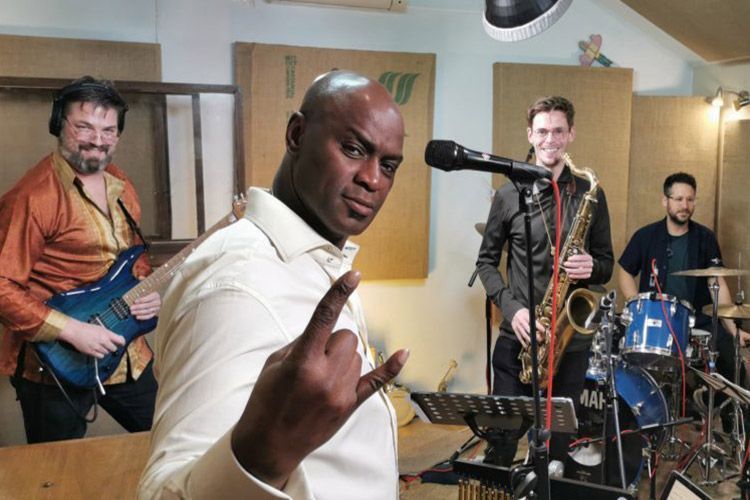
A recording studio veteran and avid user of Sennheiser and Neumann microphones, Ola Onabulé has been regularly streaming live musical performances from his home studio near London over the past few months.
With a recording career spanning more than two decades, and having performed at some of the world's most prestigious jazz festivals and concert halls, Onabulé's name is synonymous with excellence in jazz and a deep passion for music technology.
When the pandemic began, Onabulé's first reaction was dismay. "I had developed a culture of doing gigs internationally for many years. Most of my shows involved getting on a plane and going to a foreign country, where I'd stay a few days before moving on to the next destination. The pandemic created complete and utter chaos for me, and panic set in," he shares.
The initial period of uncertainty was followed by the realization that this was not a brief pause, and Onabulé realized how much he missed the buzz of performing.
"A good friend in Mexico told me I should do live streaming," Onabulé recalls. "I remember asking him, 'what is live streaming?' It didn't even register in my mind as a viable option at the time, since I wasn't sure how good it would be with my less-than-perfect internet connection and my rudimentary knowledge of it."
After seeing examples of livestreams whose production sounded very modest, Onabulé knew he wanted to do things very differently and threw himself into researching what equipment he would need to start his own livestream.
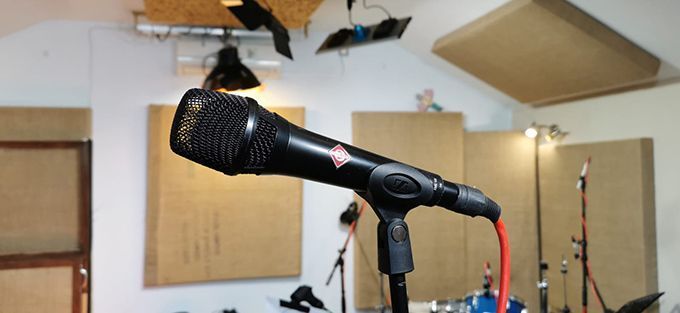
The Neumann KMS 105 has been Ola Onabulé's favorite vocal mic for the past 12 years
While he was doing so, Ola's US manager, Vernon Hammond, approached him to say that The Blue Note, one of the world's most legendary and renowned jazz clubs, had contacted Ola about doing a livestream. "Vernon said: 'The Blue Note has a livestream series, and they'd like you to be on it. Can you do it next week?'" Onabulé recalls.
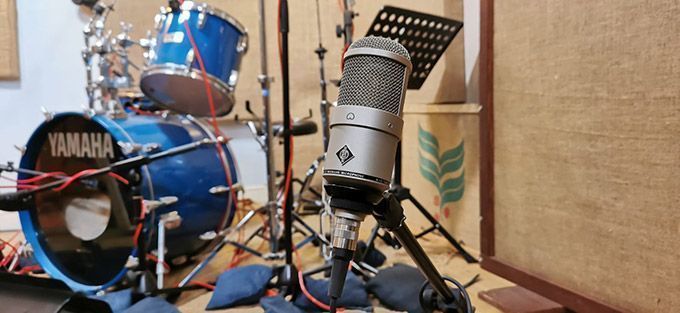
With only a few days to transform his home recording studio into a new livestreaming space, Onabulé worked tirelessly, figuring out which camera and lighting he would use, as well as who would direct and turn on the cameras on the day and monitor the stream.
"My kids helped me a lot behind the scenes with that first performance, coordinating the cameras and keeping an eye on the stream itself," says Onabulé. "The situation reminded me of a professional broadcast where someone was counting down just before going live. I was hooked. I was addicted. For the first time in about three months, I had that adrenaline of performing again, singing songs and interacting with musicians."
Later, Onabulé refined his setup and perfected his new craft and his approach to livestreaming, which he came at from a recording mindset. He spent a lot of time moving sound panels to isolate each sound, placing gobos, putting the guitar amp in a booth away from the guitarist and leaving the piano lid down. He also built what he called a "bass cave": a series of panels forming a cave with a mic for the double bass inside it. "In the end, it didn't feel like a live concert. It was like a recording session, but one where nobody can do more than one take. It felt too restrictive, rigid and stifling," says Onabulé.
As things progressed, Onabulé realized that livestreams were essentially concerts that could be captured. "And that was the essence of what we were trying to do: capture the magic of five guys in a room really having fun. That's the reason for being, what we're obsessed with doing. Then we found ways to capture it," he explains.
This new understanding required a new approach. Onabulé removed all his panels and screens, placed the guitar amp next to the guitarist, dismantled his 'bass cave' and took the lid off the piano. Then he spent more time trying to fine-tune the sound of each element.
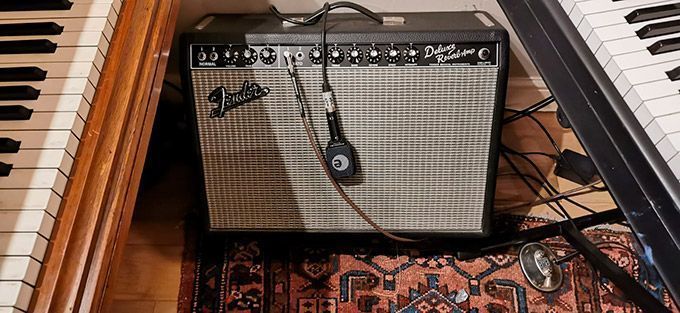
For his audio setup, Onabulé chose his tried-and-true Sennheiser and Neumann microphones. On drums, he uses two Sennheiser e 902s on the kick and e 904s on the toms and snare. A Sennheiser e 906 is used on guitar, as well as an MD 441, with the option of an MD 421 on the guitar amp when more than one amp is used. An e 908 B cardioid gooseneck condenser is used to capture the double bass, which Onabulé says is "absolutely magnificent" for picking up very specific frequencies and capturing intonation and subtlety of expression very sharply. "It's great for the frequencies from the lower mids to the upper mids, where all the richness is," he adds.
A Neumann M 147 tube condenser mic is used as an overall mic to capture the body of an instrument, which Onabulé also uses on the double bass. For the piano, a pair of Neumann TLM 170 large-diaphragm condenser mics is used, which he has also found perfect for traditional classical recording.
Onabulé's tried-and-true vocal mic is a Neumann KMS 105, which he has been using for the past 12 years. "I love it. It's almost an extension of my voice now, and it's actually perfect for this setting. If I'd used a studio condenser mic, because of my position in the room, there would be too much of everything else in the mic. The KMS 105 gives me that condenser vibe, but it's more focused," he says.
One of the most interesting things for Onabulé has been seeing live feedback from the audience and interacting with them in real time
"I realize what an adrenaline junkie I am, how much I need to interact," he shares. "In a normal live performance situation, it wouldn't be possible to get immediate feedback on what a person is thinking; in a livestream, people comment on very specific things in the live chat. It's almost like a group exercise. People say 'listen to the way he sang that note', or 'look at the way the guitarist is playing that solo,' and they're saying it as they're watching it."
Themed live sessions and inviting talented musicians, such as saxophonist Duncan Eagles and phenomenal Swiss guitarist Nicolas Meier, mean fans are always on the lookout for a new experience. For his latest livestream, on January 23, Onabulé presented Songs For A New Year with Chris Nickolls (drums), Kuba Cywiński (double bass), Nicolas Meier (guitar) and John Turville (piano).
Onabulé's reach is global, with fans tuning in from the UK, Mexico, Argentina, Japan, China, Australia, Nigeria and many other places, and their reaction has been extremely positive. "Although the livestream medium has its shortcomings, such as stream latency and the inability to stream in 4K high definition due to bandwidth restrictions, I still think this is going to be an essential part of the ever-changing music scene and the sound recording business, as well as of the way music is digested and delivered. Doing these live concerts has been good for us musicians, and it's been good for the audience in almost exactly the same way. It's as if we're feeding off each other."
Onabulé believes livestream technology directly supports people's desire to have the visceral experience of others performing, singing, dancing and expressing their almost primal behaviors through technology. This makes Onabulé very excited to see how the technology will evolve and where art travels with technological advances in livestreaming.
"I think this is the future, but the importance of having good-quality sound isn't going to change," Onabulé concludes. "I remember talking to someone at the beginning of this experience, and he told me, 'look, you can set up your phone, sing into it and people will enjoy it.' I said: 'I agree with you. But what interests me is how much more they'll enjoy it if I can give them the kind of sound quality they'd expect at a concert.' If the pianist plays a beautiful, moving solo, I feel there's a certain respect in delivering all the frequencies this incredibly complex instrument is designed to emit, because all the emotion of the performance is hidden in those frequencies, released as oscillating, exciting waves into the room!"
"If I can capture that and give the audience a completely immersive experience, why not? I'm very fortunate to be able to do it with all the incredible Sennheiser and Neumann microphones I've collected over the years. They allow me to go further and keep developing in this exciting new adventure."


