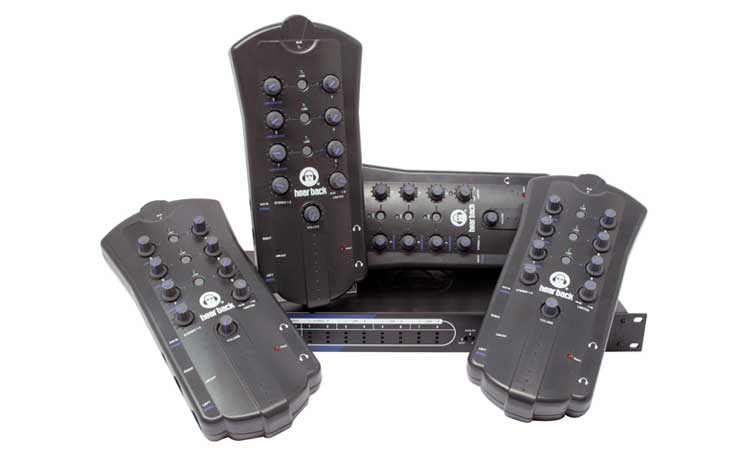
Designed for both live and studio use, this personal mixing system lets musicians create their own reference mix, whether for monitors, in-ears, or headphones. It consists of a central unit (Hub) that receives up to eight independent channels and distributes them to the individual Personal Mixers.
Each musician is assigned one of these personal mixers, with which they can vary the levels of all eight channels independently to create a reference mix to their liking.
For many years, this kind of system was within reach of only a few because of the high price. Hear Technologies now offers an affordable alternative, making it possible to enjoy the benefits (for both the musician and the engineer) of personal monitoring systems.
The Hub
Housed in a rack unit, the Hub can receive up to eight independent audio channels. There are three options for this:
The first is to feed the signal in analog through a DB-25 connector (the manufacturer warns that the Tascam DA-88 pinout must be used, not TDIF).
The other two options use digital audio; the first uses an ADAT-type optical connection (up to 24 bits at 44.1/48kHz), and the second uses a proprietary communication protocol from the manufacturer called HearBus (more on the latter below).
The front panel has the control for selecting which of these three options the Hub will use to receive its input signals (only one of the three can be used at a time).
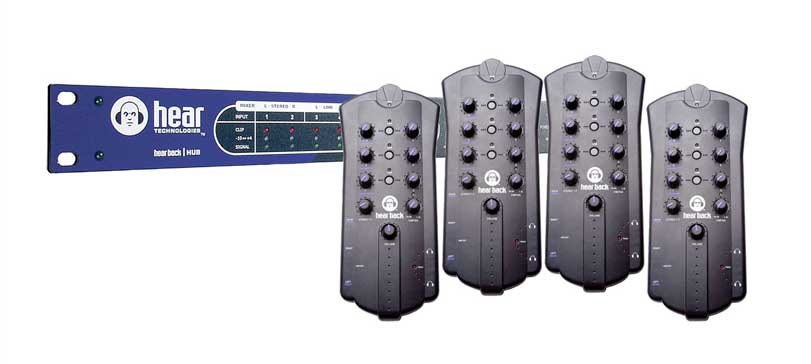
The input channel meters are also on this front panel. Each one has three LEDs: the bottom one (green) indicates signal presence, the middle one (blue) lights at different intensities depending on whether the input signal level is -10dBu or +4dBu, and the third (red) indicates the channel has been overloaded (+16dBu).
This section of the Hub is rounded out by the power switch and an LED (Clock) that indicates when the unit has synced correctly with the audio source and is ready to use.
The rear panel houses the input and output ports. Each Hub can feed up to eight independent personal mixers, connected to it with CAT5E cable (with eight-pin RJ45 connectors, also known as “network cables” or “Ethernet”).
Both power for each mixer and the audio signal travel over these cables. To prevent problems, each of these ports has a PTC fuse that isolates each mixer from the Hub in case of malfunction.
Two additional ports (HearBus IN and OUT) let you daisy-chain several Hubs, enabling the use of more than eight personal mixers if needed.
HearBus
Communication between multiple Hubs takes place through a protocol called HearBus.
It is a data bus operating at 12MHz that allows the simultaneous transmission of up to eight independent digital audio channels (24-bit, 48kHz) over CAT5E cables of up to 150 meters. In total, the hub + mixer system has a latency of less than 1.5 milliseconds.
This same bus is used to connect each of the mixers to its corresponding Hub, except that in the latter case the mixer's power also travels over the cable.
Personal Mixer
At the other end of the system, each Personal Mixer has seven knobs for mixing the eight audio channels it receives.
Channels one and two make up the main stereo input and are controlled by a single knob. The other six channels are each controlled by their own rotary control and can be turned into three independent stereo channels by activating the Link buttons, available for each pair of channels.
Each of these Link buttons has an LED that indicates whether the channels are being used in mono or stereo.
Once the various input signals have been summed, the resulting signal passes through a DSP limiter. This limiter is designed to prevent possible damage to ears and headphones from an excessively high signal level. The limiter's threshold is controlled by a rotary control, similar to those of the input channels.
At this point, it should be noted that the limiter sits before the Volume knob that sets the level sent to the two headphone outputs. This means that, even though the limiter kicks in, excessively high levels can still be produced in the headphones with the master knob.
The two headphone outputs accept impedances ranging from 8 to 600 ohms, so the range of compatible headphones is wide. As for output power, the specifications indicate that the Hear Back can deliver 500 mW into 16 ohms and 1.8 W into 50 ohms (THD<0.1%; for other impedances, see the manufacturer's website).
Two more balanced outputs (TRS) allow the signal from the mixer to be sent to external equipment, such as wireless monitoring systems or other mixers.
An auxiliary stereo input (1/8'' TRS, optimized for +4dBu) lets you feed one more stereo channel directly into the mixer (the level of this signal is set at the external source itself). This aux input is designed to receive, for example, the signal from a click track.
Finally, there are two additional indicator lights, one to show when the mixer is correctly synced with the central unit, and another that lights up if there is any malfunction in the headphone outputs.
In Action
Integrating the Hear Back into the studio was easy. The connection was made using the ADAT input, and within seconds the system was synced with Pro Tools|HD, sending the signal it received through the optical port to the personal mixer.
The first tests were done while recording a drum kit. A mix of the drums themselves was sent on channels one and two, and the cue references were sent as follows: the click track on channel three, bass on four, guitars on channels five and six (in Link mode), vocals on seven, and talkback on eight.
The personal mixer has a clamp that lets you screw it onto a standard mic stand, which made it easy to place the unit in a comfortable position for the drummer.
The Hear Back's inclusion in the system was remarkable, since the process of building the headphone mix sped up enormously, avoiding the classic “more of this, less of that...”
However, one thing we didn't want to lose was the ability to adjust the musician's mix from the control room. Sometimes the performer can't adjust their own mix, or may not even realize the mix needs adjusting to improve their performance.
This was solved in two ways. First, the personal mixer's balanced stereo output was sent back to the control room and fed into one of the inputs of the studio's monitor controller. That way, we could check what the musician was hearing at all times. Second, to be able to raise the level of any of the components of the reference mix, the send from the DAW was set to -12dB (pre-fader). We found that this send gave the Hear Back a very good working level (in fact, the knobs for each channel never went past the halfway point, and the master only two fifths), and it also left a wide margin for raising the send level from the control room if necessary.
At these levels, the limiter did its job very well when its knob was set at around two quarters of its travel. In that regard, it would have been nice if that travel had covered a narrower range, since setting the threshold would have been easier. However, that applies to the studio; that wider range may well be very useful in live applications.
The Hub's indicator lights (large and clear) are really useful, and not only do they allow send levels to be set effectively, they also proved useful for identifying which signal was routed to each channel.
The only thing we missed was a talkback facility, with a button to switch it on and off from the control room that would lower the level of the other signals sent to the mixer while pressed. That would probably have made the system fit into more studios.
Conclusions
The Hear Technologies proposition is very well designed. It is true that there are more complex personal monitoring systems that offer more features, but also at a higher price.
As a personal mixer, the system is easy to use and deploy, and it offers very good scalability. As a headphone amp, the sound is clean and the amp's power is “more than enough,” even for the most demanding rock drummer.
Integration with the studio was really fast. The Hear Back is calibrated appropriately and was truly “plug and play.”
The musicians who have used the Hear Back were very pleased with the “control” the system gave them. After a brief initial explanation, operating it is easy and intuitive.
From a technical standpoint, the Hear Back saves time and work in the studio, and it has the facilities needed to preserve part of the traditional way of working, in terms of being able to manage the mix from the control room.
In short, a serious, professional proposition for giving clients a personal mixing system.
Technical Specifications
- Hub analog inputs: Eight balanced inputs on DB-25 connector (Tascam DA-88 wiring)
- Maximum analog input level: +15dBu
- Optical input: “ADAT-type” optical connector
- HearBus input and output: Eight-pin RJ45 connector (CAT5E)
- Aux input: TRS 1/8’’
- Aux input level: +4dBu nominal, +22dBu maximum
- Headphone outputs (two): TRS 1/4’’
- Maximum output level: +24dBu
- Frequency response (line outputs): 20Hz-20kHz, +0.04dB, -0.55dB
- Crosstalk: Less than -85dB at 1kHz
- Total propagation time: Less than 1.5 ms.
- Self noise (A-weighted): -91dBu (analog), -97dBu (optical)
- Dynamic range: 112dB
- Headphone amp power (into 50 ohms; see the manufacturer's website for other values): 1.6W (THD<0,01%), 1.8W (THD<0.1%)
- Size: 29.2 x 13.2 x 9.15 cm (Mixer), 4.5 x 48.2 x 18 cm (Hub)
- Weight: 0.54Kg (Mixer), 2.27Kg (Hub)
- Power: 100-230VAC, 50/60Hz, 100 Watts