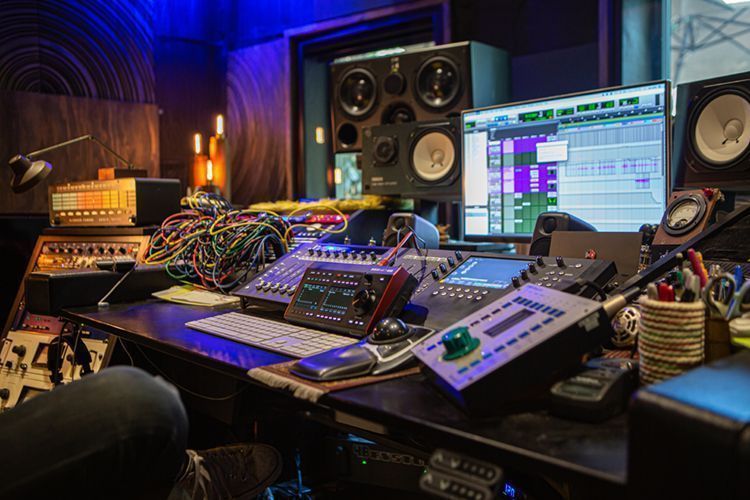
We talk with Dalama (DalaMIX), a master of mixing, about preamps. For everyone thinking about expanding their collection of gems in a home or professional studio: 500 Series, 19" rack, warm, cold, vintage, modern, European, Chinese, American, "fat sound," "in-your-face." Things to consider when choosing, and why.
Introduction
There are now many users who got started in home recording (the home studio) many years ago. Computers and technology made it possible to start doing recording sessions at home, beginning with demos and first "baby steps." This generation of "at-home" composers/producers has kept evolving and, in many cases, is now looking for ever more exquisite quality. To that end, what started out as a computer, a budget interface, cheap monitors and a shoddy mic is turning into collections built up over years of saving and effort: good mics, top-notch monitors and, in addition to good software, boutique analog outboard, as is the case with the subject of our articles these days: mic preamps.
No matter how much gear we buy, it will be really hard to reach the technical level (in terms of equipment and experience) of professional studios. The most interesting part is that nowadays you can start sketching ideas in your home studio and export parts of a project to give them the right punch and magic in a professional studio.
19" rack vs. 500 Series: when should you choose one or the other, and why?
|
||
|
||
|

What are the price differences based on?
|
||
|
||
|
||
|
||
|
What has the biggest influence on price is labor, and we all know that China is the cheapest option, which is what the big brands have been doing for many years. If the product comes from the USA or Europe, it becomes much more expensive and isn't competitive. Although quality controls in China are getting more and more serious, there are still some areas that should be monitored more closely.
Plug-ins vs. analog hardware
The eternal question many people ask... Some will say analog is best, and others that the plug-in is better. Personally, I prefer a combination of both: that is, when recording, I decide on the mic and preamp based on the final result we're aiming for, and then at the mix stage, if the performers are top-level, I stay true to analog, trying to remain in the same environment and only using the odd plug-in for convenience when it comes to automation.

What will good preamps give us that we don't get in digital?
Preamps are ALL different, with different behaviors and different colors (of sound)
Let's not forget that an analog unit is defined by the different elements it is made of: resistors, capacitors, tubes, etc., which are always reacting differently at every moment and never sound the same, since the first thing influencing each of them is the electrical current, and even if we have the best transformer and the best UPS in the world, it will never be completely stable and clean, and that is what means we NEVER get the same sound.
Also, thanks to that behavior, we color the preamp one way or another depending on what we're looking for. A classic example, to make ourselves clear, could be a guitar amp whose grit we want to change: simply by lowering the input voltage a few volts, all the elements will start to behave differently, and we'll get different timbres as we raise or lower the voltage.
We were already doing this many years ago. And that's where, for me, the big difference from digital lies. Although developers take many of the parameters described above into account when developing and coding the behavior of a plug-in, for now they cannot replicate the analog universe 100%. And this is neither an advantage nor a handicap; they are simply different tools to be used in different ways. On the other hand, in the digital world we can automate whatever we want, as many times as we want and in a thousand places throughout the song, without the timbre changing, something that does happen in the analog world.

Classic preamps: why? A NEVE from the '70s or '80s (to name one) is still a worldwide reference. What do these kinds of preamps bring to a recording?
We forget that until recently there were very few references in terms of manufacturers and brands. The brands that dominated the previous era were Neve and SSL in terms of popularity, well ahead of API, Helios, MCI, Harrison, etc., not counting older models. These great "monsters" have been so praised and revered because they defined an era that, in my humble opinion, was the most colorful in terms of sound and, while we're at it, why not say it, in terms of styles. I say this because people think that by owning that old gear they're going to sound heavenly, forgetting that the most important thing WAS and IS the sound source, which most of the time had been "worked on" by the musician or artist themselves, and other times in close collaboration with the sound engineer. To give an example: Hendrix and Kramer, how many hours they put in! A (silly) example to understand what I just said:
Why did Page, Hendrix, Clapton, Jeff Beck and Van Halen, to name just a few, sound so different from one another, using practically the same instruments and the same amps?... What made them different is that they invested enormous amounts of hours to set themselves apart from one another with elements as basic as a simple pick. We could go on giving explanations for a thousand reasons, but we don't have enough space to give it the time it needs. Conclusion: the preamp isn't as important as the sound source.
Once we invest in powerful preamps, will they work for vocals, acoustic guitars and percussion? Or does each preamp have its own field, like mics?
In this respect, there will be some preamps that get us to the desired sound faster, others that need more work, and others that simply won't add anything.
I think you shouldn't go crazy over models, brands and so on. It's enough to remember (if this can help anyone) that "in the old days" the consoles were what they were, and the 40, 60, 80 or more channels were "the same," and ALL kinds of music were recorded and mixed with those same channels: rock, folk, blues, country, big band and a long etcetera... and they ALL sounded different. What's the mystery? NONE! Musicians were chosen to suit the aims of the composer, the arranger, the musical director and the sound engineer, as well as the studio. Everything was based on 2 fundamental elements: SOUND and CONCEPT
And the same goes for mics: 4 brands and four models, not the madness we have now, where people go crazy looking for the holy grail, thinking the secret of success lies in the preamp and the mic. Big mistake!
5 powerful preamp manufacturers worldwide?
Without falling into "brand-itis," the top 5 manufacturers today are still the same, followed by all the other imitators, with more or less success. That said, the big brands such as SSL, Neve, Focusrite, etc. have been betting on more affordable products (often to the detriment of quality) in order to keep surviving in an era where consumption and sales prevail over a product with spectacular features and finishes, of which they would only sell a few units, which would end up wiping out the manufacturer. With an explosion of brands and models never seen before, the choice basically comes down to 2 factors: money, and "look how cool it is, so-and-so has one too!"
Which ones, and why?
|
|
|
|
|
|
|
|
|
Which preamps are at DalaMIX, and why did you choose them?
Here is a list of some of the preamps we use at DalaMIX:
|
|
|
|
|
|
|
|
|
|
|
|
|
DalaMIX. We offer our clients the option of using "old-school" preamps or, on the contrary, modern preamps, depending on their needs. In any case, we try to advise them, but we let them decide with their own "ears" which one most enriches their sound. With an interesting palette of products (preamps and mics), we can take on different projects depending on each client's needs. What matters most to us is that they leave happy and don't feel let down.
Right now there's a lot of supply and competition, but we try to offer our experience while fostering a good atmosphere so that everyone involved only has to focus on making good music.
Conclusion and wrap-up
At ISP Música Magazine, one of the things we admire most in the people who know the most, in any field, is their humility, something Dalama always exudes. In our own experience, moreover, the atmosphere created in the studio is really important for getting the best out of performers. A tense performer or artist doesn't usually deliver hot tracks and may even freeze up. If you come across a great expert like Dalama, who is also able to keep that friendly "vibe," and add the incredible beasts in the studio (which he knows how to get the very best out of), the sessions are bound to be a smash. All that's left is for the project being recorded, the ideas and the artist to be awesome and... "let's go get 'em, there are only a few of them and they're cowards."
Many thanks to Dalama for his time and for sharing his wisdom.