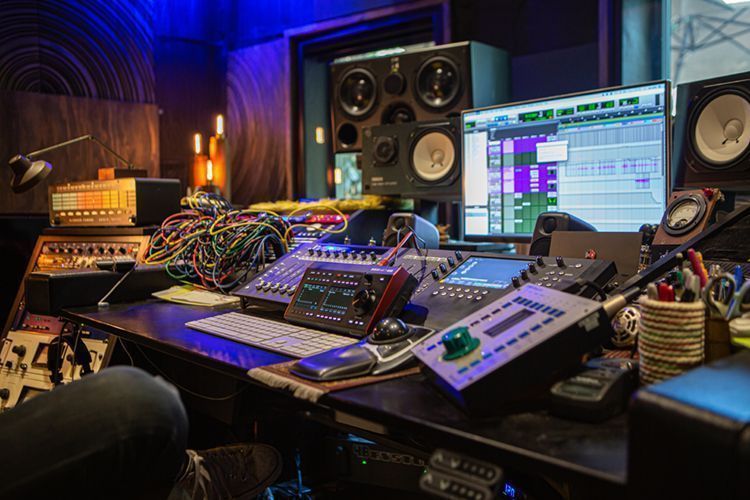
The scourge of COVID-19 has been devastating for the vast majority of businesses and self-employed workers around the world. Once again, the cultural sector, and music in particular, has taken the brunt of it. Thousands of musicians have seen their income, whether from teaching, live music or TV shows, drop to practically zero. Unfortunately, the figures aren't very encouraging, so the time has come to reinvent ourselves, diversify our sources of income and try to find advantages where everything seems to be an obstacle.
The pros and cons of lockdown
Mandatory lockdown has changed many of our daily habits. Eating, remote work, leisure time and even sleeping hours have been affected by the new situation. Shopping online and buying products and services over the internet has become the norm. According to various studies, music streaming users have increased their consumption by more than 50%. In addition, many songwriters and creators have taken advantage of lockdown to record new songs and finish projects they had pending. Contrary to what it might seem at first, it's a good time for musicians to go a step further and offer online recording services from their own studios.
 Recording from home
If you're a musician and you have an internet connection, the time has come to set up your own online recording studio. The advantages are many and varied. On the one hand, as we said at the beginning, we'll be able to diversify our sources of income and not leave everything depending on concerts or teaching. The potential of an online business is almost infinite. You'll be able to get clients from anywhere in the world without leaving home. On the other hand, it's a type of work that isn't tied to specific hours, so you'll find it very easy to combine with other tasks. Mind you, you're going to need to invest at least a little in recording gear!
What do I need to record online?
The technical requirements and the investment you'll need to make will obviously depend on the instrument you want to record. You won't need the same for a drum kit as for an electronic keyboard. Let's go over the necessary elements one by one:
The room
If your instrument is acoustic, whether it's a drum kit, a trumpet or a ukulele, you'll need to find a suitable space to make your recordings. You'll need a soundproofed room with acoustic treatment inside. This is perhaps one of the most expensive ingredients in the recipe, although with a little imagination and ingenuity you can lower the costs substantially. Soundproofing is essential to capture your sound without it being altered by outside noise pollution (traffic, thunder, the neighbor's dog…). In addition, it's important not to break local noise ordinances, which in Spain are currently around 25 dB of immission (the noise that reaches your neighbor's home). Keep in mind that some instruments can produce peaks of 130 dB, so the remaining 105 dB will have to be absorbed by your walls. There are very effective solutions for this, such as modular soundproof booths, although you can also do it yourself with recycled building materials. You'll find plenty of information on YouTube. If you go for the latter option, you'd better be handy with DIY!

Acoustic treatment is also essential to record with at least minimal quality. The sound waves your instrument produces bounce off the walls, floor and ceiling in erratic, almost unpredictable ways. These reflections can ruin your recording, creating unwanted peaks (bass buildup, etc…) or cancellations of some frequencies. As a general rule, try to make sure the walls of your recording room are neither parallel nor smooth. And if they are, try to place elements that help diffuse and absorb sound. Some "homemade" solutions might be sofas, bookcases, rugs, various pieces of furniture… By the way, egg cartons are useless!… keep that in mind.
The microphones
Continuing with acoustic instruments, another technical requirement will be microphones. This is the number-one link in the sound capture chain. Before deciding on one type or another, you'll need to consider two things: its construction and its polar pattern. These two parameters are very important when recording any kind of sound. Mics are divided into dynamic, condenser or ribbon according to their construction. Let's look at their main characteristics:
Dynamic microphones
Dynamic microphones are usually very rugged and reliable, and they don't need batteries or external power. They're also not very sensitive, so they're a good option for recording drums, amplifiers or instruments that produce a lot of signal… However, they can also be used on vocals, so they're very versatile. On top of that, they have the advantage of being quite affordable, and with basic care they usually last a long time.
Condenser microphones
They're generally much more sensitive than other types of microphones, so the signal will be stronger. They're a perfect option for recording vocals, strings, pianos, etc… If you'd like a more versatile one, choose a large-diaphragm condenser microphone, since it will capture a wider frequency range.
Ribbon microphones
They're characterized by capturing sound smoothly, producing a vintage sound that's nothing like that of condensers. They're very delicate, so they require thorough care and certain applications to avoid damage.

As we said, it's also important to pay attention to the polar pattern, which is the area from which the microphone picks up sound. Let's look at some of the different types:
Omnidirectional
Omnidirectional microphones are those that pick up sound with equal gain from any side or direction. Although it may seem like the best option in every case, it has its drawbacks, since it can pick up unwanted noise or reflections.
Cardioid
Its sensitivity is concentrated at the front, minimizing (though not entirely) rear sensitivity. Its directionality resembles the shape of a heart, so it picks up signal sources placed in front of it. It's typically used for handheld vocals, guitars, kick drums, snares, toms…
Hypercardioid
The hypercardioid polar pattern has a much narrower pickup angle, so it rejects noise and feedback more effectively. The pickup angle is therefore narrower than that of a cardioid.
Bidirectional or figure-eight
A bidirectional microphone has a polar pattern shaped like the number eight, so it picks up audio equally from the front and the back while rejecting sounds from the sides.
The preamps
Any acoustic signal picked up by a mic is converted into a tiny voltage, a very small electrical signal that travels down your cables. For it to be usable, we have to amplify it with a mic preamp, or preamp. In this amplification process, the sound can be subtly altered and enriched (in which case we talk about preamps that "color" your sound), or it can stay faithful to the original source ("transparent" preamps). It's important to do the necessary tests and get properly informed so you choose the preamp that best suits your needs.

Interface or AD/DA converter
Also called a "sound card," this is the device that converts the electrical signal coming from our mics and preamps (analog so far) into ones and zeros (the binary digital system), which is the only language our computer can understand. Conversion quality is an important parameter to keep in mind, and it's why we find converters on the market at very different prices.
Computer and recording software (DAW)
The computer will be the "brain" of the whole process of recording, editing and, of course, sending files to our new clients. Its technical requirements will also be closely tied to the number of simultaneous tracks we plan to record. Keep that in mind when calculating the RAM and CPU you'll need. You'll have to install audio recording and editing software (today there are many free ones on the market). All of this will make up your Digital Audio Workstation (or DAW)
Once you have all these elements connected and properly calibrated, you'll be able to start recording with musicians, songwriters and producers from all over the world. Without a doubt, it will become a tool that helps you get through the difficult times we're living in. It's time, as we said, to reinvent ourselves and adapt to new realities. We musicians need to create, stay active and communicate. Because, as Freddie Mercury said: "the worst illness is boredom."