We wrap up with a series of exercises that should have made this technique almost your own by now. I hope it's already part of your solos. Even so, don't miss a detail in this installment, because you'll have more than enough reasons to complete, develop and execute the technique. On top of that, I'll give you some keys so you can keep learning arpeggio tapping on your own.
We'll start this last installment with a tapping exercise with bending (already the second one across all the installments so far). We'll continue with a tapping exercise with note doubling, which will remind you of a very special guitarist who is admired the world over, and we'll finish with arpeggios, of which we'll give only a few basics, since it's a very broad subject that would fill many installments; you will, however, learn the particulars, so you can develop it yourself.
Several of the exercises we're about to cover come, as always, with their MP3 demonstration, which you can find on the website, and which I recommend visiting for any clarifications and questions.
You'll only need a string muter for the arpeggio exercise and, as always, I've laid out the sheet music as simply as possible to make it easy to understand. You can then change the tempo or the type of note values to your liking, as I have.
Tapping Bending with Slur
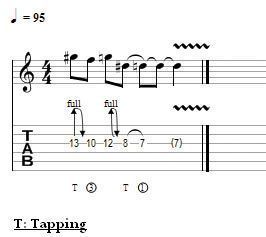
This is, as I mentioned, the second bending-with-tapping technique exercise (of all those we've done over the different installments). As you'll see, we start with two bends, which you must perform in full, both on the way up a whole step and on the way down. Then we continue with the slur into the following notes. The reasoning, as you can see, is simple, but the point is to draw out every nuance and try to play it with as much feeling as possible. Let's get to it.
Tapping with Note Doubling
If one exercise defines the tapping technique, it's this one. With it you'll create a note-doubling effect that gives a touch widely used by Steve Vai, among others.
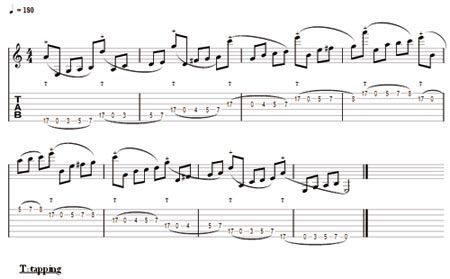
As you'll see, you need to be very careful about the distance between notes, which runs from the seventeenth fret down to the open string, and you'll also see some notes repeated on the same string but in a different octave, which gives us that special doubling I was talking about. This makes it especially hard to get the cleanest possible execution. This time I'll play the tapping-with-note-doubling MP3 freely, so you can see what kind of effect you can end up creating. Feel it out slowly at first, but keep in mind that it's one of the exercises that are made to run, so bring the metronome tempo up little by little.
Tapping with Arpeggios
This is one of the most popular techniques lately when it comes to tapping. Although the practice has been around for a long time (there's the example of a great guitarist you surely know), Jennifer Batten, guitarist for Michael Jackson and Jeff Beck, among others, has for many years been a great specialist in this area.
Other guitarists who also use it a lot are Dave Martone and Guthrie Govan, and you can see that it's possible to build real solos and melodies using tapping with arpeggios.
I'm going to try to get the idea across so you can develop it further, and then you'll be able to keep building on it on your own. It would be good to know or review how chords are formed, to make the reasoning we're about to use easier.
We'll work with a basic C major chord. A reminder that a string muter is essential here; if you don't have one, a rag or handkerchief can do the job perfectly, wrapped around the start of the neck, at the part closest to the first frets.
C Arpeggio Tapping, Starting on the Sixth String
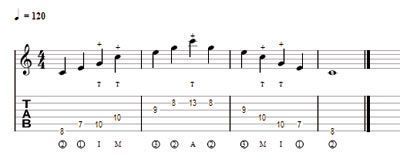
The structure of the C chord is root, major third, perfect fifth; and we'll add the octave of its root (C again). There are possibilities for doubling these notes, which we won't play for now (except the root). If you look closely at figure three, there are notes with no letter, only a number below the staff (in the sheet music these notes are circled), and so they'll be fretted (in some cases called “hammering on”) with the left hand and without the help of the pick. This is an important point, since you shouldn't have picked up the pick at any time, because you won't be using it. The others, besides carrying the letter T for tapping, carry other letters underneath, which indicate which right-hand fingers (I: index, M: middle, A: ring) you'll be using (as you can see, you'll be using more than one finger on your right hand for the first time). Keep in mind that since you aren't using a pick, whatever sound you get will come solely and exclusively from fretting the notes with the fingers of both hands; this point is extremely important and essential so you don't get lost.
To begin, feel the exercise out as I've described; it's important that you do, and that you do it with a clean sound (you can add distortion once you manage to play the exercise well). Also, for now, play that clean sound on the neck pickup; you'll notice for yourself that this position, with a clean sound, will help you most, while looking for a suitable EQ setting on your amp, of course.
C Arpeggio Tapping, Starting on the Fourth String
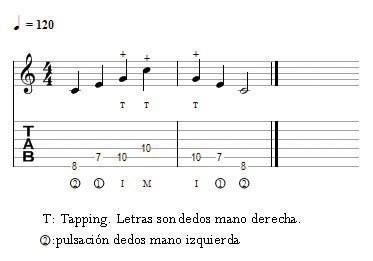
Let's now continue with the same type of exercise, but starting on the fourth string. The way it's played is exactly the same as the previous exercise (with small variations), so, as before, feel it out first until you get it right, from a clean sound up to using distortion.
We started with these two kinds of exercises because they lead to the most important one of all, a much more complex arpeggio. As with the previous exercise, all you need to do is follow the sheet music until you can play it well. It doesn't matter if you change the tempo or the type of note values; above all, try to get the maximum cleanliness. I haven't included an MP3 for figures three and four because they're so simple, but in the next exercise you'll have a very complete one that sums up everything we've covered so far and that I repeat, in the same MP3, at different speeds.
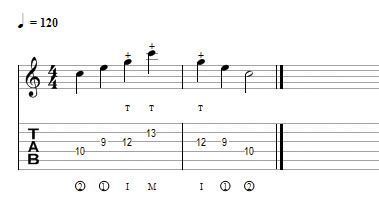
C Arpeggio Tapping over Two Octaves
We come to the last exercise, and the most important of all those on arpeggios. In this one you'll see everything we've been saying about being able to "configure" any kind of arpeggio for tapping on your own. All you have to do is follow the sheet music, as in the previous exercises, and work out that whenever we give a note, if you decide to tap it you'll also have to decide which finger of the hand you'll use. In this example, which I played with distortion, I've extended it over two octaves, so you can see that the decision-making is yours, and to advise you to do what we did in figures 3, 4 and now 5, so you can build it yourself with other types of chords. For example, challenge yourself with minor chords, major chords with a major seventh, minor chords with a minor seventh, and diminished chords (you'll surely use the latter quite a bit), first in one octave, then in two, and even across several areas of the neck; there are many combinations. Listen to the MP3 and get to work.