In this chapter we'll find three tapping exercises that will help us keep defining this technique. If in the previous chapter we told you that you'd already have a good idea of what tapping means, in this one we'll start to define and polish it.
Although it has started to become part of your solos and melodies, we still have some more decisive aspects to cover, where you'll finish getting to know it thoroughly.
We'll keep the pick in hand, and we'll use the right hand to tap with the middle finger (if you play left-handed, just reverse what's described), and you can use muting to dampen strings in all the exercises, except the one on tapping with bending.
As in the previous chapters, I've written out the scores for easy reading, but the mp3s, which as in the previous chapter are a must-listen, I've played "freely" to give them the feel I thought appropriate, so they serve as an example. Later you can change them and give them whatever feel you think is best. So I recommend that you first take a quick look at the scores and their mp3s.
The first exercise we'll play is tapping over a major scale. In it we keep breaking the mold of tapping on the first note of each string.
The second exercise is tapping with bending. If you remember, when we started in the first chapter I said this technique had a very particular form of expression, and that we would demonstrate it. Here is the first exercise where you'll see the very special effect that can be created.
The third exercise is a pentatonic scale with string skipping. This situation will help us try to achieve even cleaner execution of the exercises. We'll begin with tapping over the major scale.
Tapping Over a Major Scale
The purpose of this exercise is to get you used to defining this technique with string changes at different points where the tapping occurs. The easiest way we've already done in several exercises, in which we had three notes per string and their corresponding tap (these are symmetrical exercises that are easy to play). Now it won't be like that. In this exercise you'll see that this condition isn't always met, and that this is also used "aurally" to create certain effects that, in this case, remind me of Joe Satriani's style. Practice it by learning measure by measure and repeating the ones you've already learned along with the new ones.

Tapping with Bending
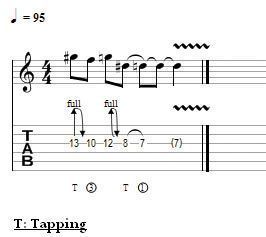
We've reached one of the exercises I like most of all in this chapter, and one I'll come back to in the future. You'll see an apparently simple score with small nuances, all of them involving bending. Pay attention to this explanation, because it's absolutely necessary, together with the score and the mp3:
- The third note of the first measure, where you're tapping, contains a full whole-step bend. You'll see that it's almost impossible to do this bend with the right hand, which is the one you're tapping with, since the string would most likely slip out and you wouldn't be able to do the exercise. So what's the right way to do it? Right when you tap, with the left hand, you'll have to hold your third finger on the seventh fret, bending precisely with this hand (the left one); keeping the tap going with the right, you'll get the note on the score.
- Careful, because you haven't released either of the two notes yet and, in fact, you'll hold the tapped one a little longer. When you release it, you'll have the bend done with the left hand, so if, besides the effect of releasing the tapped note, you add the descent of that bend, you'll have achieved the effect completely, perhaps something like a "slide" (draw your own conclusion about the sonority it suggests to you), which is what I'm trying to indicate. Keep in mind that the descending bend is ?, so it will give that feeling of a "note already started." Exactly the same applies to the rest of this score; you'll need to take the same care. I deliberately made this exercise short, with the intention that you play it perfectly, since in another chapter it will be more complicated. But it's worth it, because it's a completely essential and primary part of this technique.

Pentatonic Tapping with String Skipping
Finally, we have an exercise that, like the others, stands out for the lack of symmetry in the timing of the tapping. In the mp3 demo I play it at two speeds (a slower one and then a faster one) so you can understand it better. Look at the left-hand fingerings on the score; you'll need to take special care with those marked with a circle. Work through it little by little, learning measure by measure and alternating the ones you already know with the new ones. Go for it.

I've saved for last a technical chart in which we can summarize, without using a specific scale, the "routes" most used in these chapters.

We've used this type of chart on other occasions. Going down, you have the strings from first to sixth; the note marked "(t)" is the tapped one. With it you can set yourself exercises such as ascending and descending tapping, in groups of several notes. For example, you can choose the three notes shown on the first string, plus one from the next string, and then tap. There are so many possibilities that I'll leave it to you to explore to your liking and decide the combinations. It's an exercise you don't have to complete in a week or in a month; the idea is to develop it yourself, little by little.
In the next chapter we'll continue with more tapping-with-bending exercises and new exercises with modal scales, but with a way of tapping that creates a very special doubling effect. Until the next chapter.