We keep them, we collect them... and they often disappear as quickly as we get them. And let's be honest: most of us feel completely helpless and useless if we lose them right before playing. But the million-dollar question is: When do we stop to think, even for a moment, about how we hold the pick and what we're aiming for in terms of sound?
Keep in mind that every guitarist stands out, among other things, for their technique, which leads to a particular command of the pick. This means that if we do it right from the start, it will define us for the rest of our lives.
Without further ado, let's dive headfirst into a world that, it seems, is given less importance than it deserves. If you hardly ever use a pick, grab one and give it a chance. If you use one often, keep reading; maybe you'll learn something new.
BUYING PICKS
"Any one will do for me." Wrong. Sure, we could play with any pick, but the smart thing is to use ones suited to our style and our personal and physical preferences. If we're going to play ultra-fast metal solos with a large three-millimeter-thick pick, we'll have a problem. And if we also have small hands, it can become our own personal hell.
For beginners, this is an important milestone in your future life as a guitarist. So get dressed and head to a music store you trust.
When you're at the store and ask the clerk for picks, they'll probably bring you one or two trapezoid-shaped displays, with each slot labeled by pick brand/size/material. Now we face that brutal question: "Which one do I pick?" My advice is not to pick a very soft one (by soft I mean a thickness of 0.5 mm or less). Since it's a new element between your fingers, you'll feel a bit strange; so, to keep things simple, choose a hard pick that's easy to hold and, if possible, with a rough surface where it contacts your fingers (it increases friction, which means it's less likely to slip out of your hands). Still, buy a few, since you never know which will become your favorite. Keep three parameters in mind: material, thickness and shape. Picks made from artificial materials (nylon, plastics, synthetic fibers...) will give a warmer sound (classic example: Dunlop Tortex), while metal picks (note: prolonged and improper use can damage the strings), bone and wood picks will give us more brightness.
Obviously, the material affects the pick's stiffness, but let's focus on another point: thickness. It's a matter of taste: some of you will feel more comfortable with one thickness than another. In terms of styles, it's worth noting that jazz guitarists tend to opt for rather thick picks (1.5 mm and up), while heavy metal guitarists tend to go for picks around 1 mm thick. But as I said, it all depends on how well they fit our fingers.
Finally, there's the shape. For you speed freaks, my advice is to use picks with a pointed tip. It glides better, ergo it allows a faster attack. In other cases, things vary. We'll see that later on.
HOLD ON HOWEVER YOU CAN
Now we're talking. You've bought your picks, so it's time to think about using them, right? Well, there are no quick rules to show you how to hold the pick because, as mentioned before, each of our hands has a unique shape. That said, there are two basic principles: one, hold the pick so that you're completely sure it won't slip out of your fingers while playing; two, keep your arm relaxed, with your wrist using an anchor point as a reference (normally the bridge, though there are eccentrics, like Michael Angelo, who use the pickguard for this).
Photo 1 shows the standard way of holding a pick.
Make sure you hold the pick with the pad of your thumb and the side of your index finger. It's worth mentioning a bad habit here: many people tend to hold it with the pad of the index finger. All you'll do is make the downstroke-upstroke motion harder and, most likely, end up dropping it.
Most of the pick should be between your fingers. For a standard-size pick, hold about 2/3 of it. The less tip you leave exposed, the better (especially when playing artificial harmonics).
Now, strike the string with the pick. It may feel awkward at first, but you need to put in the hours. Experiment with the angle at which the pick hits the strings. For a clean attack, musicians like Yngwie J. Malmsteen or Michael Romeo strike with the pick completely flat (PHOTO 2). However, this position can be uncomfortable when moving the wrist. In fact, most guitarists find it so, and prefer to angle the pick slightly downward. This makes the sound more "raspy," very fitting for rock. (PHOTO 3) Then there's the opposite extreme: angling upward. Used by musicians like Shawn Lane, the result is a rounder, fuller sound. (PHOTO 4)
IMPROVING TECHNIQUE: DOWNSTROKES AND UPSTROKES
There are two ways to strike the string with a pick: the downstroke (downward) and the upstroke (upward). The most natural way to play is alternating downstroke and upstroke each time we strike the strings. This is what's known as strict picking. Breaking this technique leads to so-called economy picking, which consists of striking several strings in the same direction when it suits us (for example, if we strike all the strings from the sixth down to the second, we'd use only downstrokes and never an upstroke).
To start, we'll only consider downstrokes. Try playing exercise 1 slowly, trying to make every stroke on the string the same, but without being harsh or making the string slap against the fretboard.
How did it go? Well? In that case, you're ready to develop alternate down-up picking. You'll notice the sound is more "floating" and that you can build up more speed.
Of course, using downstrokes and upstrokes on their own has its place, as you can see in some techniques (rakes, sweeps...). But if your influences include most of the renowned guitarists, such as Al Di Meola, Yngwie Malmsteen, John Petrucci, Steve Vai or Steve Morse, alternate picking is what you're after. Personally, it's what I use for standard lead playing (some techniques, like sweep picking, which we'll see later, require sweeps made exclusively of downstrokes or upstrokes). Try exercise 2.
SOME TECHNIQUES TO MOVE FORWARD
Now we'll move into intermediate territory, but don't get scared before trying. The following solo uses three picking techniques that can add an original and more convincing touch than mere "picking":
The techniques used in the example are:
a) Rakes: Played by striking two or three strings (with a single pick motion, economy style) until reaching the string we want to play. The other strings are muted with the palm of the picking hand and with the fingers of the fretting hand, to get the desired sound.
b) Artificial harmonics: The well-known trick for giving notes a
"squealing" touch. Hold the pick firmly, covering almost
all of it with your thumb, and strike the string. At the very same
moment as the attack, touch the string with your thumb, and voilà, you have an
artificial harmonic. It takes practice, so be patient and practice.
c) Pick slide: Extremely simple, and well suited to playing
with distortion. It consists of sliding the edge of the pick along the sixth string, moving downward.
ADVANCED TECHNIQUES
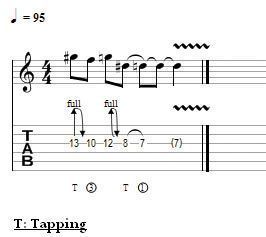
If you're beginners, I don't recommend trying these techniques until you've polished the basics. Still, they'll at least give you an idea of where to progress. Here's an exercise:
Little by little, we're moving forward. Here I describe the techniques used in the previous piece:
a) String skipping: This is a way of getting sounds that differ from traditional riffs. In those riffs, the guitarist normally plays a few notes on one string, moves to the adjacent string and continues the melodic line. With string skipping, you play one or more notes on a given string and then, instead of continuing the melody or riff on the next string, you skip it and play on another one. It takes practice, because at first it's very common to hit the adjacent strings when trying to reach another. That's why it's important for the distance the pick travels each time you pick to be as short as possible; just what's needed for the string to vibrate and ring. It's a technique widely used in rock-derived styles. The main masters associated with it are Paul Gilbert and Eric Johnson, who often use it in their arpeggio patterns.
b) Sweep picking: Another of those techniques adored by metalheads who love dizzying speed. Used for arpeggios, it's basically a technique that economizes pick movement, that is, it increases the rate at which we deliver our strokes. On a single string, we use alternate (strict) picking, but when changing strings, instead of alternating, we use the same motion as on the last string, so that we take advantage of that motion to play faster with a sweep across the strings (that is, if we played a downstroke on the last string, the next string is also played with a downstroke, and likewise for upstrokes). All of this with strictly wrist movement.
Sweeping is practiced by most guitarists, with special emphasis among rock players (Michael Romeo, Joe Satriani, Steve Vai, John Petrucci, Kiko Loureiro, etc.).
c) Pick tapping: This technique is derived, as you might guess, from traditional tapping. It consists of tapping the frets perpendicularly with the pick while fretting the strings. In short: instead of the fingers of the right hand, we use the pick. The result is a very bright sound, and it gives us the chance to play very fast. The only drawback is that it can't be done on more than one string at a time.
HOW SOME LEGENDS PLAY
So far we've been feeding on theoretical and practical content about picking techniques. But how have contemporary guitarists approached these techniques? Let's find out.
BLUES AND JAZZ: BB KING AND DJANGO REINHARDT
This man, like the most veteran blues and jazz players, uses the pick by gripping it tightly, without leaving any gap between the fingers. If we look at other greats, like jazz guitarist Chuck Wayne, we'll see more of the same. The picks they use are thick and slightly pointed, and their usual technique is grounded in strict picking, alternating upstrokes and downstrokes, with an almost strictly wrist-based motion.
ROCK: JOHN PETRUCCI, MICHAEL ROMEO AND STEVE VAI
Two greats among the few progressive rock guitarists out there, and a legendary, unclassifiable guitarist. The results they get when playing are simply spectacular, with minimal pick travel and polished sweep and skip techniques, as well as sweep-tapping combinations. In the case of Romeo and Petrucci, the wrist motion is short, keeping a straight position with the fingers parallel to the strings, lowering the forearm slightly to reach the strings farthest from the anchor point, which in both cases is the bridge. You can see in these two players that, when playing very fast solos, they tend to rest the middle finger on the index finger to keep the pick from slipping at such high speeds. The rest of the fingers stay relaxed. They use pointed-tip picks.
Vai is a different case. He uses a wider wrist angle, and his three free fingers are more relaxed than in the two previous players, with his arm more tilted. This is because he often uses those fingers to play in combination with the pick, or to perform other techniques. Vai is a master of every known guitar technique, including the rarely practiced pick tapping, widely used and championed by his teacher Joe Satriani.
Obviously, the limited length of this article prevents me from adding equally notable names, such as Paul Gilbert, Kiko Loureiro, Nuno Bettencourt, Al Di Meola and many others whose picking techniques have swelled the list of advanced learning standards.
PICKS WORTH A LOOK
We couldn't close this article without first mentioning some specific pick models suited to your style; that said, the most important thing is that you feel comfortable with them.
Dunlop Tortex: With thicknesses from 0.5 mm to 1.14 mm and different shapes, it's made from a non-slip, durable synthetic material that has won the trust of greats like Slash, Paul Gilbert, George Lynch and a very long list of others, leaving no doubt about its versatility and quality.
Dunlop Jazz III: John Petrucci's favorite pick (and mine, too). It's a synthetic pick with a smoother surface than the Tortex and a pointed tip that allows fast movement, as well as making artificial harmonics very easy.
Dunlop Nylon: Another of Dunlop's best-selling picks. Long-lasting, they have a textured surface that grips the fingers easily. Very light and easy to handle. Used by Eric Johnson, Mick Thomson and Whitesnake.
D'Andrea Delrex: One of D'Andrea's most popular picks. Made from Delrin, it delivers a warm, percussive sound.
Fender Celluloid: A pick with a very smooth and appealing texture. Made from celluloid, it glides easily and comes in three thicknesses: thin, medium and heavy.
CONCLUSION
It's more than obvious that just by looking at a guitarist's pick (at least one who knows their gear), you can deduce quite a few details about their technique and the style they play. Above all, remember that choosing a pick is neither right nor wrong, just more or less suitable. Your picking touch is for life.
Although many of you may prefer to play only with a pick, first and foremost I must make it clear that you shouldn't dismiss the classic technique of playing with the fingers alone. In fact, I encourage you to practice it too, since it has its advantages. In any case, you already know the three principles this world of technique is built on: practice, practice and practice.