Not long ago I read something along the lines of “I ran out of music.” It referred to the state many musicians go through when they feel their soul has “dried up” and, after years of pouring out songs, the well runs dry. It most likely happens when the magic that floods the creator is invaded by the monotony and routine of practical life. The end of dreams?
Dreams and practicality. Passion and mathematics. Sensitivity and reason. Art is a way of life. For musicians, it’s not about traveling roads, stages or studios (though that too); rather, it’s because the creator carries an emotional charge that outweighs the rational one. They harbor a need to condense feelings and make them burst out as songs. To feel the blood galloping through their veins, to nourish and cultivate their soul; to share feelings with their listeners, who give meaning to the artist and to the way they squeeze the most out of life.
Perhaps “I ran out of music” reflects a state in which dreams shatter and the ability to feel freezes over. Taken over by a daily grind in which the senses, petrified, have nothing to say.
Maturity and experience surely keep hammering away at the dreaming soul, and it is the artist (musician, sculptor, painter, poet, actor...) who decides to rebel and chooses a daily life that injects emotion as the energy of their existence.
For these reasons, and given our empathy with those who value the soul and make it their life, we once again devote our space to recognizing artists who give their all on stage and spend their daily adrenaline cultivating their dreams as a way of life.
Susan Santos
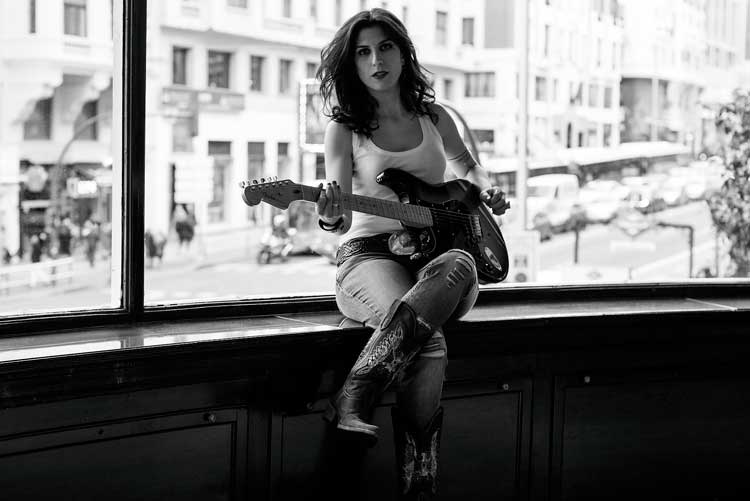
To coincide with the recent release of her fourth album, “Skin & Bones”, recorded in Madrid, mixed in California and produced by Juan de Dios Martín, we sat down with Susan to delve into her experiences in the world of artists.
She is known for her steady career and distinctive sound that blends rock, blues and other American roots music. Slide guitar, resonator guitars in the purest 1930s and 1950s style, all bathed in a seductive stage presence, her personal influences and proven musical know-how beyond any doubt.
1. Hi Susan. Surely a typical but obligatory question: how did the influences of bluegrass, blues and country come into your teenage years? What makes you connect with this style?
I started listening to classics like the Beatles, the Rolling Stones, Cream… when I was around 18. A couple of years later, by chance, I discovered a blues radio show and fell in love with that sound. I waited every week for the show so I could listen to it and record it. From then on I listened to a lot of blues artists. I’ve also listened to a lot of soul, funk… and I love listening to and discovering records or artists I don’t know, whatever the musical style. It’s this past year that I’ve started listening to more country and folk.
2. An artist’s life is always hard, even more so with the economic crisis. You know… “for the love of art”… How do you see the work outlook for the rest of 2016?
Making a living from music is not an easy road. Without a doubt, musicians in this country are great fighters. How do I see the rest of 2016? Pretty much the way it started… I hope the day comes when we can have the same rights and being a musician is considered like any other job.
3. The international circuit seems harder to reach, though more rewarding and probably with more recognition (in general) than in Spain. Where do you play live? Is it through festivals, clubs, international artists who help open doors? What does a musician find outside our country?
This year I’m getting the chance to play quite a few blues clubs and festivals in Europe, and it’s definitely a great experience to play outside your country and have people enjoy your performance. It’s very rewarding.
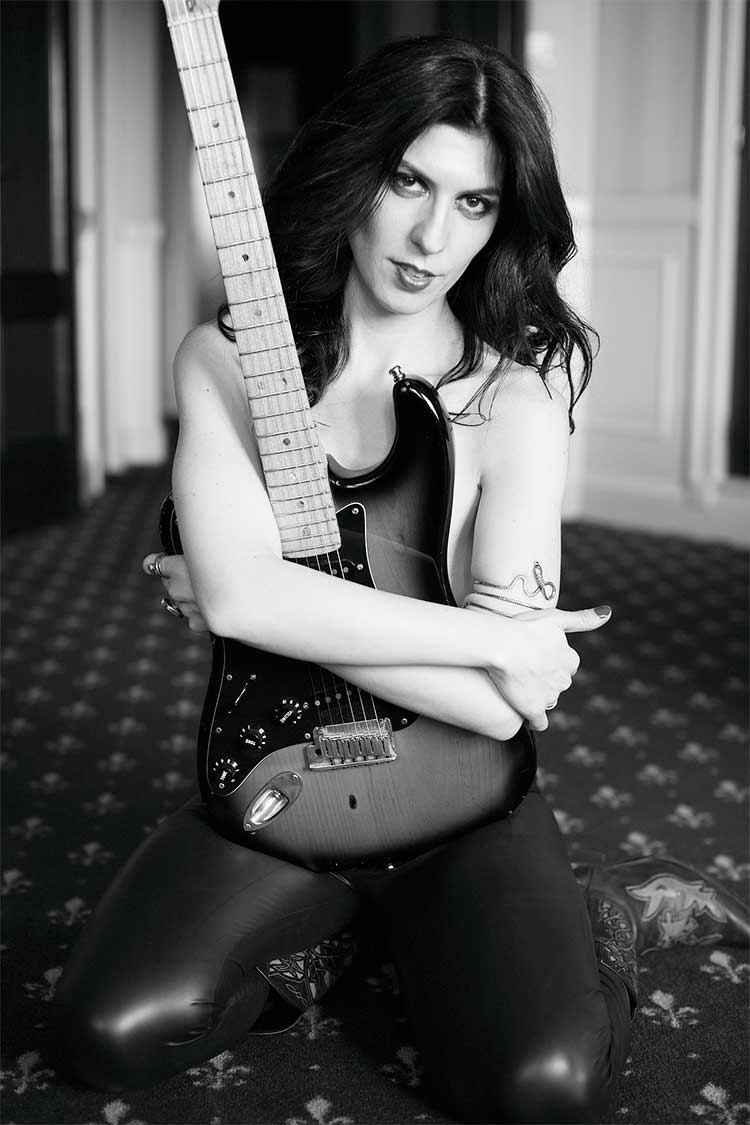
4. As for instruments, we often see you with resonator guitars or dobros. What do you think of them, and why do you feel comfortable with them?
For the songs I play with slide and in open tuning, I use the Airline Folkstar, and I managed to get the left-handed version. It’s very light, and the cone gives me that metallic sound I love so much. I’d like to find a better option for live shows, but finding a left-handed dobro is no easy task.
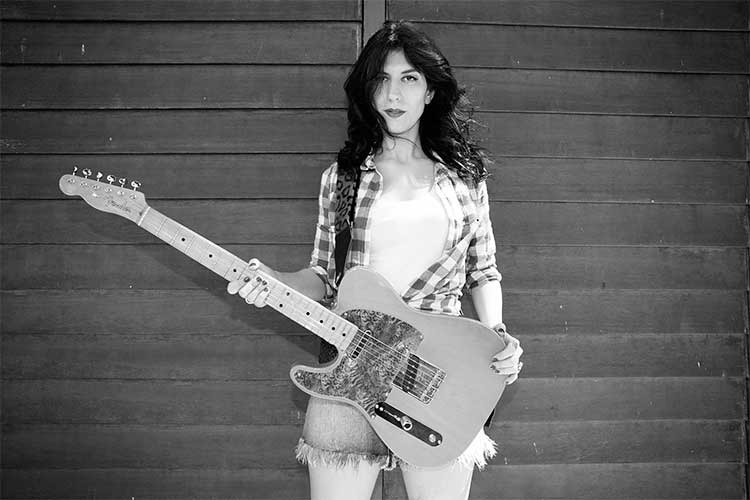
5. We also see you on stage with Telecaster® or Stratocaster®-style electrics rather than thick-sounding instruments like a Les Paul. Don’t you like them?
My favorite guitar is my Strat®. I have a special fondness for it; it’s my first real guitar. Besides the Strat®, I’ve also used a Telecaster and a Duesenberg Starplayer TV live, and I have to say there are two guitars on my wish list: the SG and the 335.
6. Regarding amplification, at some of your shows we’ve seen George boutique amps. What do you look for in an amp?
That it has body and is warm when clean, and that when it breaks up it sounds defined. I prefer amps of no more than 20 W. Live I use my George Tornado, but to record “Skin & Bones” I used a Carr Rambler for all the electric parts; I loved how the songs sounded with it. And for the previous album, I used Suhr, Fender Princeton, Mesa Boogie… If there are several amp options, I always like to try them out to get different sounds.
7. Musicians. You’ve collaborated with international musicians of the stature of Jimmie Vaughan, Joe Bonamassa, The Fabulous Thunderbirds, Joe Louis Walker and Buddy Whittington. Also respected names on the national scene you rub shoulders with every day, Eze Navas, Pablo Martín, Paco Bastante and many more. What have you learned from the best-known musicians you’ve played with, and what do you like to get from your fellow musicians on stage?
Everyone you mention is a great musician and a true professional… I have a saying, and it’s very true: I always play with great musicians and great people. That also comes across on stage, when we’re all in sync, having a good time, and we look at each other and there’s always a smile because we’re enjoying ourselves… If the recording of “Skin&Bones” went so fast, it’s because, among other things, besides having played lots of shows together, there was a great vibe.
8. A woman, left-handed and a bluesman (blueswoman?). Do these traits make your music career easier or harder?
 The beginning was hard. I arrived in Madrid without knowing anyone, and people didn’t pay much attention to me. Little by little I managed to carve out a place on the blues circuit. After the first few years, once I’d released my second album, I started playing quite a few venues in Spain, and I played outside Spain in Holland, Belgium and even Chicago. From then on things got better. I spent two years combining my project with other music jobs: I was a guitarist on La Mañana de la 1 on TVE for a year and a half, then two years in the musical theater show The Hole 2, all while releasing my third album, playing shows… and up to now with the fourth, “Skin&Bones”, combining it with other musical activities, although I have to say that since the album came out I’ve been pretty busy with my own project, and most of the shows I’ve played this year have been with it. But to survive in this country, all of us musicians play in different projects.
9. What will we find on Skin&Bones?
When I recorded the album, before it came out, friends asked me what it sounded like, and what came to mind was that it’s closer to a California sound than to blues. I feel comfortable with the songs I’ve chosen for the album; they move among other American roots music. It’s a more open sound than my other albums. The best thing is for whoever reads this interview to listen to the album and decide. And above all, come to one of my shows. http://www.susansantos.info/tour-dates
10. Name a musician far removed from the blues (commercial, jazz, pop, indie, other) whom you consider essential. Why?
Picking just one is hard for me; there are lots of musicians I like who are essential listening… For example, Pink Floyd, a very original band. “Dark Side of the Moon” is one of my favorite albums.
11. Soul or reason? Finally, we leave you an open space for some words to our readers.
For music, always the soul, both for playing it and feeling it. And for listening to it, feeling the musician’s soul. And, of course, passion. I remember many moments in my life linked to records, to songs I was listening to at the time… I can’t imagine my life without music.


