 Spanish poet and musician Marwan has become one of the most successful singer-songwriters today in Spain and Latin America. His concerts, albums and poetry collections have achieved success thanks to word of mouth and social media.
With 5 LPs and 3 poetry books under his belt, the "Marwan" phenomenon has only just begun. He is already preparing a new album, released on September 1, which he will present on a tour starting in October and reaching its high point on January 12, 2018, with a concert at Madrid's Palacio de los Deportes.
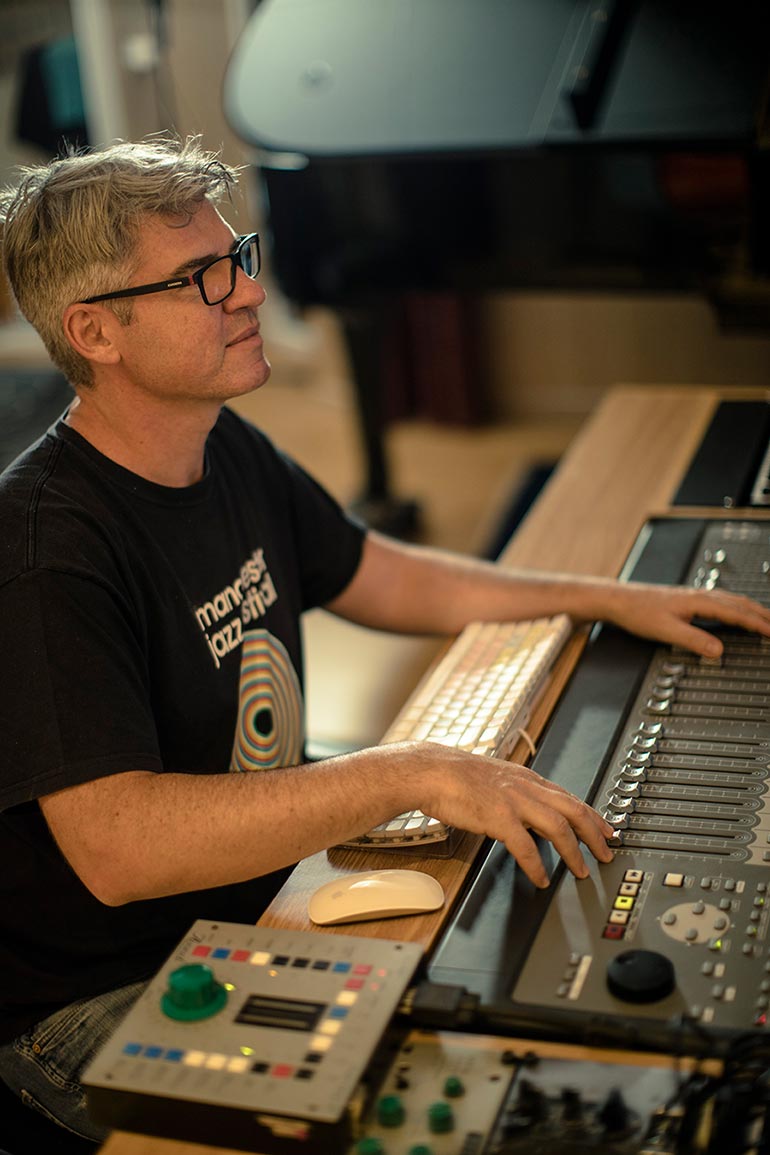
For the last 5 years, Oscar Herrador, sound engineer and technical director of Stateroom Studios, has been in charge of sound for his tours. Oscar trained in the '90s at the legendary TRAK studios in Madrid. Later, in 2001, he went freelance, working in the best national and international studios (PKO, CATA, Ardent Studios...). He has worked with artists of the stature of Compay Segundo, Antonio Vega, Sergio Dalma, Jorge Pardo, El Sueño de Morfeo (whose self-titled album earned him a nomination for Best Sound Engineer at the Premios de la Música), elBicho and Ismael Serrano, among others.
Marwan and Oscar have used Shure microphones since the beginning, and this month they gave an interview (through Earpro) to talk about their careers, their new projects and their #ShureExperience. Here is the result!
Marwan, Oscar… how are you experiencing this moment in your careers?
Marwan: Well, I'm really enjoying it right now. When you see that you're making the albums you've always dreamed of and that people are supporting you, there's little more you can ask for. I'm loving it.
Oscar: For me it's a great moment professionally. Surrounded by great musicians and with this great artist, I have the chance to carry out ambitious technical projects and put all my experience into them.
Oscar, for your part… what have the recording processes for the albums been like so far?
O: I haven't worked much on Marwan's albums, just an acoustic track on his second album, I think... I've been recording and working with singer-songwriters such as Ismael Serrano, Antonio Vega, Pedro Guerra, Siloe, etc. for 20 years, and the process is always different on each album. I've been touring with Marwan for 5 years now; maybe I'll contribute to some part of the album, recording, mixing, mastering… But without a doubt, the tour we are going to do in 2018 is very exciting.
Marwan, which upcoming projects that you can reveal are you most excited about?
M: A few weeks ago I finished recording my new album, which comes out in September, and that has taken up almost all my time lately. Apart from that, I've just done a short tour of Chile, and in July I'll do a short tour of Peru and Ecuador before releasing the new album. And in October the tour presenting the new album will start, across Spain and Latin America.
In a musical style where the voice carries so much weight, the microphone is an essential element. What features of Shure microphones have convinced you, as an artist and as an engineer, to use the brand?
M: Shure has always been synonymous with assurance and reliability. There isn't a club or theater in the world that, however many microphones it has, doesn't have a Shure SM58, the classic one we've always known, which also seems to be an indestructible mic. For me it has always been my go-to brand because of how reliable the microphones are and because they don't cause feedback problems on stage like others do, and that is essential for the intimacy of my lyrics and my performance. I need to feel very comfortable with the mic. When I've sung with poorly defined or low-quality mics, or good ones that are prone to a lot of feedback, I've suffered, because I like to have a lot of volume on stage, and the SM58 is the only one that has always measured up.
O: Without a doubt, in vocal-driven projects the voice is what we have to take the most care of. I soon learned that if the vocals are working at a concert, you can fix the rest. If the vocals aren't working, you fail. For that I've always trusted Shure. For "more rock" concerts there's no other microphone like the SM58, and when we do more acoustic tours, I go with the KSM8. It's a spectacular microphone, on which the brand has improved proximity effect and directionality.
Oscar, how do you usually shape the vocals live with this kind of artist?
O: In my case, I usually use an SM58, applying a High Pass Filter at 180Hz and a 3dB cut at 450Hz. Then I apply compression at a 3:1 ratio, using a threshold at which the compressor acts on the loud parts with medium Attack and Release, and 4dB of makeup gain. It works perfectly almost every time. I also tend to cut more lows if the room really boosts those frequencies.
Oscar, which Shure microphone model will accompany Marwan on his next tour? Do you also use Shure microphones for the instruments? Which ones?
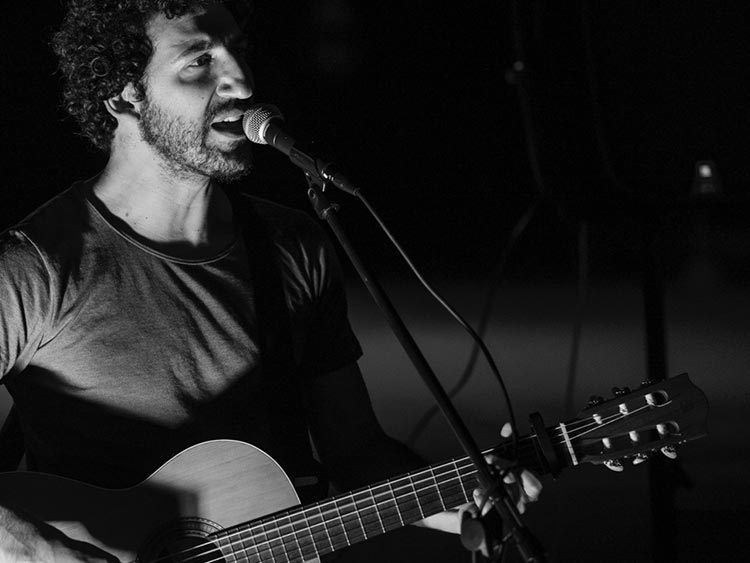
O: For the whole acoustic drum kit, as dynamics, SM57s. For cajóns I always use the SM91. For toms and brass, I really like the SM58. As for backing vocals, SM58s, and for Marwan's voice, the KSM8, because Marwan likes to move around when he sings and this microphone means you don't lose much signal when you move away from it; it behaves like a condenser while being a dynamic mic, and that gives him a lot of freedom.
How did your relationship with Shure begin, and how has it evolved into it becoming your preferred microphone brand?
M: It started at my first concerts. All the mics were SM58s; then I got to know some BETA models and I've sung with them hundreds of times. A few months ago they told me about the KSM8. They told me it was the perfect mic, because it lets you sing farther away from the mic, like a condenser, but it doesn't have as much feedback because it's dynamic, and it reduces feedback on stage at high volume. I like to hear myself loud and I don't usually use in-ears, so I've often had feedback problems because of the high volume. With this mic they've been completely solved.
O: When you start out in this profession, you work with whatever you're given. As you train your ear and learn what your needs are for each situation, that's when you ask for the best for each one in your technical riders. Shure always has a solution for every live show.
Marwan, what do you think of Shure as a supplier for singer-songwriters?
M: I think it's a great advantage. Singer-songwriter music, compared to other kinds of music, places paramount importance on the lyrics. If they can't be understood well, it loses part of its value. So a major microphone brand supporting singer-songwriters can only be good news. In my case, I'm happy with the support I've received, and I wouldn't be surprised if other fellow singer-songwriters wanted to join in.
Do you use, or plan to use, wireless monitoring systems for your live shows?
M: I haven't used them much, because I like to hear the room, but the truth is that we're using them more and more, because you often come across bad monitors in clubs or theaters, and a good pair of in-ears is a lifesaver. Besides, they make the experience as a singer more exciting, because you hear yourself infinitely better.
O: Whenever I start working with a new artist, the first thing I recommend is using in-ears. Shure has a very wide range of prices and quality levels for every case. In Marwan's case, we're starting to use them more and more.
Marwan, what message would you like to pass on to people who are starting to express themselves through their songs?
M: To write what moves them and to enjoy it. That's the most important thing. Doing what moves you is success. 11. And you, Oscar… what message would you like to pass on to people who are starting to work as sound engineers?
O: I don't really like giving people advice. What I can share with all engineers is that the only secret to becoming more competent every day and making your work sound better is to study a lot and work hard. It's a profession built on experience, and experience comes from working a lot.


