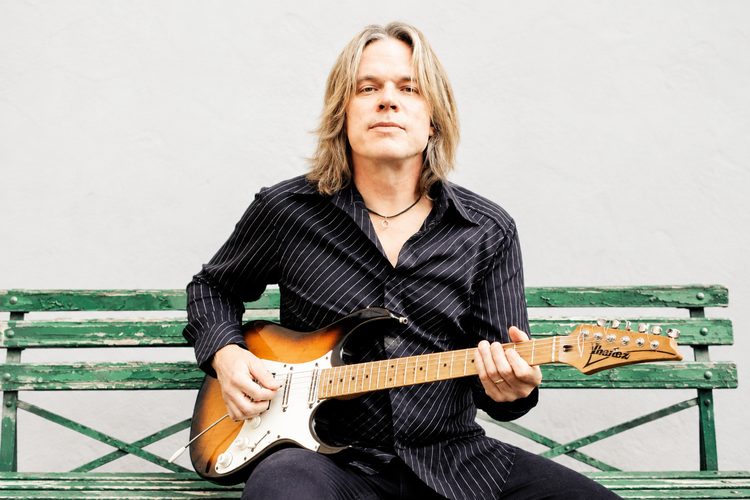
He talks about it like a girlfriend: “The guitar is there, waiting for me....” He and his instrument are one. “Every time I pick up a guitar it's as if it were the first time”... Enough to make you blush. Javier Catalá doesn't go on tour; he takes his guitar on tour, and with it on his shoulder he has traveled half the world accompanying major artists on the national and international music scene: Miguel Bosé, Alejandro Sanz, Ricky Martin, Antonio Flores, Marta Sánchez...\nJavier Catalá is a musician who dares. With an energy that radiates from him in every direction, he never tires of telling how much he has been enriched by working on such different projects with such disparate artists. He is now preparing a personal project, a musical proposal he has been developing for some time, without hurry but without pause, because he knows that's how good things are born. Still in the demo phase, he is maturing it live, performing solo on stage. Searching and finding himself...
And he combines this with recording sessions as a guitarist and arranger at PKO studios, working as musical director for Andy & Lucas and touring with Rosana, with whom he has just returned from the Americas. This musician, who has played at places like New York's Madison Square Garden, feels good and secure in a profession in which, according to him, the important thing is to keep your feet on the ground even when you're flying. He has led bands on some tours and knows well what he's talking about. Touring and traveling are two of the aspects of his work he likes most. And if by traveling we mean moving, getting around, advancing, Javier Catalá must be very satisfied. There are few countries left for him to visit. And wherever he goes, his guitar goes with him, no matter whether it's a plane, a studio or a stage. Wherever they are, as long as the two of them are there, it all ends up being one big party.
How does a guitar fanatic become a coveted session musician?
Every time I pick up a guitar it's as if it were the first time; I don't even think about it, but it's a very pleasant feeling. I think it's the secret to keeping your motivation alive. Over the years you discover the universe contained in those six strings, and you realize you're becoming more and more of a guitar fanatic... Whether recording in the studio, on tour... or on the sofa at home.
What path must a musician follow in order to grow?
It all comes down to training, talent and the experience you gain. Nothing comes by itself; perseverance, enthusiasm, vocation... are the foundation of any musician. Being a musician is a lifestyle; when you grow as a person, you grow as a musician.
What do you think of the term virtuoso? How do you handle the balance between expression and speed/technique?
Virtuosity, properly understood, is a wonder, but it's unbearable if it's just a show or a display of ego. There are incredible musicians who shy away from virtuosity and other, less incredible ones who get tangled up in impossible scales trying to prove, who knows what... On the scale of expression versus speed, without hesitation I go with the former; music is expression, and speed will either let you express yourself or not, but it will always be secondary.
People often confuse technique with speed, virtuosity with thirty-second notes. There are many more aspects that establish a guitarist's standing. In your eyes, what are they?
Daring to look inward, projecting it outward and seeing what happens. And correcting yourself. The guitar is there, waiting; it's like a mirror. The intimate bond you end up having with the instrument is incredible. It's a wonder.
Our friend Pedro Barceló wrote an interesting article he called “Being a Drummer and Yet a Musician.” Do you perceive a difference between an instrumentalist and an artist, musician or creator?
Pedro Barceló is an excellent drummer and a great musician. There's great irony implicit in his remark... Because the two don't always go together: being an instrumentalist doesn't mean or guarantee being a good musician, or an artist, or a creator. Being a musician goes beyond mastering an instrument's techniques. As for the line that separates good from bad, everyone draws it where they like, but I sincerely think there's a bit of a lack of honesty in this regard.
How do you cultivate a complete musician (teachers, listening a lot, being humble, acknowledging mistakes, knowing how to value others...)?
Of course, I have no idea, let alone the formula, but I do know how to recognize when a musician is one by right and with a capital M, and when not. Certainly, humility, humanity, honesty, training and information, as opposed to the arrogance and vanity of an ego fattened on applause, make the difference.
What do you think of the term mercenary applied to a session musician?
The term mercenary is, in principle, derogatory. A mercenary, originally, worked for money regardless of his ideals, especially in wars; they were soldiers who sided with whoever offered the greatest benefits. In any case, and from any point of view, it is pejorative.
It's absolutely legitimate to record anything from a bolero to a heavy tune, as long as you master both styles. I imagine that in a different era, when it mattered a lot to defend or champion a particular aesthetic or style, it was frowned upon for a guy with long hair, covered in tattoos and earrings, wearing leather pants, to play a swing tune.
The important thing is to be honest and get involved with meaning and consistency in what you do. Personally, I think the mercenary thing is nonsense.
Can you feel the economic crisis on stages and in studios?
The crisis is felt, of course. Expenses like buying a record or going to a concert are avoidable, unless the record is downloaded from the Internet or the concert is free. It's a problem, because both the record industry and private concert promotion are disappearing. On the one hand, we're suffering a global crisis that affects everyone, and on the other, the crisis in the sector affects record sales, which directly hurts studio recordings, budgets and so on. The big companies don't generate the money they want and compete with very low-cost productions, which are the only ones that are economically sustainable, but whose resources are smaller and results worse. And although it apparently seems good enough to the consumer, they leave larger studios high and dry, with no return on their investment. We have to find a formula and recycle the system... The current one is finished.
At what point do you decide to divide your career between your own projects and other people's projects?
From the beginning. Devoting yourself to music and making a living from it is not easy. Not for nothing, once or twice in some country I've had to hear: “...being a musician is fine, but what do you do for a living?” You can't always keep personal projects going as your only option, and working on other projects enriches you a lot musically and lets you learn and grow, as a musician and as a person.
Some musicians don't want to work with certain artists. Do you think it's pride, or do you think the image of certain artists can indeed damage your career?
I don't think an artist can damage your image, but I do think that when choosing or accepting a job you're getting very involved; you're going to devote your time and your profile as a musician to that artist, and that deserves some thought. You have to feel comfortable. Everyone makes their own way.
Speaking of your projects, what do you have in the works?
I'm always turning that over in my mind. It's very hard to carry out an instrumental project that's profitable, and you don't always have the time and resources to devote to it. In the end you wind up taking care of the commitments that come up. I have an absolutely personal project in the works, the fruit of my most private self (I can't think how it could be more personal). I'm going slowly; I'm in no hurry. Little by little it's taking shape and, to my surprise, defining itself: I'm mixing harder-hitting instrumental tunes with completely acoustic tunes with vocals. For the vocals, I'm counting on collaborations from singers I have a very good relationship with who are joining the project. I feel more comfortable with the instrumental tunes, and that gives me the confidence I need to venture out and take far more risks... I let myself go.
What personal/musical evolution have you experienced across your own recordings?
Evolving, in general, makes you a better person and a better musician. Every time I go into the studio and record one of my tunes, I'm aware that the result is defining me, and over time I'll think I could have changed this or that... but it's better not to go there. Each recording reflects a particular moment, and that's that, and sometimes you surprise yourself.
Is there a tour? Where can we see you live?
I've just come back from a month-long tour of the Americas with Rosana, which took us through Mexico, Argentina and Chile, covering much of their geography. It was a fascinating tour, a pleasure. And now, at the beginning of the year, we're starting the Andy&Lucas tour of Spain. I've been working with Andy&Lucas for some years and it's a joy; we're like family. I alternate this with one-off concerts with my personal project. On my website ( www.javiercatala.es) you can see the concert dates ahead of time.
What characteristics do you think make a guitarist stand out?
Their playing.
What do you think defines your style?
My playing.
What do you ask of a guitar? And of an amp?
It's amazing how the same guitar can sound so different depending on who plays it... and I'm not talking about better or worse, though that too, I'm talking about different. About how much pressure you put on the pick, how you use your left hand and, of course, how you mix pickups and effects, although curiously the same happens with an acoustic guitar played bare.
As I said before, a guitar is like a mirror; it projects what you give it. Right now I use Music Man guitars; I feel they fit me like a glove, for their size, sound... Everything seems to flow on their necks. As for amps, I use Vox AC30s for their warmth and quality. An amp should have that mix of cleanness and grit that gives a warm sound, so you can add effects afterward without losing that quality. I also like the power of a 4x12 cabinet with a good head, straight in. In the studio, I always record straight in, without effects. I usually record at PKO studios and La Casa de los 1000 ruidos.
Could you name some musicians who are references for you?
Pat Metheny, Mike Stern, Scott Henderson, Jeff Beck, John Scofield... And, in more of a rock context, Steve Vai, Eddie Van Halen, Ritchie Blackmore, Santana, Jimi Hendrix... Just naming guitarists, and only some of them. The list would be endless.
What does a band need to sound powerful?
Listening to each other. It sounds ironic, I know, but the opposite happens more than it seems. Some musicians play without caring much that they're not alone or that the world doesn't revolve around them, stepping on the others musically and causing an anarchy that keeps a band from sounding balanced. It's essential to be clear on everyone's role, to look for the sounds, the balance, the volumes... and to respect one another. A band can be three musicians or ten, and obviously that's very different. Each musician has to know what his function is. I've led bands on some tours, and I've always kept all this firmly in mind.
What do you think about the importance of simplicity?
Well, that often less is more. Simplicity is very transparent; it strips you bare. Playing something simple that is also complete is hard, but that doesn't make the opposite any worse. As almost always, virtue lies in balance.
Inspiration or work?
Much has already been written on this subject. Without a doubt, I stick with Picasso's maxim: “If inspiration exists, let it find me working.” I think it says it all.
Finally, we leave our usual space for you to freely offer your advice and comments to everyone reading you right now. The artistic life is complicated, and sharing experiences helps us feel motivated to fight on.
I'd like to finish by offering a bit of optimism to all of us who work in this music business. It's true there are moments when you question everything, but I always come to the conclusion that we are very fortunate. Music is a vocation, and being a musician is a way of living. It's worth taking your guitar to all kinds of stages, from Madison Square Garden to a dive in a Mediterranean coastal town, and keeping the same spirit. When I was starting to play, I read with admiration one of my idols say that one of the things that fascinated him most about going on tour was getting to see the world, and I was thrilled to imagine that one day I might travel around the world with my guitar on my shoulder. A dream I fulfilled a few years ago on a world tour. As time goes by, you accumulate experiences that fill you at an existential level, I'd say. And it's worth it.
The ISP roundtables among musicians would have been incomplete without you. Thank you so much for sharing your great experience and career with all of us. On behalf of all our readers and the ISP team, thank you.
I want to thank the whole ISP team for the invitation to take part in this interview. It was an honor.
Photo: Fran Santander