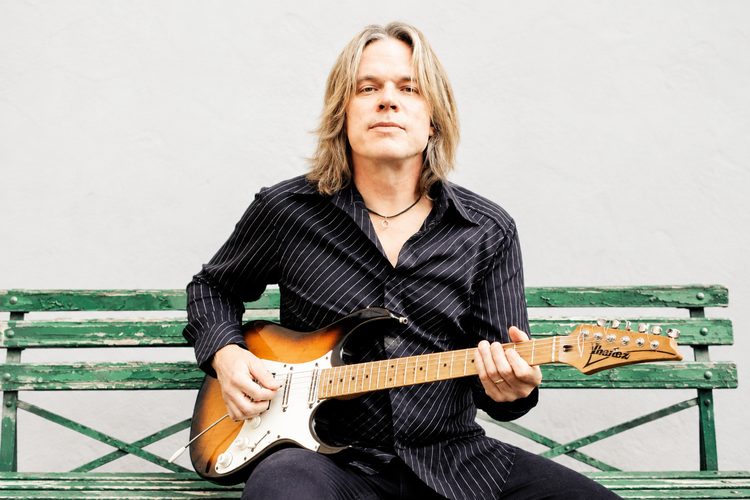
While the rest of us drank milk, Dominic Miller, as a child, drank music. He grew up with it, and he will stay with it for as long as he can remain in this world, because, for him, creating music and breathing are almost the same thing. This Englishman born in Buenos Aires combines a lifetime of guitar playing alongside Sting with his solo albums, which he dotes on as if they were his own children (he has six of the latter, one fewer than albums).
He has earned his reputation with strings the hard way. With talent, with work and with a great capacity for adaptation vouched for by artists such as Phil Collins, The Pretenders, Tina Turner, Paul Young and many others with whom he has recorded around 200 albums.
Besides playing, he also knows how to travel, compose, write and speak in absolutely musical terms: “Being a composer is a bit like being a magician or an illusionist. You create images in other people’s minds and then you surprise them.”
We hope to see him working his magic soon. We’re eager to hear live how his guitar breathes…
When did you start playing guitar?
I started playing when I was eight and, a bit more seriously, at 15. I come from a musical background. My sister taught me to play. My father sings blues and tango, and my mother is a pianist. But I’m the only member of the family who does it professionally.
Is it a profession or a state of being?
It’s a necessity.
Do you believe more in inspiration or hard work?
Inspiration is a luxury, but if you don’t work hard, inspiration doesn’t come. I think I trust hard work more.
How did your relationship with Sting begin?
The producer Hugh Padgham introduced us after I worked with him on Phil Collins’s album But Seriously. I auditioned in New York and he gave me the job. It was 1989. I’ve been with him ever since.
And how do you manage to balance your solo career with your work with Sting?
Each needs the other. Without Sting I couldn’t do my own work; without my own work, I couldn’t do Sting’s. It’s important for him and for me that I work with the band, and also on my own.
What is it like working with Sting? Do you follow any routine?
Not necessarily. But we do follow a work ethic when it comes to the strings. We both like to try different possibilities and then go for it.
More than 1,000 shows… and I suppose in front of thousands of people every time. When you get to this point, do you go to gigs like someone going to the grocery store?
Not at all. For me, every gig is like it’s the first and the last. The size of the audience makes no difference at all.
How would you define your records?
Instrumental moody fucker music.
Would you say there’s a clear evolution across your seven albums?
Not really. It’s the same person, the same vision and the same influences. I think I’m getting better at arrangements. But my records are like my children; I possibly couldn’t pick a favorite: they all make sense together and separately.
When you play electric guitar, what differences do you feel compared with acoustic?
I consider them very different, and I find many differences among electric guitars. When I play an instrument, I get the best sound that can be gotten out of it. I think I feel more comfortable with the acoustic, but I love playing electric.
And right now, do you have something in the works?
I’m in the process of finishing a new album. Vinnie Colaiuta on drums, Jimi Johnson on bass and my band.
Will we be able to see you in concert in Spain?
With Sting, very soon. With my band, next year.
What are the differences between your tours with Sting and your solo tours?
Logistics. With Sting I travel by private jet, sleep in five-star hotels and we make a ton of cash. On my tours we get around in a camper van, we have no staff and there’s very little money left after paying the band. But once I’m on stage, I make no distinction. My commitment to the music and to the people I work with is always the same.
Do you have a favorite guitar?
Yes, my Yairi Torres nylon-string acoustic-electric.
What do you look for in a guitar?
Intonation, reliability and lack of personality.
Do you usually share the same musical vision as the musicians you’ve worked with?
Yes and no. But that’s the wonderful thing about working with people.
Apart from the great musicians you’ve worked with, which other artists have influenced you?
Egberto Gismonti, J.S. Bach, Hendrix, the Beatles and many others.
The music business has changed enormously in recent years, and so have consumers. In the 20 years you’ve been touring, has the way audiences approach music at concerts changed too?
Not at all. Live music will always be alive and will always be real. There’s no trick to it.
Do you have any advice for budding guitarists who still have a long road ahead of them?
Yes: open your ears wide to all kinds of music and practice and learn as many styles as you can. That’s when you’ll find your own.