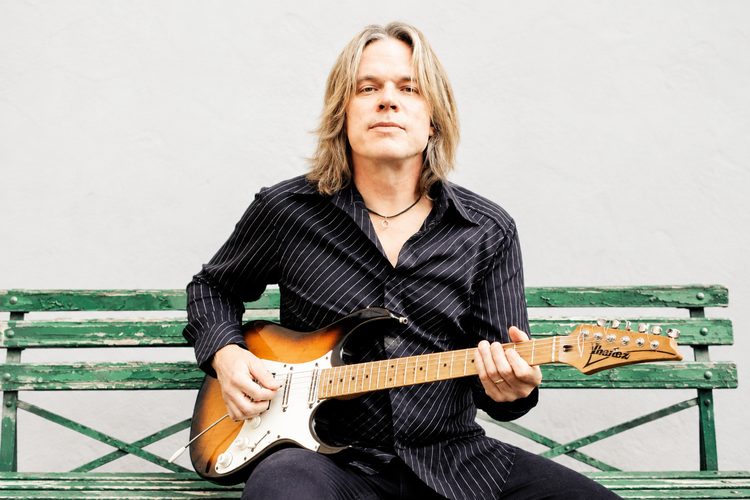
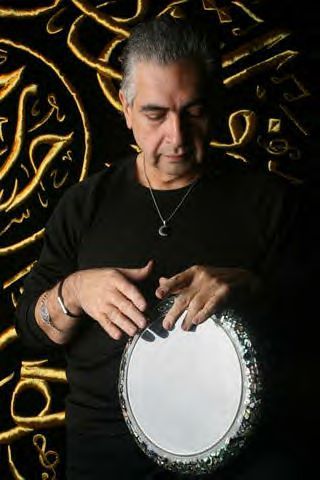
 When talent, dedication, work and effort come together, there is a great chance of success. A success that our guest has managed to achieve and use masterfully to shape his style, his music and himself.
As with many great artists, humility and calm are his hallmarks, something that elevates his quality as a musician and his unrivaled skill as a performer. We are talking about someone who has worked with names as big as Peter Gabriel, Robert Plant, Jimmy Page, Khaled, Rachid Taha, Faudel, Youssou N'Dour and Chick Corea, and who has adapted to a wide range of styles, working as a session musician for major pop stars such as Shakira and Ricky Martin, among others. But the relentless development of his work has also led him to release and produce other important names on the music scene, and to carry out his own projects, where we can find excellent internationally renowned artists.
As a musician myself, it is a true pleasure to have the opportunity to chat with this master, and I want to thank everyone whose efforts made this possible.
Without further digression, and welcoming this master, I invite you to sit down and listen with all your senses to Hossam Ramzy.
Where does your passion for percussion and your love for the darbuka come from?
I don't really know. I remember that when I was little, one day I heard an Egyptian tabla and fell in love instantly. I knew deep in my heart that this was what I wanted to do for the rest of my life. And I am doing it. From then on, I started playing and making rhythms on any surface I could find. It's a beautiful obsession; to this day I am still putting rhythms together in my head.
Who were your main influences and teachers?
Phew! Answering that would take me hours. I like all composers who make music from the heart. I could start with my mother; she was one of my first influences as an artist. She was a pianist and also played the oud, and I used to accompany her while she played. Then, of course, the great Om Kolthoum, who is the brightest star in the whole Middle East, followed by artists such as Mohamed Abdul Wahab, Farid Al Atrash, Sheikh Zakaria Ahmed and Mohamed El Mougy, among others.
From the Western world, Peter Gabriel, Miles Davis, Chick Corea, Jorge Pardo, The Mahavishnu Orchestra and Weather Report, for example, have had a great influence on me; the list is endless. As teachers, Peter Gabriel, Chick Corea, Mahmoud Hammouda and Abdel Rahman Mana have undoubtedly shaped my style.
What was your experience with the Bedouin tribes of the Middle East like, and how did it influence you?
The first time I came into contact with Bedouin tribes was in Saudi Arabia in the late '60s. It is incredible how the land is part of their lives; they live it, love it and take care to understand the language of the nature around them so they can be fully part of it. All of this is reflected in how they behave toward one another. Their rhythms are meant to be played in a group, not as soloists; it's almost like a family activity. One person's rhythm is part of their companion's rhythm, and together they form the rhythm of the land. So when they play together, life vibrates harmoniously. That vibration makes you feel great instantly; it's very addictive.
After settling in the United Kingdom and starting a career as a jazz drummer, what made you go back to your roots and delve into the world of percussion again?
In Egypt, and throughout the Middle East in general, you can feel the effects of the musical globalization and Westernization that have been taking place in every corner of the planet in recent years. I felt like a victim of this, as did other Egyptian composers. Popular music began to imitate the models of music stations and channels like MTV, for example. Everyone started doing R&B. Jazz motivated me more than the blends local artists were making. Jazz was more musical and rhythmic. What I discovered abroad is that in the Middle East we have our own blues and our own repertoire of surprising, personal rhythms that came from Africa. It's as if I had to go abroad to realize what I had at home! It was amazing to realize that in the Middle East we have percussion sections comparable to African, South American or Indian ones. It was like coming home; there was no need to keep searching.
Having collaborated with artists of the stature of Peter Gabriel, Jimmy Page, Robert Plant and Sting, or more contemporary pop artists such as Ricky Martin and Shakira, do you consider yourself a multidisciplinary artist, without prejudices or musical barriers?
Why should an artist object to working with other artists? The idea is to create music and make something special, regardless of the type of collaboration. It's an honor to have had the opportunity to work with such talented people and to learn from them; it's a way of enriching my music too. I hope to keep doing it, and I would love to collaborate with more Spanish musicians and singers.
Which of these artists have you felt most comfortable with? Can you tell us a funny anecdote about any of them?
I have felt very comfortable with all of them; we are like a family united by the music we create. One of the best producers I have worked with, and still work with, is Steve Hillage. He takes care of producing the "Western" side of the music, while I handle the Arabic strings and percussion, as we have done on some albums by Rachid Taha, Cheb Khaled and Chonchi Heredia. One day, while recording an oud session, he turned around and blurted out: "The oud is goooooood." We got the giggles, and it has stuck as one of our little catchphrases.
Do you think the fusion of rhythms helps spread tradition, or does it simply bring it to an end?
I think that, deep down, it helps spread traditions and culture. People love rhythm; it can change your mood, and you can feel the groove. Many major Western bands have used Middle Eastern rhythms. And not only that, they have also delved into the culture behind them and the reasons for those rhythms. For example, look at Robert Plant and Jimmy Page of Led Zeppelin. One of the reasons for their success as a band is that they traveled a lot and learned the music of other cultures such as Morocco, Egypt and India. They delved into those unusual genres and, from there, created songs in their own style. And the other way around too: the use of Western rhythms and musical styles has helped spread Western culture and the languages associated with it, also fostering mutual understanding and tolerance. I firmly believe in fusion. However, it's not about fusing for the sake of fusing; I believe you must learn and understand why you want to add a sound to your creative work. Before you start fusing, you must thoroughly understand the elements you are trying to fuse.
One of your latest projects was the release of the album Sabla Tolo III. It has a track called Rhythmic Illusion, where you combine ternary and binary subdivisions, as well as uneven accents. How do you approach this kind of composition? Do you use any special technique to group the various accents within the rhythms?
Ha, ha, ha, ha! I see you have listened to the album in detail! Rhythmic Illusion represents a style I learned from Chick Corea, who is a master of rhythm. The basic idea is to make people believe the musicians are shifting away from the main rhythm, when in fact that isn't happening. This works as long as you keep the same sound in subdivisions of 6 or 4. I also did this on the song "Khatwet El Ghazala" from my album Faddah: I composed a section in 17/4 (combining 9 and 8), which is what the melody required, but at the end of the song I adapted the same melody so it could fit into a 4/4 or a 2/4 over the malfuf. How did I come up with this? No idea; I guess I'm a rhythm nut. There's no logical reason behind it. I'm sure some scholars could sit down and analyze it, but the truth is that all I did was make sure it flowed musically and reached the heart. Also, I have to think about belly dancers; the music I make has to make them dance. It's not about showing how complex I can play or how many beats I can play… It has to reach you, that's all.
After so many and such varied collaborations, can we say that your percussive language is universal, or do you simply adapt your personal style to each project you take part in?
Both. I think it's because I try to adapt my personal style so that it harmonizes with the music I am invited to play on. That's what makes it fit well. I have to be part of the music and bring creative vision to the rhythm section. Too much is tiring and too little is boring. There is a place for every sound and a place for every percussion instrument.
You worked on Chick Corea's album The Ultimate Adventure, which features Carles Benavent and Jorge Pardo. You have also recorded with flamenco guitarist José Luis Montón and Rafa El Tachuela. What has your experience with flamenco been like? What does it have in common with traditional Egyptian music?
Mmmm… Flamenco is my secret passion; I love it. I have been listening to it for years and it always evokes for me the strength and delicacy it has at the same time, the emotions behind it, the movement of the dancers and their interpretation of the music… I'm simply crazy about it. I won't explain the origins of flamenco now, but the Arab occupation of Spain for more than 700 years brought many rhythms, particularly those in 6/8 or 2/4, as well as scales and quarter tones. I love it when they sing and use the Arabic scales of Hijaz, Nahawand, Rast or Bayati. It's a delight. Spain's later occupation of South America led to new fusions with indigenous rhythms, and these in turn mixed with Afro-Caribbean ones, giving rise to new genres. That's one of the reasons why rumba and salsa are so popular in the Middle East!
What I did with these Arab flamenco albums was reach out my hand across the seas and say a big "Hello, it's great that we share this part of history." I am very surprised and happy to see how quickly it has developed, and I hope to do more in the future. But mixing all three styles together as I did with Chick Corea was the greatest thing that could happen. Working with Carles, Jorge and Rubem Dantas was great; they are incredible artists.
What are you currently working on, and what are your most immediate projects?
I have just finished an album with my dear friend Phil Thornton. It is our fourth album together in a collaboration that began 17 years ago. It will be released on the ARC Music label this year. On my website, or by joining my mailing list, you can follow everything I do, see the releases or download some tracks for free. After that, I am going to complete the production I have been working on for the last ten years. It's an album on which I have invited some of my best friends, such as Billy Cobham, Manu Katché, Omar Faruk Tekbilek, A R Rahman, Jimmy Waldo and a few more… with compositions like the ones I mentioned above, where you feel the time and the rhythm, but it's the melody that goes straight to your heart.
You will be in Barcelona from November 19 to 21, teaching and performing with your wife Serena, one of the best belly dancers in the world. To what extent does a belly dancer need to know Arabic rhythms?
Thank you very much for that compliment; I'm sure my wife appreciates it. As for your question, I will answer with another question: how important is it for a flamenco dancer to know flamenco's own rhythms?
How do you hope to improve the dancers' skills during your master classes?
By teaching them to interpret the music. At our school, the Drumzy School of Egyptian Dance, we believe that dancing is an extension of the music. My philosophy is this: The art of Oriental dance is to visually hear the music. It's a motto that appears on many of my darbuka albums. The dancer must interpret the music with her movement, not just make pretty steps to the right and left while the music goes somewhere else. The best compliment you can pay a dancer is "how well you interpret the music!" And, in turn, it's the best gift a dancer can give the audience. They can see what they are hearing!
What sets you apart as a teacher from other teaching styles?
My wife and I have developed a method for training dancers who are able to merge with the music and learn the codes of all the music they dance to, rather than simply teaching choreographies.
Thank you very much for granting us this interview. We hope to see you in our country more often.
Thank you very much for giving me the opportunity to join your readers.