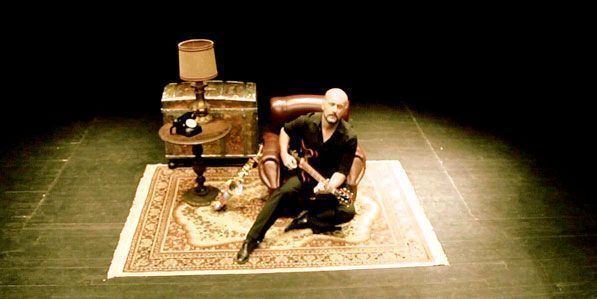
On the occasion of Pedro Andrea's latest album, just released, which compiles his best work throughout his career, we took the opportunity to continue our conversation with him. A virtuoso, creative guitarist with great sensitivity who deserves all our respect and friendship, and whom we regard as one of the role models that those of you who are approaching this instrument, the guitar, should keep in mind as a reference.
What musical evolution can be seen throughout your career as a guitarist and composer? When you have the chance to look back over years of your own work, you must feel hundreds of things, as well as recall the feelings that led you to compose the songs. For me, recorded creations are like a personal diary. What does this latest compilation album, which spans so many years of work, reflect?
Given that my training is almost entirely self-taught, my pace of development has been slower in terms of accumulating knowledge, versatility in styles... than it might have been had I learned under the guidance of teachers. However, having had so few sources of information to draw on has forced me to develop my own. I don't mean to say that formal training is dispensable. On the contrary, I defend its importance, because thanks to it a musician's work can be the result of artistic choices rather than technical limitations. However, I also recognize that someone who has no outside sources to fill their bag of resources is forced, out of necessity, to activate their imagination and creativity to generate them. I suppose developing these abilities is the advantage a self-taught musician can sometimes have over an academically trained one.
My progress as a guitarist and composer across the four albums compiled in this latest one ("Lo Mejor de Pedro Andrea") is clearly evident in each and every one of them. Perhaps not only my evolution but also my regression, because I have to admit that "Heart Art," my third album, is much more primitive in terms of the rawness of the sounds and the simplicity of the compositions than the previous one, "Tierra," where harmonic progressions, meticulous arrangements and clean sounds were my main goals. Even so, "Transparente," the first one, was an album crafted with special emphasis on guitar solos, to the point that it includes tracks such as "Sin Respiro," in which the search for innovation is evident in every note; if not as an achieved goal, then, I confess, certainly as an intended one.
On the fourth, "Vapor Blues," there is hardly any time invested in rational, cerebral composition. On the contrary, it is an album recorded almost entirely in first takes, with one hundred percent room for improvisation in the solos. Liberties I allowed myself because it is a blues album, where spontaneity is perhaps not just a right the style grants. As I see it, it's almost an obligation.
2. While sharing the general idea that what matters most is creativity, imagination and perseverance in improving technique, our tools of the trade, the guitar, amplification, etc., carry weight too. Which instruments and amplifiers have accompanied you, and which of them can we hear on the album?
As for instruments, I admit that whenever I've been able to customize the instruments that have passed through my hands, I've done so without hesitation. I suppose my goal was to make the sound I heard in my head ring out in the air. Even so, I've worked for certain companies whose guitars, amps... have left me with very fond memories. In particular, a Yamaha hollow-body guitar (a model similar to the Gibson 335) that I'm holding on the cover of the album "Transparente," and on which the song "Sin Respiro" was recorded.
Another one I'll always miss (it's now in the hands of one of the best guitarists I've ever known, my great friend Sezar Blue) is an Ibanez 540-S. I played with Santana and recorded my first three albums with it. Like most of my instruments, it underwent various modifications, with changes to the circuitry, a Seymour Duncan SH4 (Jeff Beck model) in the treble position and an old Ibanez model in the bass position. I never used the middle pickup except to switch it with a single-coil in the treble position.
Fender's influence has always been present throughout my career, specifically the "Strat," a guitar whose sound I've always tried to get close to, seeking its clarity in every brand I've used.
One of the times I came closest to achieving my sound was thanks to the Heart Art company, which designed a model (Pedro Andrea Signature) to my specifications. On that occasion, too, I opted for Seymour Duncan pickups.
As for amplifiers, I was especially happy with some Line 6 models, a vintage-style one from Crate, a 50 W Laney model and, very particularly, a model that the Sinmarc company (Pedro Andrea Signature) also designed to my requirements, thanks to which I was able to reach levels of identification and comfort with my sound that I had rarely known before.
3. The work of those who surround us in the studio, who help and accompany us. When we record, the richness other musicians bring is essential for dozens of things: dressing up and expanding the ideas we've conceived and, in many cases, even learning from how others conceive our songs. Which musicians would you highlight among those who have recorded your songs?
Thirty-five musicians take part in this latest album, which is not at all strange for a compilation that, through its 22 tracks, reviews my entire career. Among them we can highlight the incredible Alfonso Pérez, whose infinite sensitivity and delicacy I would single out, not to mention his mastery of such complex matters as arranging and composition. Among the drummers there are truly great players, such as Ángel Celada, Angee Bao, Ángel Crespo, Manu Rey and David Hyam.
Although this album includes songs on which, apart from the guitars, I play bass or trumpet, there are bassists of the caliber of Javier Quílez, Billy Villegas, Mikel Irazoki and my great friend Oscar Morgado, without whose help I couldn't have recorded any of the albums that make up this latest one, because thanks to his effectiveness, mastery and indisputable good taste in fields as diverse as production, recording, mixing... I have been able to carry out my work.
On percussion I was lucky enough to have truly great players such as Yuri Nogueira, Juan Carlos Melián, Gino Pavone, Manuel Gutiérrez and Tino Di Geraldo.
In some songs we find doses of romanticism that, thanks to violinists as incredible as Diego Galaz, could be portrayed with total accuracy.
On keyboards we find great names such as Basilio Martí, Rafael Rubio, Kaelo del Río and Iñaki García, to whom I owe a particularly deep contribution to the arrangements of some songs, especially the strings, a field in which I count him among my favorites.
Although the album is entirely instrumental, it includes vocals on some songs. I especially highlight the role of Helen de Quiroga, singing a "Doctor Feelgood" that leaves anyone who hears it glued to their seat.
Among my favorite trumpet players there are two I especially single out: one is Pochi and the other is Angelo Manchini, to whom I owe some of the most melancholy and moving performances on the album.
I wouldn't consider my answer to this question complete if I didn't give due importance to one of the elements that, together with the musicians' contributions, makes it possible to record an album. I'm talking about the studio. Although there have been many throughout my career, I especially highlight the comfort and reliability of the studio where this album was mastered and where the two bonus tracks were recorded. I'm referring to Idemm studios.
4. In terms of evolution and career path, this album is especially appealing for appreciating your creative and technical journey. How has your technique been refined over the years, and how have you rounded out your style across all these albums over time?
From my very first album I began to take an interest in matters related to right-hand technique, often going so far as to do without a pick, something I tend to use more in my career as a session musician for various artists.
You could say that in the beginning my goal was to approach the sound of slap bass on the guitar. That's why my early performances were more percussive and faster than they have become over time. Time in which I've ended up more interested in the ability to put technique at the service of simplicity than in showing off my skills.
5. A question I often ask myself and like to share with those who may feel things similar to what my musical soul feels regarding the rewards of creativity. Given how hard the work is and how tough this "little world" is, what motivates a musician to keep going? Where do you find the strength? Love of music? A way of life?
I think there is a question with destructive effects that a musician should never ask: "What for?" I think that if the many failures anyone fighting for a goal goes through affect their spirit and their drive to create, wearing them down until they're gone, it's better to learn to get back up, since sooner or later falling is inevitable, especially if it's not a whim but a vocation that draws us to music, because we are the slaves of that vocation, not its masters, to the point that giving up and quitting will, in the long run, always make us unhappier than fighting and losing. At least in the latter case there is something that the one who gives up doesn't have: hope.
For my part, I've come to understand that it's better to look for the reward in the process than in the aftermath. Because while life may deny you success and fame as a reward for your effort, that very effort gives you hopes and joys while you undertake it. The moments when I've felt them, whether performing or composing music, are for me the reward for my work and the incentive to keep developing it.
We're delighted you "had this coffee" with us, in this space that is yours and that of everyone who gives their all for music. Thank you, Pedro Andrea.