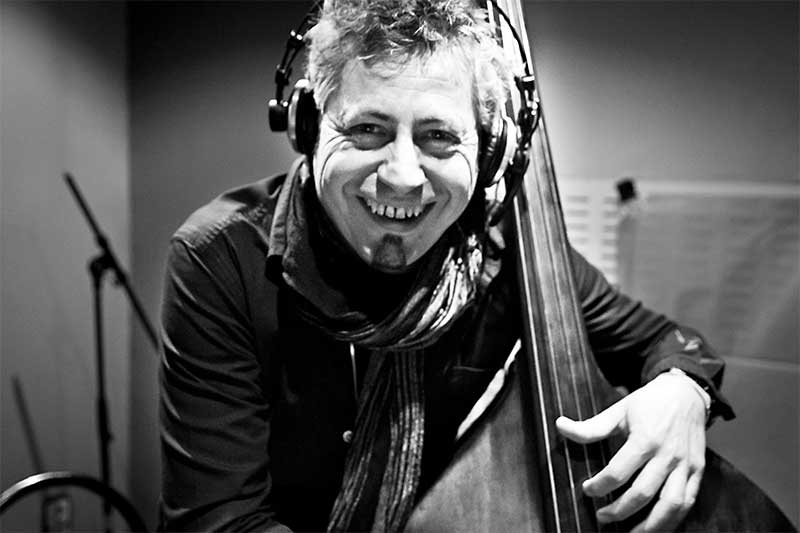
"When I began the adventure of devoting myself to Drums and Percussion, back in 1976 (I was thirteen at the time), I never imagined that some time later I would dedicate myself fully to this peculiar profession." During the twenty-four years I have been working as a professional, I have worked in many styles and with a wide variety of musicians and artists. Just to name a few, I have played drums in several rock bands, in a couple of funk bands, and in medieval and folk music groups (Libredón and Garnacho), with whom I made several album recordings. María Vidal and Charo Reina are some of the Spanish song artists I have accompanied on tours all over Spain. I have played a little jazz, just as an amateur; I have also been with several pop and disco bands, and among other things I took part in the Ríos de Gloria tour three years ago and, two years ago, I played with Alberto Comesaña, singer of Amistades Peligrosas, and with Hevia.
For the last six years I have worked in musical theater, playing in Madrid's most successful musicals, such as Grease, Memory, My Fair Lady and Cabaret, where I am currently playing. This has been my day job.
However, where I have spent most of my time as a professional drummer has been working in dance orchestras. The Escala Royal and Alcatraz orchestras, with which I spent sixteen years touring all over Spain, are just a couple of examples.
On the other hand, it was at the age of twenty-five that I began my formal training at the Madrid Conservatory to study Percussion and, since I had been playing drums self-taught since I was thirteen, I often "had to fend for myself" when it came to choosing which accessory I needed to buy for playing, from sticks to drumheads. It's true that the Conservatory doesn't teach you how to choose your instruments or accessories, but in addition to receiving guidance from the teachers, you have the chance to try various instruments and different gear. Also, being around other musicians like you helps you gain a better knowledge of the gear available on the market.
The approach I used most in my early days was to go from store to store and try everything possible until I got exactly what I was looking for, although I didn't always get the final decision right. On some occasions, either because the salesperson insisted that a particular accessory was just what I needed or because of my lack of experience, I came home with those "wonderful" red or blue heads instead of the ones I was looking for, thinking they would be the perfect gear for me. I would very soon discover, to my great disappointment, that this was not the case.
Of course, the information we have today is not the same as it was more than twenty years ago. That's why, after a few missteps with gear I had bought, I made the firm decision never again to buy anything I hadn't tried first and that didn't give me the result I wanted. That has been my policy ever since, it has worked very well for me, and it is my small contribution as an instrumentalist: don't buy anything you haven't tried or can't try and that doesn't give you the result you are after. Even if a friend tells you that a certain cymbal is wonderful and you should have it, or an article like this one tells you that a certain brand of heads is the most widely used, you should always ask yourself what you are really looking for, because what is being offered may not be the most suitable for your kit, since several factors come into play in getting the desired result, such as the type of music you play, the sound you want to achieve, the size of the kit or the combination of accessories such as heads and sticks.
The Kit
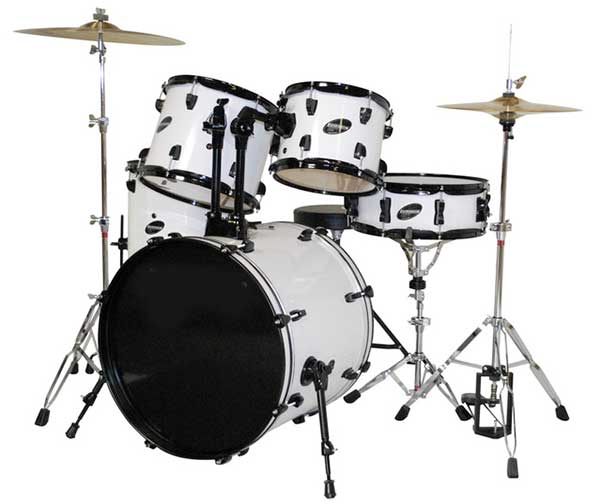
I currently have two kits that are very different from each other. The first is a Slingerland kit. According to the manufacturer's stamp inside, it was made in April 1965, forty years ago. It consists of a 20" bass drum, two toms (one 12" and one 13") and a 16-inch floor tom. The snare was a gift from a friend (a great friend, by the way). It is a 14" by 5½" wooden Gretsch from the '60s. To this kit I added a 10" by 10" Remo tom from the Encore series. Finding that tom, which ended up being the chosen one, took me several days of pilgrimage around different music stores with my 12" Slingerland tom in tow. I tried quite a few 10" toms from different brands. My goal was to find one that sounded as close as possible to my Slingerland, and in the end I chose the Encore.
The sound of my kit is very crystalline, with impressive overtones. That's why I have to be very careful in choosing the types of heads I use. If I fit heads that boost the overtones too much, it goes overboard very easily and I can't control them through tuning. In the end, the only resource I have left is to dampen it with the mufflers that rest on top of the head, or with a trick a sound engineer taught me, which consists of sticking on a little toilet paper with adhesive tape. It's like magic! But the consequence of dampening the heads is losing part of their natural sound. Whenever you can, don't put anything on them. Just don't.
The heads I now use on the 10", 12" and 13" toms are Remo Pinstripes (the classic oil-filled ones) on top. On the bottom, Diplomats, also from Remo. For the 16" floor tom I use an Emperor head, once again from Remo. The Emperor has more attack, and although it brings out the overtones a little more than the Pinstripes, it is equally true that the sound is brighter, which is why I usually use it on my floor tom. On the snare I use a medium-weight Evans head on the bottom, snare side, and on top, the Remo Weather King (the coated one). On the bass drum's front head I have used everything from Attack to black Remo heads, which are the ones I currently use. On the batter head, where the pedal strikes, I now have an Attack with a reinforced center that gives me perfect depth with a velvety sound without losing punch.
The hardware I use on this kit comes from several brands: the bass drum pedal is an old pedal with great response. It is a Ludwig Speed King. I find it curious how, after going through several models and brands (Yamaha, DW, Sonor), in the end I went back to the one I had stored in a drawer, and it is the one I usually use on this kit. The hi-hat stand is a Sonor. I like it for its sturdiness and because I find it very comfortable to play. The cymbal stands are from several brands. I have everything from a couple of Tama boom stands to some Premier stands that have to be adapted with clamps, and two straight Yamaha stands. Lastly, the snare stand is a Yamaha. The great quality of this stand is that when you set it up, it's as if you had nailed the snare to the floor, avoiding the discomfort of playing with everything moving with each stroke.
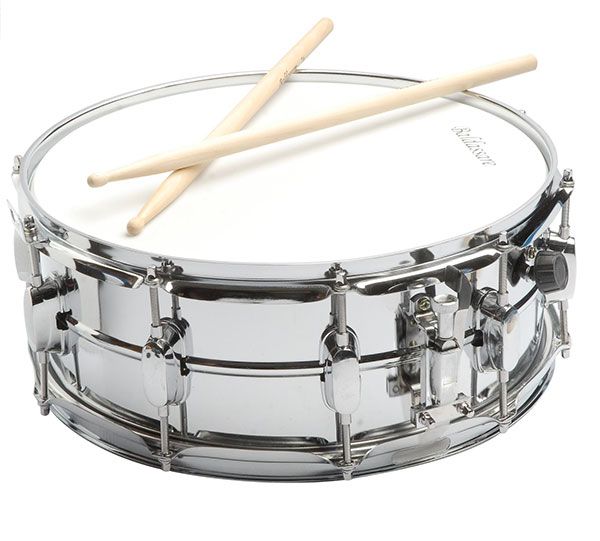
My second kit is a Yamaha from the Power V series, which I have as a second instrument. It is a mid-range kit with a very different sound from the Slingerland. It has a 22" bass drum, and its sound is considerably deeper and has more attack than the 20" bass drum. The 12" and 13" by 10" toms don't have as clear a sound as those on the other kit, but they do have much more depth. So I usually use it for playing rock or pop. The bottom heads on all the toms are Diplomats and the top ones are Emperors. The snare I usually use is a 14" by 6½" metal Yamaha from the Recording series. This snare has a lot of depth and a very big sound. The cymbal hardware is Yamaha, Sonor and Pearl, and the hi-hat stand and bass drum pedal are Tama.
My Cymbals
I firmly believe that choosing drum cymbals is very personal, just like choosing a snare. For me, the different "colors of sound" in the kit are very important, depending on the type and model of cymbals used, since they make the whole kit seem different. That's why we discuss them separately from the kits.
I have two sets of cymbals that I define as indoor and outdoor. The indoor ones are the ones I use when I am going to play inside an enclosed space such as a theater or club. The outdoor ones are the cymbals I set up when I am going to play in an open space, such as a bullring.
The cymbals I use indoors have a very fast attack and a short sound. I usually use a 16" and a 14" crash from Zildjian's A Custom series. After using the same brand's K Custom series for years, I decided to switch series because, as well as being somewhat cheaper, I found them much more durable. The 18" ride is a handmade Zildjian Avedis model that has been with me for twenty-five years. I usually use two splashes: a 10" from the A Custom series and an 8" Sabian from the AA series. This choice is because for years I used several 8" Zildjians and, since they didn't give me the durability I expected, although they did deliver on sound, I opted for a cymbal with slightly lower sound quality for my taste but greater durability. The 14" hi-hats are Paiste 2002 Classic series. These cymbals have been with me my whole life (since I was 13) and the results have been unbeatable. I have had cymbals of different brands and models, but these are the ones I currently stick with for this kit.
The cymbals I use outdoors have a slower attack but a much longer sustain, and they are thicker. I normally set up a 16" Sabian AA series crash and a dark crash, also 16", Paiste 2002 Classic model. Along with this selection I also use a 14" Paiste 2002 Classic crash-ride and a 10" Zildjian crash. The hi-hats are 14" Zildjian Avedis. To this combination I sometimes add an 18" Zildjian K series china.
My conclusions
If you are starting out and need to buy gear, start with a mid-range kit. If you keep going, it will always serve as a second instrument once you get a better one. When choosing, never buy the best or the worst: if you buy a great kit, you won't know how to get the most out of it for a while, but if you buy a low-quality one, you'll soon have to replace it.
A personal piece of advice: when choosing cymbals, always go for good ones because, unlike the drums, they last forever. It's better to buy a small set of cymbals you really like than to spend more money on more drums for the kit.
If you already have a kit and what you want is to improve some aspects of it, start by replacing parts little by little, always comparing or having a reference sound, and never looking at the brand, model or price. Just let your ear guide you.