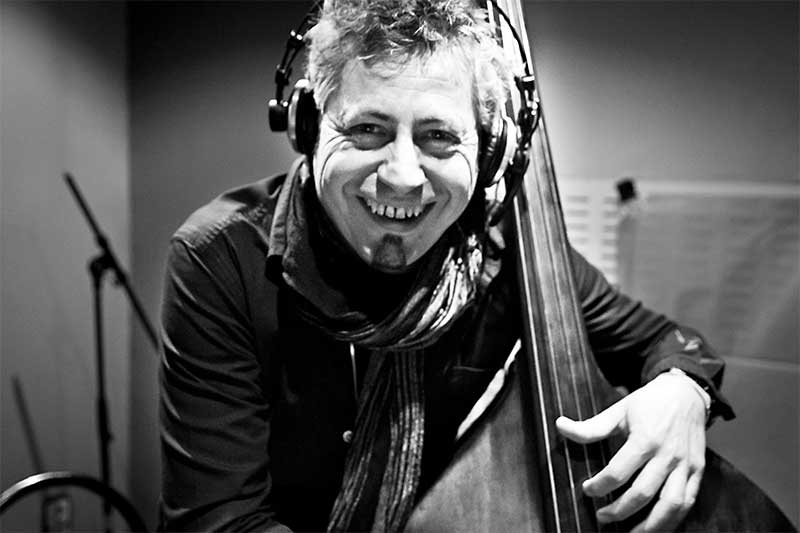
An excellent bassist, an extraordinary double bassist, and above all a musician devoted to art and to capturing new sounds and rhythms, who breaks the bonds imposed by the dictatorship of music marketing and ventures into experimenting in the territory of improvisation.
From the first intuition, from the first musical contact through study and on to the professional world, a long road opens up that many begin, some continue, but only a few finish, if it is ever finished at all. Could you tell us about your path?
That's a complex question that I'll try to answer without going on too long. When I was seventeen I was a big music fan, mainly of jazz rock and symphonic rock. I had a special fondness for the bass. Around that time I managed to get hold of a 30W Marshall amp and a Fucker electric bass, a Jazz Bass copy, which stayed with me for quite a few years.
I started taking private lessons and playing with different pop rock bands, and about two years later I went into a studio for the first time to record what would be the first album by a band called “Dinero Negro.”
It was at that point, encouraged by my teachers, that I decided to study the double bass, and also where I came to understand the difference between being part of a successful band and being a professional on your instrument.
Over the next three years, supported by my family and backed by being laid off from the company where I worked repairing computers (collecting unemployment), I began studying at the Taller de Músicos de Madrid and the Escuela de Música Creativa, where I received several scholarships and was able to devote myself fully to studying the instrument for eight or ten hours a day.
I had discovered an amazing path: jazz and the language of improvisation. Also, in a short time I was working as a freelancer with many groups on the Spanish scene, I was part of the Café Corrillo de Salamanca trio accompanying American soloists, I was hired to play at several jam sessions in Madrid clubs, and I began recording as a studio musician on both electric bass and double bass.
At this point in my career I decided to enroll at the El Escorial Conservatory to refine my left-hand and bow technique. It was a difficult time because of my age, my need to work to support myself, and the level of demand and commitment required by both the institution and classical music itself, but I managed to graduate as a Double Bass Teacher.
Since then, a few years ago now, and up to the present, much of my philosophy toward music boils down to “the more I learn, the more I realize how much I have left to learn.”
What chance do beginning musicians have of reaching the professional world?
I'd say that of course a beginning musician can reach the professional world, as long as they're clear that they're at the start of the road and that it is hard and long. I'd recommend perseverance, seriousness, and humility.
Some people like to confine themselves to specific musical styles, while others let the art flow, fusing sounds and savoring the possibilities of one and another. In your professional career you've played jazz and blues, and you've made forays into flamenco... How would you define yourself? Do you think there are real opportunities to experiment and look for new styles within the commercial tide that sweeps through the music world today?
I have tremendous respect for musicians who focus on a single style or language; I think it's a possible path, though not mine.
Throughout my career I've always had one foot in what I'd call improvised musics. Although many artists, styles, and musicians have given me wisdom, my work alongside flamenco singers and dancers like Enrique Morente, Carmen Linares, and Joaquín Cortés has greatly influenced the way I play and also the way I feel.
I'd define myself as an accompanying musician across a wide range of styles. I feel very comfortable in that position, offering my help and experience to build solid foundations. When I'm more involved in a project, I define myself as a musician shaped by the concept of improvisation and the language of jazz.
I do think there are opportunities for experimentation in music. To me, that's what makes this profession so exciting. Another matter is the total lack of support from institutions for projects that don't follow the trends of the moment or that “commercial tide” you mentioned. There are heaps of interesting works by Spanish musicians that never see the light of day for lack of resources or circuits to showcase them, which are indispensable for the public to have access to them.
As a double bassist and bassist you've worked in orchestras, in musicals like “Cabaret,” and on recordings with artists of the caliber of Pedro Ojesto, but you've also been a double bass professor at the Royal Conservatory of Madrid. What have you learned from each world? What advice do you give your students?
That's an interesting question. Any of the cases you mention is nourishing. Playing a work by Beethoven, for example, in a section of eight double basses, or any solo from one within a symphony, are marvelous experiences. So is recording as an accompanist and as a soloist in a trio. Last July I was part of the soloist quintet that recorded a work by Pepe Nieto for jazz quintet and orchestra with the RTVE orchestra. It was truly interesting how the two languages coexisted.
With my students I try to instill respect for all kinds of music and for performers with heart, regardless of technical difficulty, and I look for steady work that includes a short study of each major genre in order to work, in parallel, on intonation, technique, and pulse.
One of your latest projects was with Enrique Heredia “Negri”, on his album “El último beso,” a tribute to the Mexican composer Agustín Lara. The flamenco reinterpretation of Lara's boleros is perhaps the album's guiding thread. Lara's Mexican lyrics, Negri's flamenco voice, Pedro Ojesto's piano, Fernando Favier's drums, and you on double bass... Do you think there is room for multicultural music? What was your experience on this project?
This album was born mainly from the great work done by Pedro who, together with Enrique, gave shape and direction to an idea that seemed complex at first. But when we started working on the project, everything flowed in a surprising way.
Pedro's trio, of which I'm an integral part, as is my friend Fernando Fabier, is a group that in itself denotes the multiculturalism you refer to. You can hear the sound we're after on our latest work, “Quiero.” It basically consists of the union of modern harmony and the color of flamenco with the concept of a live jazz trio. What we did was fuse this formula with Enrique's voice and the Spanish guitar, across different flamenco palos. The recording was a lot of fun and very exciting, and I think the result reflects that.
The bass, the double bass, and the tuba are the three instruments that handle the low sounds in jazz, although the latter has nowadays been relegated almost entirely to brass bands. Going back to the bass and double bass, what does each of them bring to the jazz sound? Are they complementary, or do they mark different styles? Which of the two do you feel more comfortable with?
I think the electric bass carved its own path, especially since the appearance of Jaco as far as jazz is concerned, and gave it the jazz-fusion label. In my opinion, it hasn't stopped evolving since then and is in a brilliant moment. I keep discovering new virtuoso players who in turn bring new techniques to the instrument and therefore new sonorities.
As for the double bass, although truly incredible virtuoso players such as Edgar Meyer or Renaud Garcia-Fons also appear, I think it evolves along a different path, in which the player's melodic and rhythmic delivery, or their sound and character, are valued more.
I'm in love with both, and with every new tune I face I can't help feeling it works with one instrument or the other, but for a few years now I've felt fundamentally like a double bassist, because I believe it's the instrument through which I express myself most honestly.
Let's talk about gear now. What qualities do you look for in a double bass? And in an electric bass? What would you recommend to someone taking their first steps with these instruments?
There are two important aspects for me: sound and construction. With an electric, I look for good assembly, good woods, and not too much weight (my back complains). If I'm looking at a five- or six-string, I pay a lot of attention to string tension, especially the low B and the high C and how they relate to the other strings, with no dead notes. Once the bass is plugged in and with flat EQ on the amp, I analyze the response of the electronics. I like it to be drastic and versatile so I can shape the sound from the instrument, not with changes on the amplifier. I also think it's important to have easy access to the truss rod and bridge for emergency adjustments due to changes in temperature and humidity.
With the double bass, I think it's a bit more complicated because, although they're built to a similar pattern, there is a big difference from one to another. Ultimately I look for a noble sound with good volume, a string length suited to the size of my hand, and a good setup (this is a delicate point because it involves deformation of the instrument, if it's old, the angle of the neck relative to the body, and so on). I lean toward basses with arched wood tops. And lastly, the design of the instrument's shoulders. I like them not too high so I can comfortably get into thumb position.
For someone taking their first steps with either instrument, I'd recommend calm and perseverance because, although they may seem a little thankless at first, over time they'll discover versatile, truly beautiful instruments with a truly special role in every style of music.
And amplifiers? What are your preferences?
As I said before, in general I look for amps that, without being pushed, that is, with a flat response, deliver good quality and quantity of sound. If that works and they have a good preamp, everything goes well when working in venues with tricky acoustics.
My favorites are Eden and Ampeg for electric bass, and A.E.R and Acoustic Image for double bass, amps that let you work with a pickup and a microphone at the same time, and both deliver good power, clarity, and punch without losing the acoustic essence.
Regarding your present and future plans, what are you working on now? What are your upcoming projects?
I'm currently working on the musical Cabaret and I'll be accompanying Enrique Heredia and the Pedro Ojesto Trio at the jazz festivals in Madrid and Barcelona. We're also in the middle of the tour presenting Enrique's album “El ultimo beso.” In addition, I'll soon be going into the studio to record with Anita Rowe, singer of Hermanas Sister, a very interesting Acidfunk vibe that I hope you'll be able to hear soon. Also, in the coming months, Pepe Nieto's work that I mentioned earlier will premiere live at the Teatro Monumental. Finally, I continue playing jazz as a freelancer in the clubs and I'm focused on a very personal project that I don't want to talk about for the time being.
To finish, we leave this space open for your opinions and personal comments, thanking you for your participation and the exquisite attention you've given ISP.
I'm the one who sincerely thanks you for your interest in my opinions. I hope I've been of help both to you and to some of your readers.
Congratulations on the work you present in your magazine.
A hug. “Good vibes and Good music.”