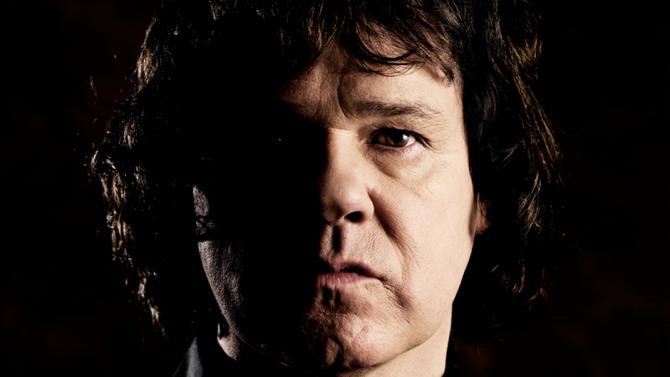
 My name is David Fernández. I'm a drummer born in Zaragoza, I'm 32 years old, and I've been a musician practically forever, because it's the environment that has always surrounded me.
My father is a bassist, which means that, unlike other people who have had to make superhuman efforts to buy an instrument behind their family's back, I haven't had that handicap. I've been able to have all the gear I needed for my studies and the chance to play with highly skilled, experienced musicians, from whom I received the best lessons. This has been fundamental to my musical training.
As for my opinion of music in this country, which is the point of reference by which we judge, it's that there is a lack of unity in the profession that makes everything evolve very slowly. For many years I've attended countless clinics and seminars in which interesting information is scarce. The topics usually covered end up repeating the same thing. There's more concern about knowing what kind of heads or how many plies of wood the endorser's drum kit has than about knowing how to approach a professional job or how to develop good study discipline.
In general, there's an obvious gap in knowledge and in opportunities to gain experience. Music schools are generally not very affordable for young people, considering that, because of our culture, parents invest little in their children learning artistic activities. In addition, the scholarships provided by public bodies are barely enough to cover a small part of your studies, and they put a lot of obstacles in the way of getting them (many of them require you to show proof of payments already made before they pay you the amount awarded).
On the artistic side, I think there's a need to pigeonhole music and musicians into trends: this sounds like..., this guy's a rocker, he's a metalhead, etc., when it's something more instinctive than we want to see. Music is born from emotions, regardless of the style. As a drummer, trying to use everything you hear as a contribution to the way you play will give you the flexibility to understand what's sounding around you and to project, from the very first quarter note, the most comfortable rhythmic support for the rest of the band. This has to be developed in parallel with the study of technique, independence and control of the volume of each element of the drum kit. Not being prejudiced about what you play makes it easier to assimilate many concepts you can use when you least expect it. "Everything has something to offer in building your musical personality."
In my professional career I've played very different kinds of music and worked on things as diverse as dance orchestras, where I had the chance to gain a lot of live experience, as well as large-scale shows with written arrangements (learning to sight-read). I've also toured in Spain and abroad backing artists in pop (Amaral), rock (Pocho K), Brazilian music (Nadia Godoy), funk (Fac Simil) and jazz (Alejandro Pérez, Joan Díaz, Meli Bernett). "The best thing about touring: the travel. The worst... the usual: friends who leave us in accidents or other things." One of the phrases I remember most from a tour was with Aute. At a rehearsal two days before leaving for Argentina, Luis gave me a pointer about what he wanted from a drummer: "I only want people to notice there's a drummer if he stops playing." It's not as easy as it seems, but once you get it, it works for playing in that vein. Reading is also important. It's simpler than it might seem at first. Twenty minutes of reading a day is enough to gain speed. The satisfaction of playing with a big band is worth it. It has also been useful for other jobs, for example musicals ("Chicago," "Hello, Dolly!," "When Harry Met Sally"), where reading music is essential. These projects have also taught me to develop discipline when playing nine shows a week for several months, every day, exactly the same thing, eliminating the creative part and sticking rigorously to the chart.
As for the creative part I just mentioned, I develop it by playing jazz. Fifteen years ago I started getting interested in records my father had (Miles Davis, Bill Evans...). Without much detour, that led me to study with, among others, Jorge Rossy, Marc Miralta and Carlos Carli; combos with Bobby Martínez, Bob Sands and Miguel Ángel Blanco; and two years in the big band led by Bob Sands. To date, I've worked with leading figures such as Mikel Andueza, Segundo Mijares, Norman Hogue, Elisabeth Raspall, Jordi Bonell, Mariano Díaz, Bobby Martínez, etc.
Apart from all this, I also have my own projects. Among the most interesting is "Casa de Fieras" with three friends of mine: Daniel (guitarist with "Easy Rider"), Peri (bassist with "Mägo de Oz") and Nata (singer with "Rosa-Rosae"), a very powerful rock/funk fusion that I hope you'll hear soon.
I'd also like to share a few suggestions about cymbals for readers. To begin with, I'm not very orthodox in my cymbal setup. When choosing a cymbal, I need to know what role it will play in my set so I can think about both size in inches and timbre. I don't think any single series of cymbals from any brand has all the sounds we need. For example, my hi-hat is a 14" Paiste 2002, and the bottom isn't rippled. I have a 16" Sabian HH Thin Crash on the left, and on the right I put a 16" Paiste Line crash. For jazz, I use an 18" Stagg ride that cost me less than a tank of gas (it blends brutally well with the snare, the bass drum and the hi-hat), and as a second ride, an 18" Paiste 2002 that has a small crack that produces a buzz when struck, as if it had rivets. For other kinds of music, I use a 22" Paiste 2002 as my ride, which gives me a powerful sound and a very defined attack. I also use a 17" Zildjian Avedis China and a 10" Sabian HH splash that I place above the hi-hat. I've chosen each of my cymbals for its timbre. The blend they create among themselves and with the rest of the kit is an important part of my musical personality.
Walking into a store to buy cymbals is a bit tragic, since there's little on offer to try on the spot. So either you buy from a catalog or you're lucky and one of them has the sound you're looking for (which almost never happens). It's important to test with the sticks you normally use, since the weight, thickness and size of the tip significantly change the response. I never look at the brand or model before trying them; I just listen to them. You can't test them on the stands where they're displayed. You have to ask for a stand and a seat and place the cymbal in your usual position. It's the least you can do when you're buying something for your work. Ideally, you'd be able to take them with you and try them with the rest of your kit. Luckily, I have that option.
Hi-hat cymbals can be the hardest to choose, because the bottom can be rippled or flat, and there's a big difference in feel depending on the size. The hi-hat I choose depends on the snare and bass drum in the kit. Snares that are 5½" deep, which already sound full-bodied, prompt me to look for a hi-hat with a dark, soft sound without much attack. On the other hand, with thinner or smaller snares, I look for a hi-hat sound with a very defined, rather bright attack that still keeps some body. For example, in the first case, a 14" Paiste 2002, and in the second, a 13" Sabian HH. Never rippled. I only like 16" crashes. I usually look for a sound that isn't very aggressive in its attack, that opens up well and doesn't have a very long tail. However, I also need a sound with a more powerful attack, which I get with the 16" Paiste.
As for effects cymbals (splashes, Chinas...), I look for somewhat shrill metallic sounds that may even seem unpleasant. When an effects cymbal sounds unpleasant and I like it, it's probably because it fits at some point into things I play. Incorporating this kind of cymbal into your set means studying the sound possibilities it gives you to find the optimal way of striking it so it always sounds the way you want.
Finally, I think rides are an essential point of stability, mainly with the bass and the vocals. What I want to hear when I try one is that each note is perfectly defined when struck and that the wash isn't louder than the attack. The bell, if you want it to sound dry and with attack, has to be wide. A thicker cymbal will also give you a lower sound.
These are my criteria when buying cymbals. My set has nothing to do with other drummers', but what we do have in common is that the choice has been made according to each person's way of playing. If you hear a drummer with a good set of cymbals, you can be sure they bought them by ear.