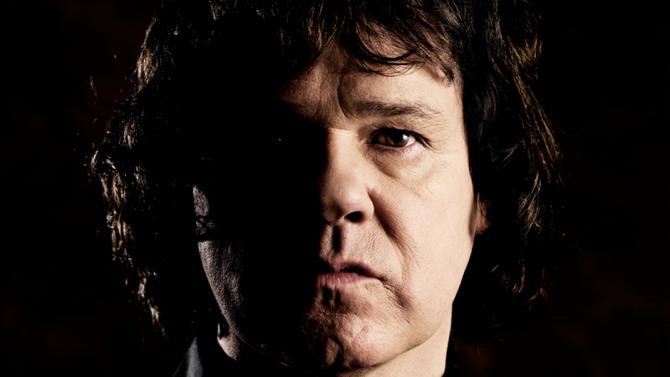
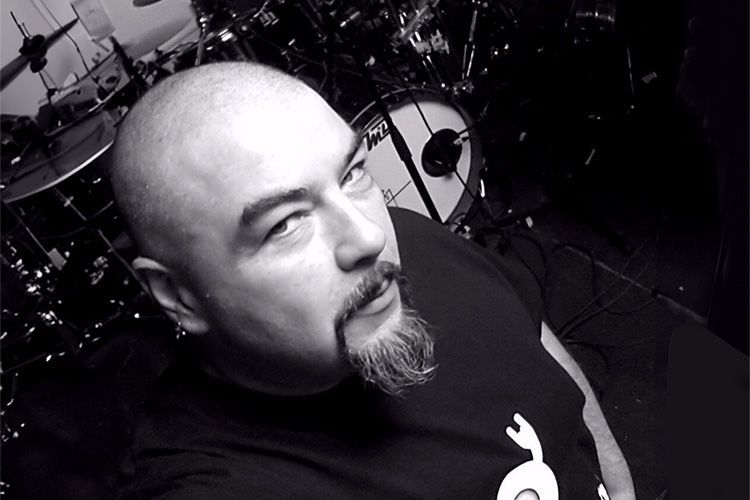
A versatile and experienced drummer based in Madrid (Spain). Alongside his great contribution to the world of drumming, he is a skilled percussionist, composer and arranger. His long career began in La Paz (Bolivia), his home country, around 1980.
Since then he has worked on recording sessions and live performances with a wide variety of artists and bands, across a broad range of musical styles (jazz, flamenco, pop, Latin, reggae, rock, etc.).
It's hard not to have heard of Yayo, since his magic has been making the rounds of the professional circuit for a long time now. In our case, we're very familiar with his career, but it was when we saw him live that we felt his tremendous power. It's not very common to find a musician who combines a good dose of different ingredients: technique, versatility, creativity, and all of it wrapped in dedication and passion. Yayo is one of them, because he can give you goosebumps, turning the rhythm section into a clear center of attention without ever stepping outside of a perfect blend with the "band."
Interview
Dear Yayo, first of all, welcome to our circle of musicians for musicians; your words, experiences and stories will benefit all of us.
I find it especially commendable that percussionists, with their rhythmic training, also turn their efforts toward composition, since the drums seem to be a harder instrument from which to reach the process of melodic creation. How did you come to be interested in creativity? Which instruments do you rely on to compose your own work?
Well, I sincerely believe that every drummer and percussionist absolutely must have direct contact with some harmonic instrument (piano, guitar, etc.) that in turn allows them to understand a bit more of the essence of music in its other aspects, which are not only rhythmic but rather harmonic and melodic. That begins a (complementary) process for the drummer and percussionist that involves ear training, which is different from rhythmic training. That training isn't a matter of a few weeks; it's a long process, especially for those of us who spend many hours working on and studying the drums and can't spend all the time needed in contact with an instrument like the piano. Even so, this process is very exciting, because you start to discover those sonorities that make music something divine.
Then, once that ear training is under way, is when we should take an interest in harmonic and melodic analysis, which is also very exciting and rewarding and at the same time requires many hours of dedication.
In short, those of us who play an instrument like the drums (which I dare to define as a harmonic instrument but of indeterminate pitch) need that contact with harmony and melody to better understand music itself and thus be able to contribute to its rhythmic side, enriching it as much as possible from our instrument.
Personally, I use the piano to work on my compositions. I'm not a pianist, far from it, but I use it to help me compose. Arrangements, however, are a separate matter: first I look for the inspiration (which usually takes a few seconds) and then I work on it (which usually takes hours).
As for the life of a professional musician, I think many readers will be very interested in knowing how a musician develops from the "musical awakening," through the learning stage, to professional life. Could you tell us about your experiences in this regard? What advice would you give to those who want to make their way and earn a living from music?
Well, I'll start with the last question… My advice to everyone who wants to devote themselves to music is this: if you reach the point where you're sure you want not only to make a living from music but to give yourself over to it, then don't stop until you get there, no matter what others tell you; never let other people's insecurity get to you. Of course it's easier to decide to study for a profession that guarantees you a good income at the end of every month, but that's not what matters most either. All that matters is having chosen something you believe in, something that makes you feel good, that makes you feel special and above all happy to be doing what you love... The rest comes later, little by little, but it comes.
As for my experiences learning and developing in music, I can sum it up by saying that I felt its calling when I was a child, at about 9 years old. I loved being in the school choir. Curiously, one of the Christmas presents I remember most vividly is from when I was 7. My parents gave my twin brother (José Luis) and me toy drum kits. How excited we both were. My brother is also a musician; he's a bassist and a highly sought-after session player in La Paz (Bolivia).
But it was at 13 that I chose the drums. With four other friends from school we formed a rock band ("Trueno Azul"). That's where it all started; suddenly I realized that, even without having learned from a teacher, I had a knack for the instrument and could more or less copy the beats of the drummers in my favorite bands. Then I enrolled at the Conservatorio Superior de Música in La Paz and studied there for about three years, but I remained self-taught on the drums until I came to Spain in 1990, which is when I studied with a teacher (Carlos Carli) for about two years. Some people think that when you say "self-taught" it's as if you were saying you haven't studied music. I think quite the opposite. I think it's very important to study music, as I said before, in all its aspects, theoretical and practical, but I also think approaching the instrument directly is very valid, that is, learning to play an instrument by spending hours and hours experimenting with it, though, mind you, with your own discipline and method, not just doing whatever you please.
Once I settled in Madrid, I enrolled at the E.M.C. (Escuela de Música Creativa), where I now teach Ear Training (rhythm, drums and instrumental ensemble, or combo). And I was lucky enough to have very good teachers. Back then, for nearly three uninterrupted years, I devoted myself to studying full time (between nine and twelve hours a day).
Then I started working. The School was very useful to me in terms of studies and later in terms of contacts, and I ended up playing in maestro Miralles' trio. I also worked in the quartet of Dan Rochlis and Tony Haymer… and with countless other great musicians who called me to play with them. That was the best thing that could have happened to me, because I learned much more from them than you learn in class. It's as if the conceptual side of music weren't written in books and you learn it by being fortunate enough to play with people more experienced than yourself, absorbing those concepts by playing and experimenting at rehearsals.
And so, ever since then, I always try to play with people who are at a higher level than I am, and to keep learning and absorbing information, while giving everything I can contribute to the music I'm playing.
Let's turn to the instrument. There are large camps of opinion regarding the importance of its quality. Some believe the instrument is secondary and that what matters is the musician's ability, while others believe it's highly relevant, since a good (or decent) instrument makes playing easier and even awakens the musician's feeling when playing. Which camp are you in?
For me, it's indisputable that a good instrument is very important when you're looking for a better sound and a more defined and precise response at a professional level, but obviously that's not everything. I always say that a drummer's sound is more in his hands than in the instrument. Personally, I can say that I'm a musician who cares a lot about sound. I always try to find not only the tuning I like, but rather the timbre that makes me feel comfortable playing, and to that end I experiment with different types of heads and different tuning pitches. However, honestly, where I spend the most time pondering is the matter of cymbals… they're my passion, and whenever I can I try to get my hands on one, but within certain parameters, the ones I like.
Piece by piece, what do you look for in each part of the kit? What do you expect from a bass drum, from the rack toms, from the floor tom?
For me, each element of the drum kit moves within very similar ranges. Let me explain: what differentiates two bass drums of the same size (say 20"), apart from the head or some accessory, is, without a doubt, the wood. A walnut bass drum will sound much drier and with many more mids than a birch one, which usually has more body and more low end, though still not as much as a maple one, which will have a much warmer, rounder sound. Still, there will be similarities between them, because the sound will be that of a 20" bass drum, more or less round, with more or less body, but a 20" bass drum in the end. In other words, that bass drum has a tuning range where it sounds good. If we try to make it sound like an 18" or a 22", it will sound worse because it'll be outside its tuning range. The same goes for rack toms or floor toms: they'll sound good within their range and with the characteristics the wood and heads give them. That said, there are toms, bass drums and snares that respond better than others, and the difference... is the quality of the material, which usually comes with an increase in price. In short, what I look for, whether in a bass drum, rack toms or floor toms, is that they respond within their range with a good sound, both PP (piano) and FFF (fortissimo). The rest (tuning, timbre, color, etc.) depends on each drummer. Personally, I lean more and more toward smaller sizes in general.
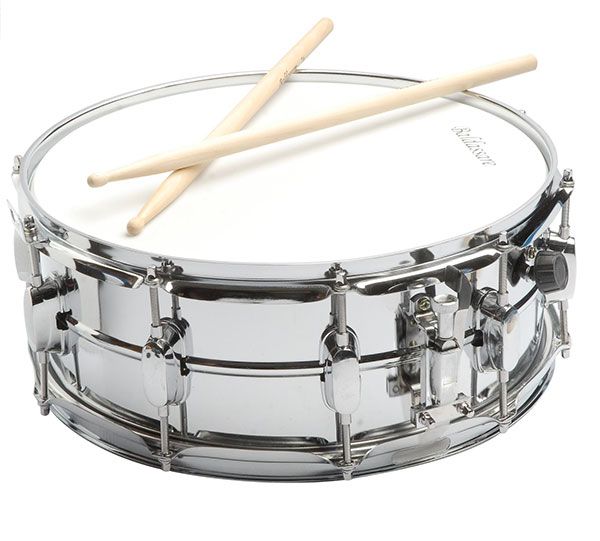
The snare. I think it deserves a question of its own. Wood, metal, inches: what should a snare deliver for Yayo Morales?
The snare I do see as something more personal; not as much as the cymbals, which in my humble opinion are what most define a drummer's own sound, but the snare is definitely something very individual. I like both, wood and metal, depending on the type of recording or music in general that you're playing.
What interests me most in a snare, regardless of timbre, tuning, size or the material it's made of, is the response of the snares. A good snare drum for me has to have an immediate snare response with just the brush of a finger on the top head. This is something you don't usually notice at first glance when trying out a snare; hit it with a stick and the snares will certainly respond, but what if we play ppp (pianissimo) and they don't respond? Or, even more so, what if we play with brushes and all we hear is the sweep across the top head and not the snares?
Right now I have three MAPEX snares: a 12" x 8", a 14" x 5" and a 12" x 5".
On to the cymbals. This issue offers readers a special on cymbals, so we'll take advantage of your welcome presence to ask your opinion on the needs they should cover. Are you in favor of a big setup with plenty of effects cymbals, or do you think any situation can be handled with a good hi-hat, ride, crash and a splash? Are expensive cymbals the good ones?
I'm in favor of having a very varied set of cymbals that covers the range of sounds you want. Cymbals in general are an enormous source of sounds and timbres. A single cymbal can produce a range of colors like a rainbow! And indeed, with a good ride, a good crash, a splash and a good hi-hat, we can handle any situation. But if we want to embellish the music, or if the music calls for more sounds and timbres, then we'll need more cymbals, effects cymbals or not, but more cymbals.
We always run into the cliché that expensive things are better than cheap ones, and logically, in general, that's the case. However, every rule has its exception, and in the case of cymbals it couldn't be otherwise. Let's say that above a certain line, every cymbal manufacturer offers a product that meets the requirements for professional use. Now, cymbals are a very, very personal thing for each drummer, and there's no accounting for taste… so some will like a cymbal with certain characteristics and others will like different ones; that's normal. What would be a mistake is choosing a cymbal simply because it's expensive. I bought my favorite cymbal secondhand and got it dirt cheap.
As a curiosity, I can say that these days I've opted for a very defined cymbal sound, some leaning toward dry and others more open, but definitely not very bright. I've never liked very bright cymbals or ones with a lot of ping, although I admit that for playing pop I use a brighter ride because it doesn't open up as much (when I say open up I mean the cymbal's overtones).
A few days ago we had an interesting conversation (you and I) about how the concept of digital/MIDI drums fits into a drummer's head. We've already discovered their interesting applications, but I think your point of view is a real contribution for those who complain about their lack of realism. Could you tell us about it?
Of course, it'll be a pleasure. The digital audio industry is advancing by leaps and bounds. Nowadays anyone can have great tools for recording all kinds of music (good and bad) at home without needing to go to a professional studio, and with a quality that would have been unimaginable a few years ago. Well, this progress has brought about some very good things and some very bad things. The good things are that musicians today have countless new tools for making music, one of which is the one we're discussing right now: digital, electronic, virtual drums, or whatever we want to call them. The bad things are that there are a lot of people wreaking havoc on music just because they have a computer and know how to program it, without having the slightest idea of the most basic rules of harmony (music made by non-musicians).
Getting back to electronic drums, we can say that they have evolved rapidly to reach very, very good levels of expressiveness. Now, of course they're not like an acoustic kit… thank goodness!!! That's the difference that matters. In other words, once you accept that there are two types of drums, acoustic and electronic, this whole conflict of wanting an electronic kit that sounds, responds and expresses itself as if it were acoustic is resolved. So I ask: what would we think of a guitarist who told us he wished his electric guitar sounded like an acoustic guitar, or vice versa? Well, there's the answer. Why strive for an acoustic sound, response and expressiveness when what really matters is quite the opposite?
From my point of view, the electronic kit is a different instrument that you have to learn to play and get the most out of. If anyone is interested in hearing some demos I've made using an electronic kit and triggering different sounds, they can do so by visiting my website http:www.yayomorales.com (see iDrummer®).
As for your personal projects, what are you working on right now? Your own bands? On tour with...? Studio recordings you're working on?
Right now I'm doing some shows with "La Calle Caliente," which is a Latin jazz band and one of the most rewarding musical gigs I have. I've also been doing some appearances with Enrique Heredia (El Negri), singer of "La Barbería del Sur," who has just released his first solo CD. In addition, over the summer I've been working on the arrangements and programming for the album of a singer from Mozambique named Wilson, featuring Carlitos del Puerto (bass) and Vinnie Colaiuta (drums), among others. I've also produced some songs commissioned by Javier de Juan, a great drummer and producer for "La Década Prodigiosa."
I'm also still working to promote my new CD, "Los Andes Jazz Project," an album based on Afro-Andean and Andean rhythms and styles in general, featuring Jerry González, Bob Sands, Norman Hogue, Germán Kucich, Caramelo Massó, Manuel Machado, among others, and for which I had the enormous privilege of being mentioned by the jazz writer and critic Luc Delannoy in his latest book, published in August 2005, "Historia del Jazz Latino" (Volume 2).
I'm also already working on a new project, my second CD with "Los Andes Jazz Project," which we hope will see the light of day before the end of the year.
Finally, we leave this space open for your own comments to all ISP readers, and we want to express our gratitude and affection for being able to count on Yayo Morales' expertise today.
First of all, I want to thank everyone at ISP for giving me this opportunity to connect with your readers and, above all, for treating me so wonderfully.
I'd also like to take this opportunity to send my affection and gratitude to everyone at Garijo-Euromúsica (MAPEX and MEINL), who have always treated me so warmly and so specially. You're the best!!
And to all readers, drummers and non-drummers alike, there's nothing more to say except to express my most sincere wish that I've been able, in some way, to contribute something positive to you that you can use as much as possible. Thank you so much!
Yayo Morales