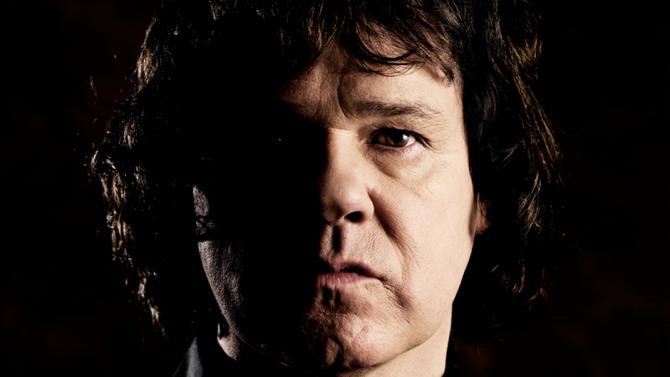
Since the 1960s, British rocker Gary Moore has played across the entire guitar spectrum, from the powerful hard-rock strings of Skid Row to jam sessions with the Allman Brothers. He started his career with a passion for Elvis, the Beatles and '60s rock and roll, and soon after developed an interest in all kinds of music, including soul and funk.
Although Gary loves every genre, he has a deep connection with the soulful truth of the blues.
On his new album, The Power of the Blues, Gary has drawn on his constant source of inspiration—life—to produce his wildest album yet. With tracks like "I Can't Quit You, Baby," "There's a Hole," and the title track, he continues to show his skill at blending blues with rock and funk. He is currently in physical therapy for a hand injury he suffered last year, and he took a few minutes to talk about great bands, being "the fastest gun in the West," and finding inspiration in the strangest places.
How is your hand? What happened?
I hurt my hand last year and went to get an injection. I ended up getting an infection from the injection and my hand swelled up. I was on antibiotics. It's been really painful! I had to do physical therapy because my hand locked up in the same position. I still go about once a week, but I was going about three times a week. I couldn't even play for weeks.
Compare your time with Skid Row to your time with Thin Lizzy.
Well, there was a common denominator with Phil (Lynott), because he was in both bands. But they were very different bands. Skid Row was much more like a jam band, and Thin Lizzy was much more structured. When I joined, it was much more rigid in the arrangements. We played more in the tradition of Cream and Hendrix, and with Thin Lizzy the music was inspired more by the poetic side of Irish music, so there was quite a difference between the two bands.
What did it feel like to be part of Skid Row at only 16?
I had to leave home, and I was living 150 km (about 90 miles) from Belfast in my own apartment. I had a room with a little red light bulb. It was great because suddenly, overnight, I was playing as much as I wanted and going out as much as I wanted. There were certain people in the band I didn't like. It was the bass player's band, and he wanted me to be "the fastest gun in the West" and all that s***. And I wasn't interested in that, so I almost felt like I was being manipulated in a way. When he introduced himself to me and told me (Skid Row) needed a guitarist, I asked him if they played blues. He said they didn't play blues, so I said no, I wasn't interested. But Phil drew me into the band, and they had some interesting aspects. And then Phil left, well... after that it was a bit strange. Still, we played some good gigs.
How old were you when you learned to play guitar?
I started when I was ten. My father had a ballroom in Holywood, and one Friday he came home from work and asked me, "Would you like to learn to play the guitar?" He had a friend who was learning to play guitar, and this guy showed me the A chord, with just three fingers together there. And it all simply started there. I never really had any formal training. I just listened to the old records a lot and drove people crazy.
What made you want to learn?
I just loved the sound of the guitar. My father's ballroom had a lot to do with it. He had been taking me there since I was about five or six. We had bands that came there, big horn sections, and there were also older guys wearing suits and all that, but they always had a guitar. So I was exposed to live music from an early age. I'd sit in school at five, six, seven years old and think about guitars all the time. So it was something very important to me even before I learned to play it.
Who were your most important musical influences?
When I started, there were only people like Hank Marvin in my generation. And from there I jumped to George Harrison because I really loved the Beatles, and then, right after that, there was British blues with Jeff Beck, Clapton, Peter Green, and then Hendrix, who simply blew the whole thing wide open. I was just sort of putting together my own style. I'm sure (my influences) came out in my own playing without my even realizing it. I also love the blues kings like Albert King, B.B. King, Albert Collins... I love all music, really. There's an old cliché that there are only two kinds of music—good and bad. I agree with that. It's all there to be enjoyed; you just have to keep an open mind.
Is there anyone you're listening to now that you thought you never would?
Well, I listen to all kinds of music. I went through a phase where I listened to a lot of dance music coming out of London about five years ago, because I was really curious about why there was no guitar in any of that music. So I tried to make a dance album with guitar, and I found out the hard way that the guitar just doesn't work in any of that music! But I had fun trying to pull it off! I like the Green Day single. I actually bought the album. I like a lot of rock; I really still listen to a lot of rock. System of a Down, Rage Against the Machine—I really like Tom Morello. There's a lot of great stuff out there.
I really like Muse a lot. They're doing really well now. They're a bit operatic, with some classical influence. They sound really British, but they're not trying to copy anybody. So it's nice to hear a band that stays so true to its roots. That's what I liked about Thin Lizzy: they always kept their Irish heritage. They had an American in the band, a Scottish guy, two Irish guys, and then there was always that Celtic thing underneath. Most of the music I love comes from the blues, but you have to do it your own way, if you can.
Let's talk gear. Tell me about your Gibsons.
Oh man... (laughing) how much time have we got? Well, the two main ones I have are two 1959 Les Pauls. One belonged to Peter Green, a very famous guitar that he used on a lot of his recordings. He did The Hard Road with John Mayall. I saw him when I was 15 in Belfast, and it made a huge impression on me. He eventually left it to me a few years later when he left Fleetwood Mac. I have another Les Paul that's very close to that one. Peter Green's was used to play Thin Lizzy music and a lot of other music, and the other one was used on Still Got the Blues, and from there on. Each one has a very distinctive sound. Peter Green's is much harder to play than the other one. I have my own model (offered by Gibson from 2001 to 2003), which I mainly use for my live appearances these days, and it's a great guitar. It has the best of the old and the new. It has the tone of the old ones and the best of the new ones. It has the best of both worlds. I've recorded live with it. I've used it on tours, and it sounds spectacular too.
I have a '61 Les Paul SG, like the one Eric Clapton used to use in Cream, and I have a couple of those yellow Les Paul Juniors, just the little single-pickup ones. I have a '55 Les Paul Jr. that Steve Jones of the Sex Pistols gave me. I didn't ask him where he got it (laughing)! He left it at my apartment one day and asked me if I wanted to buy it, so I did, in the late '70s, and it's been on Victims of the Future and things like that. I have a Double Cutaway Les Paul Jr. and a Melody Maker, and a couple of the new Double Cutaway Les Pauls. I also have five Gibson Explorers.
Do you have a favorite?
If it comes down to it, those two '59 Les Pauls have to be my favorites. They're special to me because of the moments I've lived with them. Those would be the two that stand out.
Why did you want a reverse-wound neck pickup on your own Gibson model?
Well, as on Peter Green's Les Paul, you can see how the pickups are. The way the two pickups interact, it's the only guitar that sounds like that. I don't know what it is—it's something different. I've heard other people try to get that sound... it's just not the same.
You have a new album that came out in the U.S. in June—The Power of the Blues. What do you like most about this album?
The fact that it was simply played live in the studio. It's very authentic. On that album I also used my Gibson Explorer—a white, production-line one. It's really become one of my favorites to play live now. Recording that album, it was just three guys in a room, not even separated by walls or anything, and we just played together and made the album that way. It was nice because a lot of people don't do that anymore.
Why did you choose to record most of it live in the studio?
It's the kind of music... when you play it, it's simply better not to overcomplicate it. That takes all the personality out of it. We were trying to make a blues album with a touch of rock. It was really good because everyone was really pushing each other. We had Bob on bass, and I hadn't worked with him since the '80s. By the way, he's using a Gibson bass, which is why he has that old distorted sound. So Bob sort of resurrected the EB-3 right there. It was fun to do it and keep the authenticity of the music there and not make it sound too polished or perfect.
When we did "I Can't Quit You, Baby," we did it in a single take. We just played, and we didn't rehearse or anything; we just went in and did it. If you don't have the right players, sometimes it doesn't come off, but this time it did. We had the right people, and it was just fresh and great. And really everyone has to nail it in the first couple of takes. We had a rule: only three takes, otherwise we set it aside and moved on.
What continues to inspire you musically?
Oh, everything—the world, the universe, the people I meet. The things I see, the things I read in the news. That's really what has always inspired me. I've always written songs about things that have happened in my life or to the people in my life, just things that were real. And musically I aspire to be a good player and to be as good as the people I grew up listening to, and just try to develop in that way. You're always hearing new things, from everywhere. You can just turn on the radio, and my son plays guitar now and makes me listen to a lot of rock coming out of the United States these days. System of a Down and things like that, so then I get curious about different guitar sounds and things like that. You can learn from other styles of music. Inspiration comes from anywhere.
What can we expect from you in the future?
I have no idea. To be honest, I just follow the music instead of dragging it somewhere it doesn't want to go. When I did Still Got the Blues, in Germany, I was making After the War, and it was 1989. I found myself playing blues when I was on my own, and Bob said, "You should make a blues album." So I did. So that taught me a lesson right there—just follow your instincts. I don't mean that in a commercial sense, just as a musician. If you follow the music, it will always take you where you want to go; that's what I believe.