 Dear Horacio, first of all, welcome to our musical chats. The world of music is complicated, and it's always encouraging and inspiring to learn about the experiences and advice of those who have already come a long way. Starting with a formal, classic question..
How did you get started, and what made you realize you would devote your professional life to the instrument?
I come from a musical family; my father and grandfather were musicians, so my house was always full of music. Ever since I was a child I had a great passion for music. However, I wasn't sure that's what I was going to do for a living, but I had that passion, and that's what drove me and pushed me to pursue this career in the world of music.
It seems most of us musicians agree that the ability to communicate is more important than the "complexity" of the performance, although technique certainly helps improve our expressiveness and expand our communication tools. In that sense, how do you think good learning should develop: putting in lots of hours, with good teachers, playing with people who know more than you, setting goals, taking things from other musicians?
That's a hard question to answer; I don't know if it can be measured. Communicating something goes beyond what we want or are able to do; being able to communicate is a gift, something to do with supernatural, divine things. Technique helps us express ourselves. Unfortunately, many people only study technique and that's never enough; in fact it's a big mistake. You have to listen to records and devote as many hours as possible to learning. For me music has never been a job; I could do this 25 hours a day... In my case, I was lucky enough to have a teacher for a year, who opened up a technical and musical universe for me. He gave me a guide for continuing to study, he taught me how to study and to learn even without him. After that it was no longer necessary to have him; although today he's a great friend, he was like a father and the one who showed me the way. Playing with someone who has more experience and more knowledge is always an excellent school. It helps us express ourselves and gives us the opportunity for these more experienced people to offer their opinion and point of view and help you see where you can improve.
More than one prestigious musician has mentioned your name when answering this question, and I'm curious to hear your answer. Speaking of drums, which musicians on the international scene are, in your view, essential or your favorites, and what would you highlight about them?
There are so many, far too many very good and great musicians; I'd need days to mention them all, many of whom I'd love to play and connect with. No one is more important than another. I don't have a favorite drummer, I have many, and as I say, it would take me far too long to mention them all.
Getting into the purely instrumental side, could you describe your set for us, what it gives you and why you chose it?
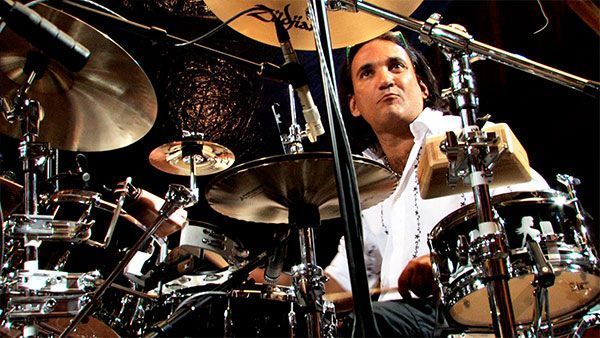
For the last 3 years I've used the same kit; before that I used different ones depending on who I was going to play with or the type of event. Today I use a PEARL kit: 22" bass drum, snare: 5 ?, toms: 10, 12, 14 and 16", cymbals: 22 and 18" rides, and crashes: 18, 17 and 15", 12" China, 8 splash, 14" hi-hats and extra 10" hi-hats, plus a mini percussion set built into the kit with 5 bells, 2 djembes and a tambourine. It's a fairly standard set, to cover different musical styles. I spend my life on planes, and it's impossible for jazz groups to always travel with all this gear, so I settled on these sizes, since they're the easiest to find anywhere in the world. (Drums: Pearl, heads: Evans, cymbals: Zildjian.
Thinking about people who are just starting out, and the debate over entry-level instruments, where do you think the happy medium (price/quality) lies, and what should a beginner or intermediate musician look for in their future purchases?
As you know, I come from Cuba, where musical instruments aren't sold and where getting hold of a music stand is a feat. The most important thing was always to get something that would last a long time and be sturdy. The instruments I had were Russian drums; I tried to make them sound as good as possible with various tricks. What I strongly recommend is getting an instrument that, even if it's not the best brand, is quite tough and will last a long time, since we'll spend hours and hours with it. After living in the USA and being able to get any instrument, for me PEARL has been the best in terms of value for money.
Again from the learning perspective, from the point of view of "socializing" with the rest of a band: what makes you feel comfortable with a band: flexibility, blend, organization, virtuosity? Or, looking at it another way, what do you think the rest of the band looks for in a drummer: simplicity, versatility, adapting to the style, bringing their own personality?
Definitely all of these aspects are fundamental; all of this is what ultimately makes the music flow and come out at its best. It's not just about playing well, being versatile and adapting to the band's style, but about being called for who you are. It's important to have your own voice. It's something you can't even plan; the more you study, the more you learn, studying those who came before you, and that way you find yourself more easily. Things that have nothing to do with music are also very important, such as getting along with the team, because you spend a lot of time with them. The interesting thing is that music makes people more down-to-earth and sociable, so you rarely come across unbearable people. You also can't think too highly of yourself because you've played with this or that person; you mustn't let success go to your head and cloud your thinking. It's important to talk about what you're doing openly and honestly.
Do you think the natural evolution of any musician leads to fusion?
I think so, and that the word fusion was pigeonholed in years past as a term that only refers to jazz and rock. However, I think it's a much broader word. Fusion should be the same as World Music, which is many styles, not just jazz and rock: it's African music, Latin music, flamenco, etc., so many kinds! Each one has developed so much that you have to study them all, and that leads us to put a bit of flamenco into a Cuban timba... You have to bring in all these styles, mix them and see what comes out!
Drums and MIDI. What's your opinion of technological developments via MIDI, triggering samples from pads, etc...? Do you know of any digital kit whose advantages outweigh its drawbacks? What do engineers need to develop to make these instruments more comfortable to play?
The development of technology is impressive! In recent years these have become very interesting and fun tools. You can have a recording studio in a space no bigger than 14". Personally, I have a Mac G4 laptop, an Ozone keyboard, a hard drive and a mic, and with this I record when I'm on tour in hotels in the middle of nowhere. And it's not just that this tool is fun; it has become an incredible teacher. I never thought I'd be playing with trumpet loops, saxophone loops, etc... Having this around has taught me a huge amount. The only problem I see is that it leads you to do everything on your own: bass, piano, arrangements, mixing it and putting it all on a record. Human collaboration always leads to doing better things. This tool will never beat a bass player, a sax player, etc. Sometimes I feel there's a certain coldness in the idea that with the help of technology you can do EVERYTHING; however, the audience is the judge, and if they like it, it can be done!
The Virtual Drummer School. Salvador Niebla is quintessentially one of the most important figures on the Spanish drum scene. What has your experience been like at the VDS, and what do you think it can offer virtual students?
I think Salvador has been a pioneer, not only in his studies and in everything he has contributed to the universe of music, but also with this virtual project. Salvador is the first to have had such a beautiful idea, and it didn't just stay an idea... he made it happen, and now the school works 100%. As a teacher at the Virtual Drummer School, it's really nice to know that students have access to lessons and to the best drummers without having to pay the equivalent of €50 an hour. It's an easy-to-use, accessible and affordable tool. It has a roster of teachers who make music worldwide and who enjoy great recognition and prestige.
As for your recordings, what's your latest work, and what have you put of yourself into it?
I finally have my first solo album, called "Italuba". It's titled that way because I had the opportunity to live in Rome for 3 years, about 10 years ago, and I was always looking for a way to thank the city for its hospitality and warmth. Two years ago, while touring Italy, I met three Cuban musicians who live there, and we had a huge musical connection, so there was no choice but to make a record. This album was mixed by Dave Weckl, who is an excellent drummer and a teacher at the Virtual Drummer School. There was such a strong musical connection that I decided to put all my effort and love into this project. We played in Barcelona at the Coba de Track, and I think we'll see each other there again very soon!
Finally, as is customary at ISP, we leave an open space for your recommendations, in your own words, for everyone who is enthusiastically reading you right now. What would you say to all those musicians who are passionate about the drums and are desperate to get better?
First of all, never get discouraged. There are always difficult moments when it seems nothing is working out no matter how hard you try, but if the passion is there, you have to follow it. We mustn't get discouraged; with a lot of love, anything can be achieved. You have to study a lot. This isn't an easy road or a gift; it's simply the result of what we study, what we know and how much passion we put into what we're doing.
We conclude by thanking you once again for your time, presence and kindness, and offering you our admiration and our best wishes for the future success your musical excellence and know-how so richly deserve. Thank you, Horacio "El Negro".