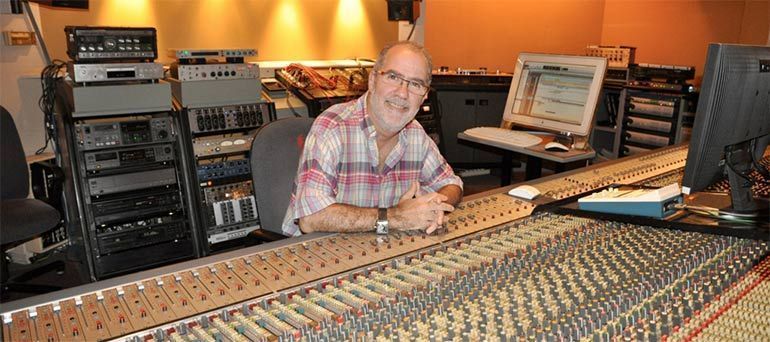
One of the most important recording studios in Spain, and one with the strongest international profile, is Red Led. It is located in Madrid, and the truth is that when you walk into this studio you feel as if you were somewhere else, because when you look around its facilities all you perceive is incredible harmony and tranquility. It is a very modern studio in which the space is put to excellent use. Red Led is the kind of studio where everything is designed so that the artists who decide to work on their projects there feel right at home.
Apart from the studio itself, which is on the ground floor, there is another zone upstairs with several areas set aside for resting and relaxing at times when there is no recording to be done, as well as a place where the manager can keep working as if in his or her own office while following everything that happens in the studio via closed-circuit television. There is a dining service for when it is time to stop for a meal, as naturally happens in every recording session. There are more details worth highlighting, but we will save them for those lucky enough to have the opportunity to use its facilities.
Unlike other studios of this kind, where several productions run simultaneously, at this studio the entire staff is devoted to a single production at a time.
Taking advantage of a free slot in their tight schedule, we stole a few minutes from Helena, Rafa and Eduardo so they could tell us how the world around Red Led works and about their experiences over several years at the helm of one of the most important studios in this country.
Since we wanted to know how Red Led began its journey in the world of music production, Eduardo was the one who told us how it all started...
"I have a certain residual responsibility, because I was president of the only studio association there has ever been in this country. I can tell you that I lived through, not its complete disappearance, but its suspension, which is as good as saying it doesn't exist. The AEX Studio Association at one point wanted to be something of a forum where studios of all stripes could meet to share concerns and present a coherent image of the profession to the outside world. But for one reason or another, or perhaps because in this country we are a bit individualistic and have a certain tradition of 'I'll mind my own business and everyone stays in their own house...', in the end the association doesn't exist, so I think we hold one of the least boast-worthy distinctions: we are one of the few business sectors that is not collectively organized for any purpose. And if I regret it, it is not because of the corporatist side of the matter, which I detest, but because of what it could do to bring together actions that benefit the industry, professionalism and the relationships among us, which I do find interesting in such a peculiar sector. People on the outside know nothing about what we do, and we do have many things, naturally many common concerns. So we live very isolated. Therefore, I will always speak on behalf of this company, because when it comes down to it, each company has its own way of seeing things, and we can't speak uniformly for the others."
When was Red Led formed?
Red Led was born from an idea that is basically the same in essence as today's, but not in quantitative terms, since it was born with certain characteristics similar to the current ones, fundamentally one: it was a facility dedicated to a single production. So all the auxiliary services and everything surrounding the production would be dedicated exclusively to a single client, and that idea was cherished from the very beginning by those of us who founded the company. But the truth is that it has evolved enormously, and I think it should be divided into two stages. I should clarify that Red Led started in '87; it wasn't formally inaugurated, but we began doing our first jobs, which you could almost call trial runs. Before that, I had a studio that was much more modest than this one, smaller, located in Getafe. It was a studio devoted to demos; we made a few cheap little records, on practically nonexistent budgets, but personally it helped me reflect on what I wanted in this studio. Even back then I had the idea of building this studio, with highly professional aspirations, but based on the work of that semi-professional studio. (I am of the opinion that a studio, whether small or large, is essentially the same thing, and a professional's challenges must necessarily be similar, since they are rooted more in solving problems to achieve a given artistic goal and applying the means at hand: if they are few, they are few; if they are many, they are many...) But the ABCs of a studio basically apply to a small, medium or large one. So that served as my training ground, and with it I worked out the details of this project, and in '87 it opened. Then came a very long period, the first stage of Red Led, which had a turning point at the end of '91 and the beginning of '92, that famous... At Red Led we made a very substantial transformation in our investment in equipment and machinery, and we transformed it qualitatively in a major way. With that, for better and for worse, we also changed the profile of our clientele. I say for worse in the sense that, unfortunately, we lost some of the regular clients from the first stage as regulars, because in a way we moved up a level, and a studio's activity is tied to budget levels. We gained new clients and lost some, but we positioned ourselves where we wanted to be. From then until now, we should talk about the definitive consolidation of the studio, which has naturally evolved but has remained very focused on the market segment of more ambitious music productions in terms of sophistication or perfection and, necessarily and logically, in terms of budget...
What kind of artist are we talking about specifically?
Rather than talking about a type of artist, I would say we should talk about a type of production. Because artists are quite irregular; although there are certain rules, you may find an artist who, because of commercial decline or for whatever reason, is very well known and yet is going to make a record on a very modest budget, or you may find a newcomer whose label bets heavily on him or her, grants a very large budget and decides to record in a big studio. That's why we talk about productions, those that could be comparable in their technical and artistic approach to the best productions in the world. What we aim for, and I think, even if it is very immodest to say so, that we achieve it quite well, is to measure ourselves against the elite of the big studios and always be at the cutting edge of music production services, which is our specialty. In that sense, the artists who come through here are generally well known, very important, with a significant market presence, but fortunately not exclusively, because that also gives us the chance to frequently see new artists who are just starting out, of all kinds and all styles. It is a pity that budget is so omnipresent in the decisions about an artist's direction, but the truth is that is how it is today. Artistic quality can't be bought; you either find it or you don't, you either hit the nail on the head or you don't, but there always seems to be a tendency, when you want to do things well, to spend a lot of money to make the most of all the resources, and above all of time. The great raw material that recording artists, or record production, work with today is time. Understanding that, we have always tried to make sure that, if the studio has to stand out for something, it stands out for its high productivity. In other words, we want our clients, if possible, never to feel that certain procedures could have been done faster. If we see a shortfall in something, whether material or human, that can be improved and saves the client time, we believe that, far from hurting us, it is always an advantage, because the client will trust the studio and say: "If I spend three hours there, I get the most out of them, and in those hours I get as much done as possible." That, more or less, is our working philosophy.
Earlier you were talking about the comparison between what is done in Spain and what is done in countries such as the US, England or Germany...
Why do people still think that what is produced abroad is better, or at least comes with signs of a better guarantee?
I would have shared that concern a few years ago. Ten years ago, I would have had to agree with you completely and say yes, everyone would have agreed that productions made in England or the US were noticeably better than those made here, which doesn't mean I share the idea that it was true ten years ago, because there would be much to discuss on that. But what was true was the general conviction, especially among people who weren't really in the know, that this was the case. And that was undoubtedly due mainly to a virtual value, an unreal value conferred by the record companies' marketing strategy. Because while it is true that, ever since studios came into existence, more than equipment, it took investment and the professional experience of many professionals, both musicians and technicians, etc., and it took many years for the profession to mature. There are thousands of things surrounding a recording, so in that sense, even if there were two or three good professionals at the time and a suitable studio, everything else was missing, and above all, I would say, experience was missing when it came to certain productions, especially avant-garde ones or those using modern production techniques. You had to be on the lookout to copy, to watch how things were done, in order to do them here in a rather self-taught way. That always left us a step behind what was being done in international productions. There was a time when all of this was true, but it created a habit: productions that aimed to be at the highest level resorted to the ploy of being made abroad, seeking out the great English or American producer, or the great studio, and so on... I am not of the opinion that the studio radically determines success; saying so is, I think, deceiving yourself. So it was by no means automatic that a record made there would sell more or be liked more. What was much better orchestrated was the marketing campaign: when a DJ said that So-and-so had just come back from New York after working with Such-and-such, obviously that had an impact and created expectation, and it became a habit. The labels exploited that, and it was done at every level, of course; it suited the label for people to believe that what was made in New York was great and what was made here was not... because, logically, if they had gone to the trouble of making that investment to give the product that added value, they wanted it to be known. This created a stereotype many years ago that is very hard to destroy and still hasn't been destroyed, but that undoubtedly has no reason to exist today. In our case, I think we have more than enough proof, proudly, why not say it, to show that it is a reality: today in Spain, the good studios and, why not, the good professionals surrounding the recording industry, recording services and all the related fields around them are on a par with the best human and technical teams in the world. Obviously, if we want to compare, I will always say the same thing: the best production made in the US today will surely be better in certain respects than the best production made in Spain, logically; otherwise we would be the leaders of the industry, and we are not. I am referring exclusively to those stratospheric cases where the American industry really gets its act together and says: "Let's make something massive for the whole world." But in anything just a little below that, we are up to the task. And not only us; speaking particularly of Red Led, I would honestly say it was the first studio to break that barrier, because we have had several cases of people who had been working abroad regularly and who tried making their production in Spain with us and said: "Hey, it turns out they know how to work here too." We already knew that, and we weren't even the only ones. We had the good sense to break that cliché a bit, and in recent years things have become much more evenly distributed in this respect. There are even artists... I have to mention the case of Juan Perro: once, after he had recorded here, I heard in a radio promo: "recorded entirely in Madrid." That really surprised me, because saying that was a kind of taboo; saying it a while ago was like saying "in other words, it's bad"... and today that is not the case. Quite the opposite: people boast that magnificent productions can be made here.
As you probably know, we belong to the World Studio Group, a group of high-level international studios that you join by invitation only, after a selection of studios capable of providing services at the highest international level. For many years we have more than met that selection, and year after year we remain members of the group, which for us is an honor more than something useful in itself; it is an honorable mention that gives us great satisfaction, and I offer it as proof. But I could also give you the example of international people who have come through here, including an American Grammy-winning producer with extensive experience in American studios who, working here, was very surprised to find that Spain has a professional level. I am convinced this is now a reality, and lately it worries us less. In any case, if there is anything residual, any mystification in this area, it is the same as in thousands of other areas: marketing and the media in general tend to confuse, and it can hardly be said that they inform in the strict sense of the word. The recording studio is a great unknown; I don't know why, and it is something that really strikes me.
Perhaps because, I think, people are content to see only the tip of the iceberg. Very few people buy a music product and read... "recorded at ... studios"
Almost no one, and I understand that. If I were just a fan, it probably wouldn't mean anything to me...
However, what people do bother to say is that this is the Chicago sound, or more recently the Seattle sound, with the whole grunge thing led by Nirvana...
I would say that in this case it is not so much the fan as the journalist, radio host or music promoter who, at a given moment, likes to round out the presentation of a song with some kind of information that somehow justifies their own role in presenting a new product. But let's call things what they are: record labels and radio are a symbiosis that forms a system that is not perfectly structured, but is a very tightly knit socioeconomic system, which makes it very hard to separate what may be information from what is promotion, and for me everything done at that level has little value, especially educational value. You will rarely hear debates on the radio about how a record was really made, only from a promotional perspective. I think it would be good to do some outreach about the work of studios, and even of studios in general. Music is very attractive to everyone, and that has put the figure of the recording studio in everyone's mind. Fans, or people more or less outside the profession, have a somewhat romantic and distorted image of what a recording studio is, because of countless movies and documentaries. Film has resorted to the recording studio countless times to justify the dramatization of a protagonist who is a musical artist. And of course, showing a recording studio as it really is isn't very cinematic; it's more useful to invent it, and that has hurt us. Today film does important cultural work in showing the moviegoing public, which is very large and young, the things around us, not just fiction. So I think film sometimes takes certain liberties that can create false images of certain things, and that is what has happened to the recording studio. As proof, by way of anecdote: all of us who experience the recording studio from the inside have often had people, friends or acquaintances, say: "I want to come one day because I'm really interested, it's so fascinating," and after the first time they come and see it, almost no one comes back, and everyone says: what a drag! Because recording today is a very sophisticated and very complex thing that requires a very high level of qualification, and it is not the simple image we have of it. I think when you see it from the inside, you inevitably realize that there is no other way for Spanish studios to operate at an international level, because today we are not cut off anywhere. How do you record here? Just like everywhere else, no more and no less. We use the same machines, the same techniques, and we start from the same fundamentals.
Do you think a phenomenon like the one we mentioned earlier, the Chicago sound, the Philadelphia sound, etc., will ever happen here?
I think that has been heavily mythologized, the "local" sound; there are very few in history. I could perhaps mention Nashville as one of the cases where it did happen, or New Orleans in its day, or some other. I think that although they are named after places, they are more the result of a trend that arises in one place, as happened here with the Movida Madrileña. It's not that whenever we do something we do it that way; it was a moment, here, when a series of things happened, and then we go back to the same thing. That has value when it comes to marketing a product, probably: if a product is a success, nothing is more common than hanging that label on a bunch of products so they follow in the wake of that success. So I think we can hardly really recognize it, here or anywhere else except the US. Why not there? Because the industry in that country is so big that there is a lot of specialization, and with a lot of specialization there can be a particular sound, for example. There are some studios that are highly specialized in certain services, something that is also very hard to find elsewhere, where the industry isn't big enough for anyone to devote themselves solely to recording certain things. It is more realistic to talk about the sound of a certain artist, or of a certain producer, or of a team of people; it's more natural that, like it or not, they distill and shape a style. Then there are also schools. In Italy there is a production school we all know, the Italian melodic pop-rock school, which is undoubtedly a school. And it works in the slipstream of a huge success; it is nothing more than continuing to do what works. It is dangerous to believe in those kinds of labels; what they encourage is copycat production: "this is what's in, so let's do it." I understand that this way of working has to exist, but as professionals, we don't benefit industrially from the record; we are pure craftsmanship, we work day by day with each of the problems that come up. And so we live completely apart from that kind of strategy. We do see it, though, because over the years we have watched trends come and go; we have to start from the fact that we work in the culture industry.
Since it's about selling, and doing it in the best possible way, you always have to be competitive with respect to others. How does Red Led stand in that regard?
I think Red Led has made clear, within its environment in Spain, that its commitment to technology and equipment is the maximum the market offers, and we always try to be at the top of what optimal equipment for a music studio means. Today we continue to deliver, and with great effort, I must say, because in a studio like ours, balancing the budget to pay off a very large investment, such as the cutting-edge technology we have today, is not at all easy. One of the foundations of our structure is having cutting-edge technology in our equipment. We have been at the forefront when it comes to looking for what the future might bring and anticipating certain things. We have adopted certain techniques and devices that others later followed, and we are delighted about that. It has been recognized that we chose well, and I think we currently have the optimal equipment, or one of the best, worldwide. We like to say, because it is true, that in our studio, except for symphonic music, which we can't do for physical reasons since we don't have a large symphonic hall, there is absolutely no music production challenge in the world today that is beyond our reach in terms of technology. Now, having said that, our personality as a service company is defined much more by our human capital than by our machine capital. You will always hear me say that machines are just money, and money, however expensive things are, doesn't require much reflection or nuance. You either have money or you don't. An expensive machine costs so much, and I go and buy it; or someone who wins the lottery can have a great car if they want, but that won't make them a great driver just because they won the lottery. That is something you have to work at day after day. In that sense, we believe we have a great car, and over the years, with very sustained and constant effort, we have managed to become great drivers, which seems much more important to me. The day the value of people in a record production is less than that of the machines, I think we will have become so industrialized that I won't be around.
A key issue is that all this sophisticated machinery requires permanent maintenance that is so sophisticated and of such a high level that it is as demanding as the production itself. We work as hard at maintaining the equipment as at serving our clients. There are thousands of factors that come together, and if they aren't ready for work, everything falls apart.
When a studio is considered one of the best, it is no accident; when people speak well of a studio, that is no accident either; when the artists considered the best want to record in a particular studio, that is no accident either. All of it is due to a set of conditions that must be met. Red Led meets those conditions, thanks to the efforts of the people who work day after day in pursuit of the very best.