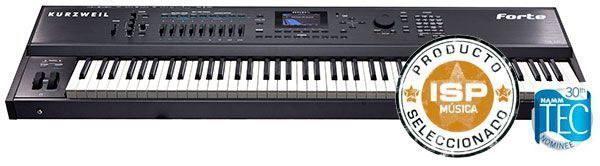
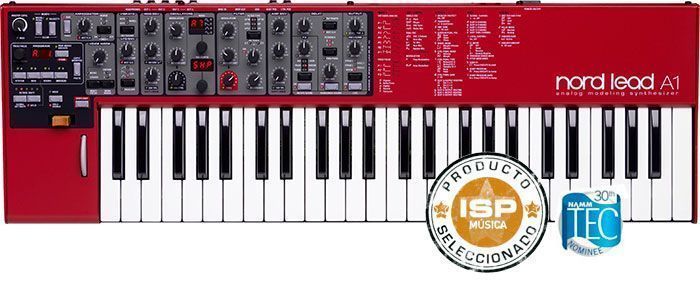
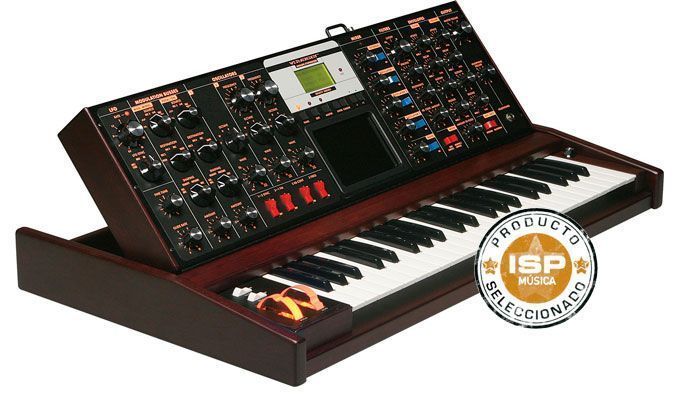
 While selecting some of what we consider the most powerful indulgences in analog sound processing and synthesis, we also turned our gaze to the Minimoog Voyager. It is a monophonic analog synthesizer. It incorporates practically all the sound resources and functions of the original Minimoog Model D, which was produced by Moog Music, Inc. from 1970 to 1982. But it has additional features, including a three-dimensional touch surface, MIDI IN and MIDI OUT implementation, extensive patching facilities, and a large number of new panel features.
* Frequency controls (2) vary the frequencies of oscillators #2 and #3 over a +/- 7 semitone range relative to oscillator 1.
* Octave selectors (3) set the frequency ranges of the oscillators in six octave steps. * WAVE controls (3) provide continuous control over the oscillator waveforms, from triangle to sawtooth, to square, to narrow rectangular.
* 1-2 SYNC switch synchronizes the waveform of oscillator 2 to the frequency of oscillator 1, for dramatic timbral effects.
* 3-1 FM switch provides linear frequency modulation of oscillator #1 by oscillator #3.
* 3 KB CONT switch disconnects oscillator 3 from keyboard control, allowing it to function as a "drone."
* 3 FREQ switch lowers the frequency of oscillator #3 into the sub-audio range, allowing it to function as a low-frequency sound or modulation oscillator.
* Mixer module with five inputs for combining audio sources before filtering.
* Input level controls (5) adjust the relative levels of the oscillator, noise and external audio input signals.
* 5 input switches let you quickly switch individual audio signals in and out.
* External level LED lets you set the correct external audio signal level.
* Filter module: dual mode includes dual lowpass and highpass-lowpass filtering. Dual lowpass mode consists of two lowpass filters in parallel, one for each output channel. Highpass-lowpass mode consists of a Moog lowpass filter in series with a highpass filter.
* Cutoff control sweeps the frequencies of both filters across the entire audio range.
* Spacing control sets the separation between the frequencies of the two filters, over a +/- 3 octave range.
* RESONANCE control adjusts the resonance of both filters, from none (pure lowpass response) to filter oscillation.
* KB CONT AMOUNT control: the filters open and close as you press different keys on the keyboard.
* Dual lowpass / highpass-lowpass switch selects between dual lowpass operation and highpass-lowpass operation.
* Release controls (2) determine the release time constants.
And much more, which you can scrutinize on the Moog website. What a beast.