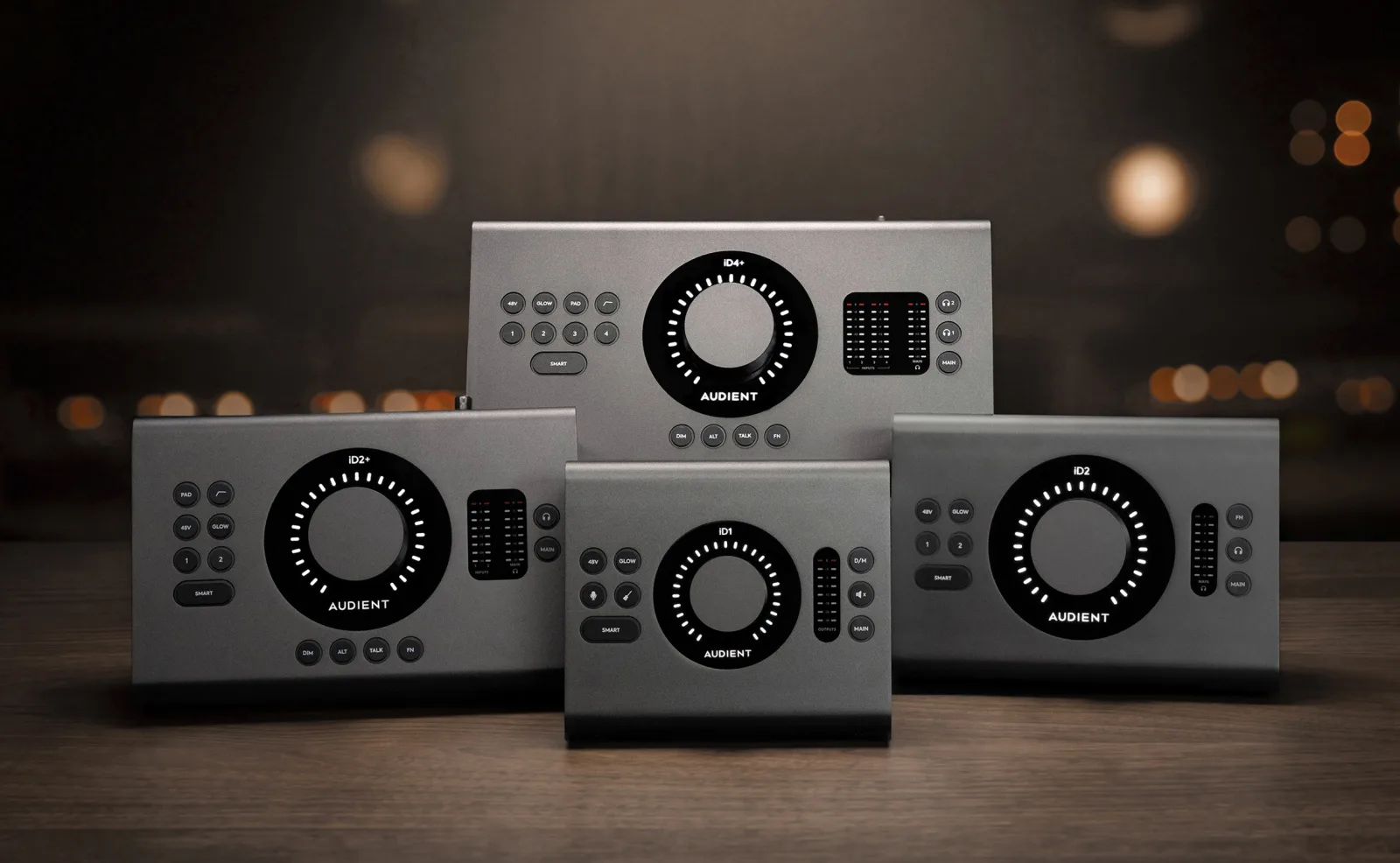
Audient's iD family has long been a benchmark for desktop interfaces in the home studio. The third generation is more than a facelift: it changes the internal platform, simplifies the names and adds something that until now required separate software or higher-end gear, room correction inside the interface itself.
One shared platform
All four models share the same foundation. Each one has ASP8024-HE console mic preamps, the same discrete Class-A design, with 75 dB of gain, 32-bit conversion with 128 dB of dynamic range and up to 192 kHz on Mac and Windows. They also share the onboard DSP, which runs zero-latency EQ, compression and reverb, and Smartgain for setting levels. All of them run at full performance on USB-C bus power, with no external supply.
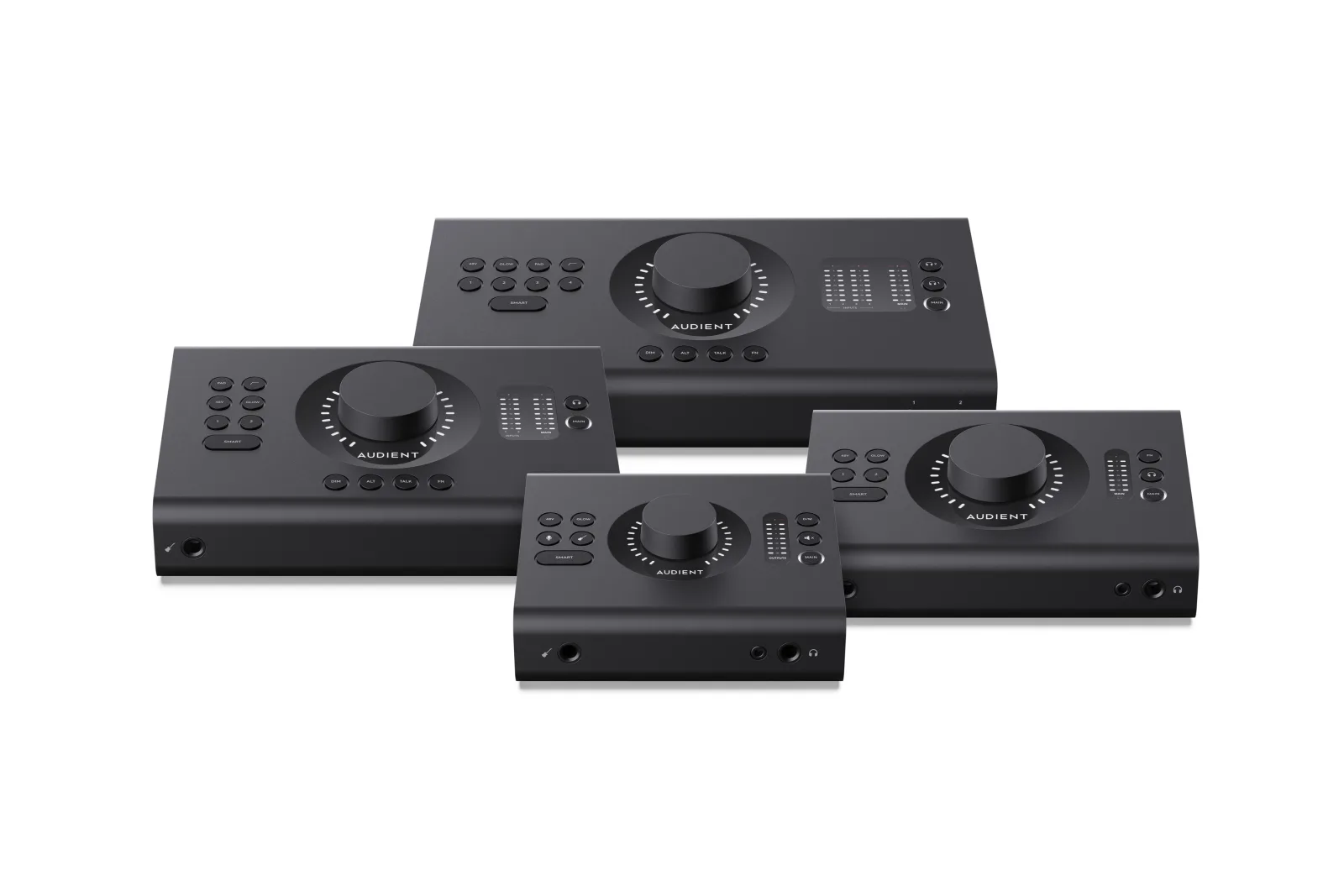
RoomTune: room correction in hardware
The most substantial new feature is RoomTune, Audient's monitor correction software. Because it runs on the interface DSP rather than the computer, it uses no CPU and applies system-wide: it corrects what comes out of your monitors in the DAW and in any other app. For a home studio in an untreated room, it is probably the most cost-effective monitoring upgrade you can make, although it is worth remembering that digital correction helps but does not replace basic acoustic treatment.
At launch it corrects stereo monitoring on the speaker outputs; headphone correction and new target curves will come in a free update. It requires the RM1 measurement microphone, included with the iD2+ and iD4+.
Analog color before the DAW
The Analogue Tone Suite lets you shape the signal before it is recorded. Orbit is an analog circuit that varies input impedance and changes how the mic responds, from open and modern to thicker and vintage. HMX adds harmonic saturation through a MOSFET, useful for giving body to a thin kick or a clean guitar. LIFT brightens the top end and GLOW combines the two. It is an interesting approach: making sound decisions at the recording stage, as you would in a console-based studio, rather than leaving everything to plugins.
Which model to choose
The names now reflect the number of preamps. The iD1 (formerly iD4) is for the solo musician: 2-in/2-out, one preamp and a JFET instrument input usable at the same time. The iD2 (formerly iD14) is 10-in/6-out, with two preamps, ADAT for eight more inputs and control of two pairs of monitors. The iD2+ (formerly iD24) goes to 10-in/14-out, with two balanced inserts and ADAT in and out. The iD4+ (formerly iD44) is the largest: 20-in/24-out, four preamps, two JFET inputs, two inserts, 16 channels of ADAT and two independent headphone amps with up to four cue mixes.
More information: www.audient.com