I confess that the first time I saw this device I was stunned. It puts a new spin on sampling and the use of virtual instruments to achieve tremendous realism and live sounds, while taking advantage of MIDI editing on our traditional acoustic percussion instruments. Polyend is a well-known brand of special, one-of-a-kind musical instruments whose creativity overflows with imagination.
A little history
Founded in 2015 by Piotr Raczyński, the company is made up of a small team of designers, programmers, technicians and musicians based in Olsztyn, in the Thousand Lakes region of northeastern Poland. A cutting-edge, innovative brand. Its first product, Perc, the first digital drummer, had a positive impact on the musical instrument market that encouraged its creators to keep going in the right direction. Shortly afterward the brand introduced two more products, Seq and Poly, with WYSIWYG interfaces that give users unique features for controlling sophisticated software and hardware setups and breathe life into their machines. Encouraged by rich feedback from users, from modest home producers to the most renowned, the team keeps working on new products of its own or in collaboration with other music hardware manufacturers. Polyend has shown great creative ability.
Unboxing
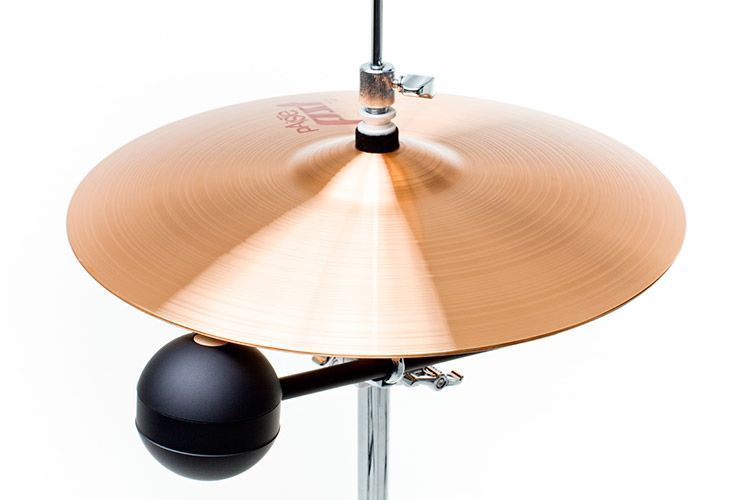
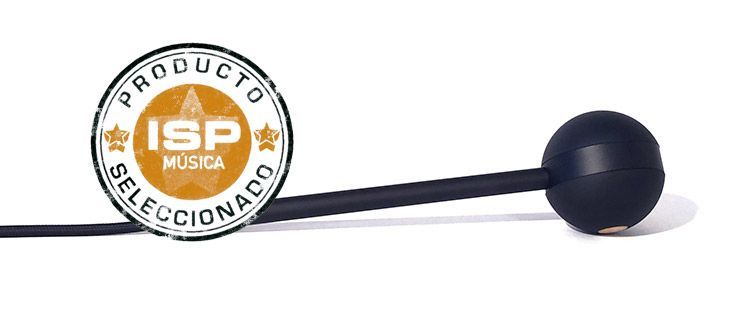
We opened the box with curiosity. Inside we found the clamp for holding the beater in the perfect position on our hardware (stand), the power supply, cables and the Perc controller, shaped like a guitar pedal (old school... an MXR?). Added to this set is the beater unit itself, which is quite curious. It is built from sturdy materials, under an aluminum housing that guarantees a long life and stable operation. The same goes for the controller: metal, well-built materials.
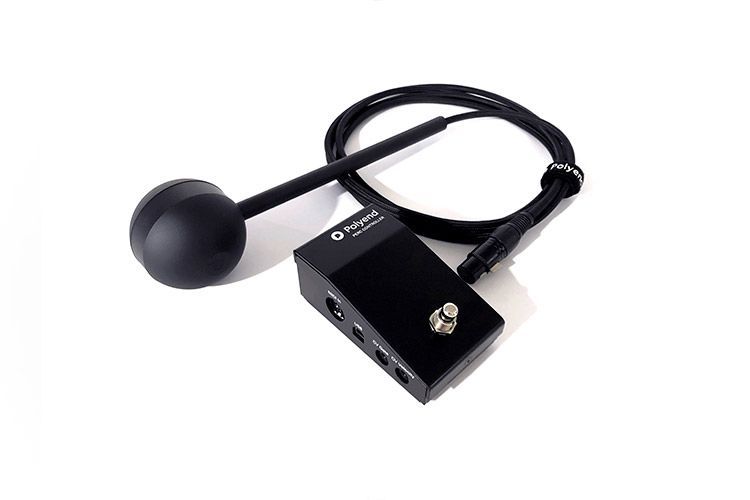
The unit works via MIDI or USB and can be connected to any device: DAW software, drum machine, smartphone, groovebox, etc. The controller, for its part, drives one beater (in this case), but units can be chained via MIDI to link as many as needed.
The concept
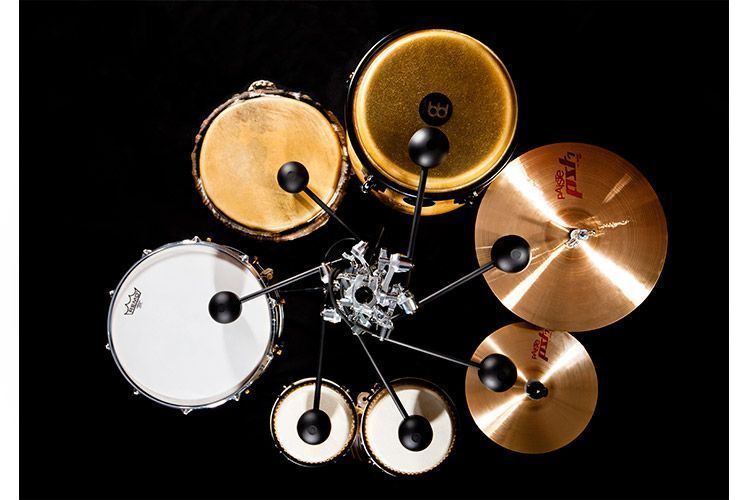
The idea, revolutionary in our opinion, is to use MIDI not to trigger samples but to fire a physical beater "hammer" that "strikes" whatever you put under it. This means we can fire our loops or sequences from the DAW (for example) and the Polyend Perc's hammer will act on the chosen piece: a snare, a hi-hat, a tom, the kick, etc.
The idea is really powerful for getting organic, rich, genuinely "real" sounds. We just have to place the "percs" on our various percussion pieces, according to the MIDI sequence, and capture the analog sound with a mic to bring it back into our DAW, this time as an analog performance.
The idea is powerful for generating loops, for example of real acoustic drums, even if you have no idea how to play them (just how to sequence them, mind you, or how to gather MIDI tracks for that purpose that you can then trigger). We have also seen how effective this device is in more "fashionable" settings. Think of generating a series of grooves that fuse electronics with acoustic sequences, producing truly powerful, rich and different sounds.
So much so that you can play percussion hits not only on a snare head, but also on a cowbell, a glass? a... let your imagination run wild.
The tests
Now all that remained was for the test to work and for the beater "hammer" to be rock-solid in its precision when accurately playing our whole range of half notes, quarter notes, eighth notes, thirty-second notes, sixty-fourth notes and anything else our MIDI sequence sent it. To see the machine in action, in this case we used a Mac with Pro Tools as the DAW on an 003 Rack interface, and launched a very complex MIDI sequence that sounds wonderful with a good drum library. This time we only had to change that track's output, replacing our virtual drum instrument with the Polyend Perc Drumming Machine.
With only one unit, the ruffs and flams (as if we were using two sticks) fell short when it came to really testing the "firing" precision. However, by splitting the snare into two tracks and sending each playing hand (one per stick) to a different track, we were able to check the subtleties of even the flams, which are played with tiny gaps between hand "A" and hand "B."
On the other hand, with our creative spirit, which, by the way, gets fired up quite easily, we tried a wide range of ideas on "classic" percussion sources and on anything that could give us interesting percussion colors in various loops, whether more realistic or more "otherworldly," with varied textures.
Another test consisted of controlling a real drum kit (in this case reduced to a single piece) from a master instrument. A groove station: you hit the kick pad and "bam," the hammer strikes your head perfectly.
Consequently, it has been proven to our senses that we can effectively and precisely play anything that can be played with a "stick" or with the hands: xylophones, congas, snares, pots and pans, our drummer's head?... unsettling.
Conclusions
We really liked this outpouring of creativity in a well-finished product that works in a stable, precise way. Whenever we test an innovative tool or instrument, we feel a strong boost to our creativity. The Polyend Perc drumming machine is a totally surprising concept that overflows with imagination. It opens many doors and helps us generate organic textures that would otherwise be harder for us (especially if we work alone, without other specialized musicians). It takes our grooves into other contexts and helps us generate 100% fresh, real analog sounds.
Congratulations to the Polyend team, this rocks.
Distributed in Spain by: Zentralmedia
Manufactured by: Polyend