Study, learn, grow. Erase and start over. At what point in your career did you find yourself resetting what you'd learned and looking for the music within you as a new starting point? If I'm to be specific in my answer, and with all due permission, I must say that the very wording of the question underlines my answer. The turning point was the day I realized that studying was not uniquely tied to learning. I had made great sacrifices to map out my life as a music student as precisely as possible.
If I'm to be specific in my answer, and with all due permission, I must say that the very wording of the question underlines my answer. The turning point was the day I realized that studying was not uniquely tied to learning. I had made great sacrifices to map out my life as a music student as precisely as possible. I studied here and there, I went wherever the sirens' songs told me to, I left everything to enroll in internationally renowned schools, I studied with very famous teachers… all of it added very positive ingredients to my training. However, as time went by I still found myself in my room putting in 12 hours a day as I had in recent years, with the feeling that I was lying—not to others, which I don't much care about—but to myself. I wasn't able to play the note I wanted at the moment in the bar where I wanted to be. I wasn't able to write on the staff with the guitar in my hands in real time. At that moment I threw it all overboard, went back to my lifelong teacher, sat down in front of him and said: "Will you help me tell myself the truth?"; and here I am at 41, defending, foil in hand, my hours of monastic, cloistered study against the day-to-day, against "let's get together sometime," "come on vacation with us," against the cold, the heat or simply the fact that willpower doesn't come to visit me that day.
It's a process I've gone through several times in my life with different disciplines. Music is a facet of art that fascinates me, and possibly the one that requires the most work, since subject and object coincide. At the same time, thought and History have been with me since I was very small, even before music. Exactly the same thing happened to me: at some point I untangled all the assumptions handed down by years of schooling and took them up again in absolute terms. That was an exercise that cost me a great deal, since we human beings always tend to interpret facts from the angle that will help us reach the conclusion we had a priori, before facing the reasoning or proposition in front of us. In the case of History it was somewhat easier; I simply didn't settle for only the winners' interpretation. That premise takes me to extraordinary landscapes that I couldn't enjoy if I hadn't made that effort.
In any case, the process of stripping bare before objectivity is something I still do, whether studying Coltrane alone or with others, reading "The 900 Days" about the siege of Leningrad, or in my vital need to read Nietzsche, Unamuno or Ortega every day. I understood a long time ago that I am the eternal student, the eternal adolescent…
Art, curiosity, expression. How do you blend your interests related to communication, and how do you think that affects your music? Philosophy, history, reading, writing—is there more?
There is more and there isn't more. There is more, because one of the first conditions I set for myself as a child was that the only one who was going to choose in my life was going to be me. I choose above all else; I wasn't going to let anyone or anything choose for me. So I will always do what my free will decides—thoughtfully, since madness and absurdity aren't in my nature—but I will always do what I want. I remember a summer when high school had ended and I didn't have much left to read at home. My mother, seeing me restless for lack of reading, suggested I go one morning to the library where she worked in case there was a book that interested me. Imagine my surprise when I found a few books by Sartre. I spent several days enjoying his thought and coming into contact with the idea of "I am always free": nothing stops me in my choice, I can always do what I want. That idea has fascinated me to this day. I should also say that afterward my mother asked me which books I had taken, because she'd been told those texts weren't appropriate for my age… it was too late, I'd already read them. Last year, in August, I finished recording some guitars one Saturday for a work commitment, and the next day I set off from Madrid on my bicycle with little more than the clothes on my back. I reached Cádiz six days later, crossing trails and trying to stay off the road as much as possible, with my book well advanced. So today it's this that I'm here to present; tomorrow I may set out to travel around the world as if I were Homer, or I may do nothing else in my life after The Übermessenger…
At the same time, however, there is nothing more. I'm of the opinion that the only thing that matters in this life is art; it's the only difference between us and the rest of the animals. We are capable of admiring beauty; if it weren't for that, we'd be monkeys with cell phones.
The way all these disciplines coexist in my head is quite harmonious, since they've been there for as long as I can remember; one way or another they have always shaped my little universe. So I can't stop being me, and that forces them to get along with each other and coexist. For me, music is language and mathematics, so the day I understood that "your universe is as big as your language," I told myself, "Time to transcribe!" Mathematics is another guest that rounds out part of my interests; the "incompleteness theorem" has always driven me crazy and at the same time has helped me get past the feeling of never being able to feel fulfilled with music. In conclusion, all those subjects that live in my day-to-day help one another to make the most important thing shine: the message.

What is "The Übermessenger"? What is the relationship between the book and the album?
The word Übermessenger didn't exist; it's something that pulses because I give it life, but you won't find it in dictionaries. With that word I tell myself that, of all the correspondence we receive throughout life, I keep only what I truly decide is important. That is very present in the figure of Hermes as messenger of the gods, which is why I say it to myself. On the other hand, the prefix "Über," which in German means over/super, means that what's present here unmasks false mail carriers with messages of little importance to me. The book is titled "Fundamentos instintivos de una tarde de invierno" (Instinctive Foundations of a Winter Afternoon). It is made up of 8 stories that interact with one another, each of them harmonized with each of the album's songs bearing their names. The text is written to the rhythm of the tracks we can hear on Übermessenger. When you buy the album you can download the book as a PDF, and when you buy the book you can download the album in MP3.
Influences. In an elaborate, mature cuisine where nuance takes center stage, the album exudes thematic aromas of many kinds. How do you think everything you've listened to so far (rock, pop, jazz, funk, world fusion, etc.) has been unleashed on your album?
Influences are often something you can't control; you're a living being and there are many things around you. But in this case I did try to be firm about what I wanted to show. I think character lies in the NO; the YES shows no will. So I suffered saying NO to a lot of music in order to highlight the music I said YES to. I always say the styles that interest me most are the ones that end with a "k" sound: jazz, funk and punk. On a second tier you can find Balkan, ska, classical and traditional music. Although I've flirted with many other styles, I realized they were nothing but mirages that deceived my eyes when I was lost in musical deserts.
One of the principles I prayed to before starting the album was that I wanted there to be a popular feel, mainly in the harmonies. Although I'm crazy about Monk, and I've included a nod or two to him on the album, I didn't want to get lost in chained II/V/Is or modal matters more in the Miles vein. I wanted the songs to be reducible to I/IV/V. On the other hand, the rhythmic feel should always have a certain lift, trying to rise up through accents on the second eighth or sixteenth notes. But above all I wanted it to keep a harmonically minor feel. I love the feeling of nostalgia, of lament. That's when I most feel the need to compose; when I'm happy I don't want to shut myself away at home with my guitars or the piano, I want to go out and enjoy what's happening. This brings me close to musical feelings that are very Eastern, very Russian, very Scandinavian, even French… that melancholy I would die for over and over again. The song "Too much time…" on the album lets itself be intoxicated by this feeling.
When composing, recording, telling a story and even listening to others, what grabs you most musically right now, and why?
In this kind of setting, my focus is very clear. I'm only interested in the message. When I talk about a message, it doesn't have to be verbalized. It's the most important thing for me. A few months ago a friend came to me asking me to help him make his album. My working life revolves a lot around production and the studio, so I drop everything if a friend thinks I can help. With the utmost caution and humility, the first question I asked him was: What do you need to say? And the second was: Who do you want to say it to? He told me he hadn't thought about it, that he had a handful of songs in the style of this or that band, singer or instrumentalist. With a heavy heart I told him I couldn't help him, because for me making an album is making a work of art; it's fulfillment. At that moment the composer has to bare himself and project himself onto his work to convey the message he wants to give to others, to himself or to eternity. However, wanting to have an album the way someone wants the latest trendy car means, for me, entering the realm of whim rather than necessity. That necessity is what I look for when I listen to something. That necessity is you, and so I come to the conclusion that very few people want to be themselves. I realize that most people always want to be someone else, not themselves. No matter how often I see it in advertising slogans, I still think that being authentic and honest is not a pose.
If we get into something more technical, the first thing I notice is rhythm. For me, at this point on the journey, it's the most important thing. When I talk about rhythm, I mean everything from which rhythmic figure you choose as the head of a motif for later development to which parts of the beat you decide to place your notes on, your rhythmic framework… it's Dionysus. This intertwines with how the melodies respect the harmony and how they dance horizontally through the changes.
If the question is more specifically which musicians are mainly playing in my head, I can say that this past week I've listened only to Coltrane, solely and exclusively, and in fact 3 albums: Ballads, Soultrane and Bluetrain… Mike Stern, Chet Baker, Scofield, Django, Chopin, Bach, Tom Waits, Parker, Dexter Gordon, Art Pepper… my Art! From here I recommend his biography, "Straight Life"; his music influenced me as much as his life… but at the same time Bad Religion, Social Distortion, Dead Kennedys or Gogol Bordello… When I first heard Greg Graffin pondering anthropological questions amid 2-minute songs and distorted guitars, I sensed he would stay in my prayers. What a contradiction!
Lots of gear over the course of a musician's life. After all the experience you've built up live and in the studio, as far as "tools of the trade" go, what stands out, or what has really become important in your day-to-day?
Ahh, gear! That great ally and, at the same time, deserter on the battlefield. Indeed, there are styles heavily based on the sound the instruments project, stripping the musician of the tone that lies within himself. There are instrumentalists who base their approach on gear and develop their discourse from there. I've tried it… I won't deny I peered down that path, but some time ago I realized it wasn't for me. When I stripped bare in the dead of winter and showed myself to myself, I came to the conclusion that I should be able to play alone, without needing any pyrotechnic fuss. So my main tools are a metronome, a tuner, a staff, a pencil and an eraser, and I season these ingredients with my Spanish guitar. At the same time, I must say I can spend a long time listening only to the metronome, and the rest is superfluous. Once I'm able to play the bass line, the chords and the melody at the same time, that's when I move on to electric guitar, amps and pedals. But I spend 80% of my time with my nylon-string guitar or my piano. At the same time, I enjoy being an endorser for brands such as Ibanez, Supro, Pigtronix, Bose and Beyerdynamic, and Mesa Boogie has also treated me very kindly. This gives me the chance to try a lot of gear and always stay up to date with everything going on. I mainly use an Ibanez Artstar semi-hollow, a Supro Rhythm Master amp, and Beyerdynamic M160 and M69TG mics.

The instrument and musician-products industry has taken a bit of a hit. We read news such as Gibson not attending NAMM in 2018 due to a considerable drop in sales and its current interest in other kinds of consumer products (consumer electronics and others). Why do you think the industry has changed and far fewer instruments and much less gear are being bought and sold?
When one of the most traditional companies isn't present at NAMM, it ends up unsettling the whole industry. It is clearly a symptom, but like doctors, I'll try to make my humble and cautious diagnosis of what's wrong with the patient: art is necessary for life, just like water, air and nutrients. Within art we find music. To make music, musicians need instruments. In a society where things are valued according to the profits they generate, music is at a disadvantage, since its nature is not to feed bank accounts; yet it is required to be one more contributor to economic growth, as if it were a company designed for profitability. This affects the instrument industry, which is tied to the altruistic side of art but is also required to deliver that economic return. In other words, I imagine the investor who has put capital into instrument companies doesn't care whether your guitar has the twang you wanted, or whether Jimmy Page used a sunburst Les Paul, or whether Slash's bridge pickup loses its mids. He'll want 15, 16 or 20% on the money he invested in instrument companies. Twang as such isn't listed on the stock market. And here we come to what I always see almost everyone forgets: physics. If we put a lit candle in a room, it's unlikely to go out because there's enough oxygen; but if we cover it with a glass, the candle will go out within a few seconds. Well, in my opinion, and from a cautious point of view, I'll conclude by saying: that's what's happening in this industry. There isn't much oxygen left, since the world of instruments is much smaller than other economically profitable activities. But the candle is expected to perform as if the glass were the entire room. I suppose that's why Gibson is looking for alternatives to get more oxygen to burn.

What do you think of social media in relation to creativity? Do you find it helpful for promoting talent? Confusing? The Tower of Babel?
My opinion of social media is something of an extension of my opinion of technology. Once again I come back to the first question of this fascinating interview, which I'm enjoying so much: I will always keep at bay any thinking that someone tries to impose on me. I always have the feeling that on social media the majority imposes itself on the individual, on the subject. Those forums force mediocrity, making the most talented and the most foolish alike end up falling within the limits of the majority, within the limits of the mediocre. I don't believe in equality, and living alongside other groups without preparation can make you shipwreck in the waters of the herd. It's impressive how many instrumentalists I see playing on social media—spectacular technical level, incredible sound… but even though they're not my cup of tea, I enjoy Vai, Satriani or Yngwie more, to give examples everyone knows and many criticize. And why do I prefer them? Because they are themselves, because they have a solid proposal, because they've searched for themselves and found themselves, and they have a universe inside—even if it doesn't appeal to me, I do value it. I don't think the world needs another guitarist sweep picking at devilish tempos, or another cover of a trendy song or a rock classic, or another love song… So what I see is that social media cultivates that culture of imitation, giving the world something it already has and doesn't need. But the most striking thing is the moral condition the social network of the day imposes, and how the rest of us abide by it. So I don't think it's confusing at all; it's very clear: we're not mature enough, in terms of education, to live together in a public square where we share our interests. In the end, all the monkeys imitate the one the majority found funniest.
How does an album grow while it's cooking? How did you make your ideas grow until they shone? Gear, hours, other musicians, patience, time?
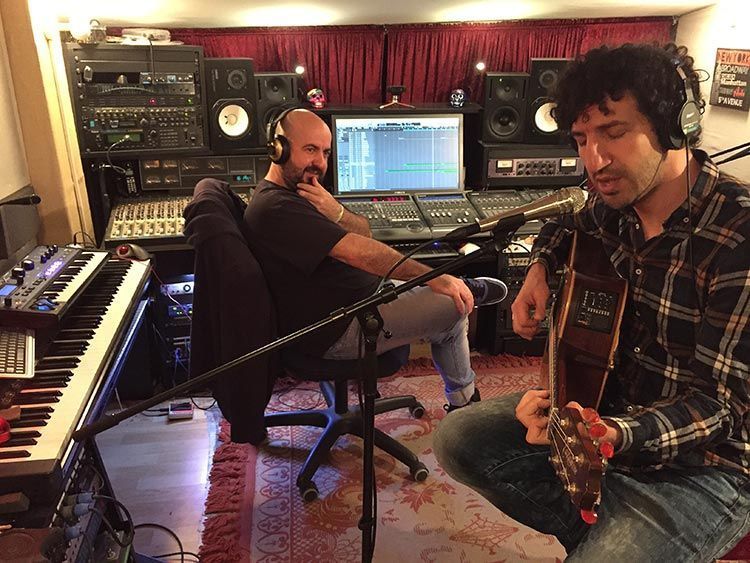
The album took me 4 years, many tears from stirring up feelings deep inside that I'll take to my grave and have written on my headstone; even today, when I play certain songs, I struggle to hold back tears. It cost me my guitars, turning down jobs for a Rodrigo de Triana shouting "Land!"… I've left friends along the way, I've sent others away telling them "Never come back"… I've hugged lifelong friends tighter than ever and valued every inch my arms embraced. I've bowed in admiration to colleagues who supported me on this journey and lifted me up with their art. I've opened my doors to new discoveries that made the walls of my firmament shine. I wrote down every last note that was to be played, with the intention that lives in my eyes. I've banged my head against the wall on realizing that what was sounding wasn't what was in my head, and I've started over as if it were the first day. My patience stretched to the limits of time; time stretched to the limits of my patience. I used only one guitar, two amps, 3 preamps and the 3 mics I paid homage to a few answers back. I've hauled gear with my own hands only to erase what I'd recorded; I've played the eternal return over and over. I've danced with a vocal track. I dreamed of a clarinet, and life presented it to me more brilliant than in my dream. I've spent sleepless nights writing lyrics, stories, pirate poems, tales of mute princes, one-eyed plays… I've fought for who I am… and I'd do it again and again…
Lessons, demos, live shows, production, creation: can a musician today make a decent living in Spain? How can we find you?
The other day I was in a dressing room before going on stage. During a break, someone from production said to us, "Professional musicians, follow me." I told him I wasn't a professional musician, to which my bandmates said, what do you mean you're not? One of them even dared to recite part of my modest body of work… and I replied that I don't consider myself a professional musician. I'm Fernando Girón, and today I do this; tomorrow, God knows what. I said it with modesty and never from arrogance, but I believe that professional suit is too small for any human being, unless that person wants to put it on—then I assure you they'll fit into those pants. So I enjoy my work producing, playing live, giving demos, master classes or whatever I see fit. That said, I must say we'll always make a decent living, since this musical discipline will always contribute a social good. There are other kinds of professions with much higher, more refined salaries in the shop window, where dignity is not the first word that comes to mind. If we focus on how one faces domestic life with music as one's banner, I've never had any doubt: when they built the system, they didn't think of me, they didn't think of a person like me. They thought of an office worker, a civil servant, a manager… So I try not to look at the difficulties that come with the working life I've chosen. Let's get past them, and that way my reasoning is freed from that burden and can fly higher. Sometimes I wonder whether those with those powerful salaries, mostly paid by us, wouldn't burst into tears like a beardless boy at any lash from one of our "bohemian," "artistic" lives, as they like to call them…
You can find me at www.fergiron.com, and from there you can always find other ways to get in touch with me. You can also see me on stage performing these songs or others', at master classes and on some recordings I've played on or produced.
I'd like to sign off by stressing that I've always been of the opinion that the one who asks says more than the one who answers, and in this case I couldn't have been happier doing this interview, with very interesting questions, asked after reflection and exhaustive listening to the album, making the answers a challenge and making me think beyond where my thoughts can see. Thank you very much.