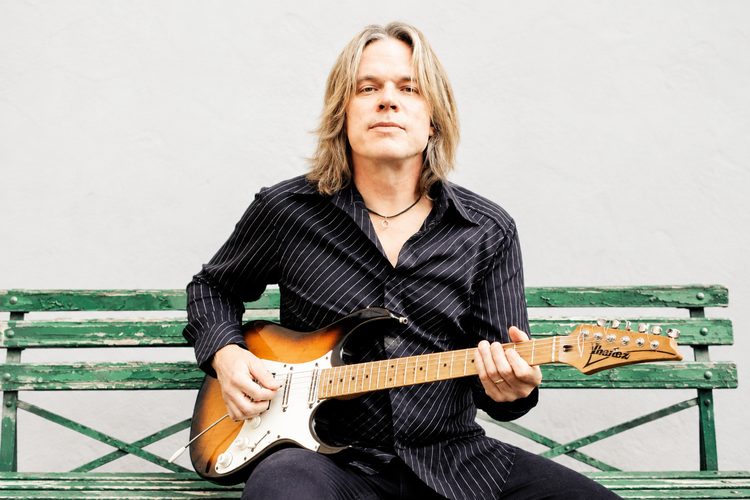
Dear Andy, it is a pleasure to have you join our conversations among musicians. We know that many ISP Música followers comment and talk about you on the forums, Facebook® and other social networks. Surely they, like us, admire you for your rich musical language, sensitivity, great expressive power and the great originality of the techniques you use. We are passionate about the way you blend rhythm, accompaniment and melody on your acoustic guitar. The day we had the chance to discover your work, we were frankly fascinated. We are eager to start asking you...
As for the type of instrument, have you gone through any kind of evolution? That is, did you start with an electric guitar, or was your passion for the acoustic love at first sight?
My first guitar was a classical guitar, but I didn't have much of an affinity for it. My real passion began with an electric guitar I got a few months after the classical. When I started playing, what I listened to most was heavy metal and hard rock. And also virtuoso electric guitarists, especially Eric Johnson. He became the reason I wanted to learn to play guitar! I got completely into acoustic guitar when I was 16, after listening to artists like Preston Reed and Michael Hedges.
Were your first steps as an instrumentalist in a band, or did you start out playing solo?
I played in several bands when I was in high school. We covered songs by Metallica, Primus, Dream Theater... and we also wrote a few originals. I started playing solo acoustic guitar when I was 19 or 20.
We all know how hard it is to play well, and the hours and dedication it takes. But, without a doubt, the most difficult thing is arriving at a completely personal style. What prompted you to start applying percussive techniques, working with harmonics, and combining rhythm, accompaniment and melody in such a wonderful way?
Well, when I started playing guitar I realized that what I really liked was chords. Especially chords with lots of intervals, like major ninths or minor elevenths. I think they help you a lot when you're a solo player. I was also heavily influenced by four acoustic guitarists in particular: Michael Hedges, Preston Reed, Don Ross and Billy McLaughlin. I spent a huge amount of time trying to figure out their pieces by ear. When I started writing my own tunes for acoustic guitar, I borrowed a lot of what I learned from these artists and blended it, adding, of course, things of my own. In the end, I wound up doing something that turned out to be unique and particular. I think it's a story that happens quite a bit in the world of music!
Who are your guitar heroes?
Mostly those four I mentioned above, but also guitarists like Eric Johnson, John Petrucci, Joe Satriani, Stephen Bennett, Masaaki Kishibe and Isato Nakagawa. I admire many other guitarists, but these are the ones who have influenced me most directly.
When you compose, do you start with the melody, the rhythm, melodic arpeggios...? Or do you perhaps just let your soul flow? (Your songs show technique, but also feeling. It's very sincere work.)
Generally, when I compose, I first experiment with new tunings. I think using different tunings can be very liberating. Instead of being limited to the conventional way and the standard chord shapes you've memorized, you're suddenly free to try new things. So, usually, I come up with a chord progression or riff I like and then I start hearing melody ideas in my head that make up the whole of the song. Then I try to find a way to play both parts at the same time. Other times, though, I hear a whole song in my head and try to find a way to arrange it for the guitar.
 Watching you play, we have questions about your training. On one hand, we see academic, classical execution; on the other, we notice more contemporary influences, with informal “street” phrases. Add your revolutionary techniques to that, and we could say you have created a new musical language. Where does that blend come from?
I consider myself, above all, self-taught. For a year, I took electric guitar lessons but, after that, I tried to learn to play by ear. I learned a lot by studying the music of Hedges, Reed, Ross and McLaughlin. It was very hard to find sheet music for these players, so I sat for hours and hours in front of my stereo trying to learn their melodies. I copied many of their techniques. To be honest, I don't consider myself all that revolutionary in guitar technique; a lot of what I do I borrowed from them! There are some things I may have added to the musical vocabulary, but I see myself more as a guitar composer than as someone who has changed the way the guitar is played. Many did that before me!
Do you feel comfortable on an electric guitar? Have you recorded anything with that instrument?
I feel very comfortable on electric guitar. At home, I play a Steinberger, which has been my main electric guitar. But I don't use it for concerts and I haven't recorded anything with it yet.

Do you rely more on marketing or on artistic ability?
Well, I'd say a combination of both. If you want to advance your career as a musician, you have to lean on marketing a little to get yourself known. That said, I will never compromise my music for money or popularity. I think music is something very powerful and positive when it's honest. I'm not interested in trying to be someone I'm not; that's why my music will always be authentic and from the heart.
We are amazed by the harmonics, intonation and resonance of your guitars. If they weren't in your hands, things would probably change, but what do you especially value in an acoustic guitar: materials, specific construction...? What do you ask of the instrument to feel comfortable playing? I'm not very picky about that and I really don't know much about guitar construction or other details. For me, it just has to sound perfect. In general, I lean toward darker tonewoods, like rosewood or ebony.
But do you have a favorite guitar?
Yes, my Greenfield guitars and my harp guitar are the best instruments I've ever played.
Setting your talent aside, has YouTube been what put you in touch with the great many fans who follow you?
The success I've had on YouTube has been truly surprising. I uploaded the videos in the hope that maybe some guitarist out there would find them interesting, but seeing that it has reached people all over the world has been truly incredible. At that time, I was working as a guitar teacher and ended up quitting that job to start touring, because suddenly there was a huge demand for live shows everywhere. Now I'm very active on Facebook, and it's wonderful to be in touch with the audience that way.
As for musical concept, do you have a preference for any kind of sonorities in chords, scales, etc.?
As I mentioned before, I'm a fan of chords with lots of intervals, especially sevenths, ninths and elevenths, major or minor, but not really the dominants. I created a tuning: F#m11, a chord that comes from: F#, A, C#, G#, B, E. I use tunings on the songs called “art in motion.”
Finally, we'd like to leave this space open for you to give your opinion and some advice to musicians who sometimes feel frustrated or desperate over the difficulties of the business. We're sure they will appreciate your words enormously.

As advice to every solo guitarist, I encourage you to start playing live, even in small venues, as soon as you feel comfortable with the idea. At first, playing alone in front of people can be pretty intimidating, but over time it gets easier and easier. Also, try to develop your own sound by combining and blending different influences, and including music from outside the acoustic guitar world. If you suddenly find that some of your ideas sound just like another guitarist's, don't be afraid to work on them or simply throw them out. I've had to do that many times! And, most important, don't throw in the towel. Remember that there's always tomorrow, and enjoy it!
It's a pleasure to meet musicians like you, with great talent and the humility that experience brings. We are delighted to see that your work and dedication have been deservedly recognized across the great network of networks. Thank you, from the heart, for your kindness and the time you have invested in sharing your experiences with all our readers. With our affection, respect and admiration, thanks to Andy McKee.