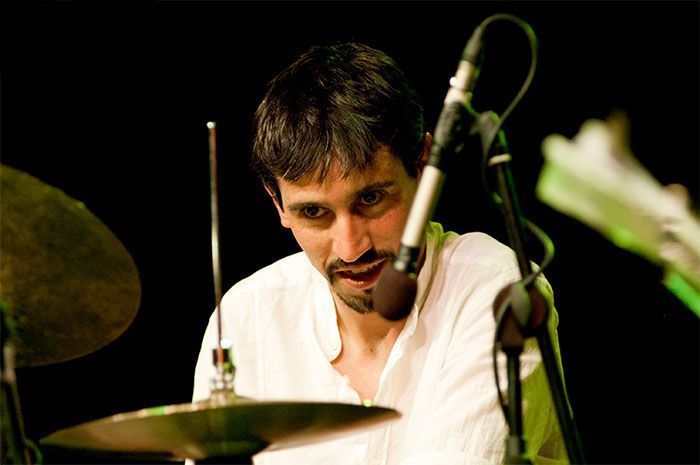
An attractive sound seeped into my ears. I didn't know who was singing or who wrote the songs. I only thought about how pleasant the harmonic whole was. A certain peace when listening to it, and a lot of craft in the making of the album. And who are Sweet Wasabi? My feline curiosity made me dig deeper. What a surprise! Our dear Pedro Barceló was behind the curtain of this work, a card that gave us the firm assurance that, as a whole, this would be serious work. Pleasant and serious? What an unusual combination. Laura Pamplona's magic joins the more than renowned career of this undisputed drummer, or rather, musician. Together, in their fusion, they make their work something exclusive that reveals musical experience and delicacy in perfect conjunction. An album for musicians, made by greats, that any self-respecting music lover could easily understand.
The band
Sweet Wasabi was born from the voice of actress Laura Pamplona and the music of drummer Pedro Barceló. This pair embarked on the adventure of releasing an album with a classic air, with hints of jazz, bolero and bossa nova and unmistakable Latin influences. A revisiting of our roots, with a clean sound that, without losing sight of modernity, deliberately sounds old-fashioned. Listening to this album is like taking a breather, a break from everyday life. It's a convertible ride through Monte Carlo, an afternoon in a Parisian café, a waltz with Fred Astaire, lying on a sofa on a Sunday after a night out... At least that's the idea.
Until now, Laura Pamplona had built her professional career in the world of acting. Although she started out working as a model and studying design, the artistry that ran in her family, and life itself, gave her the opportunity, at 20, to step onto a stage alongside Arturo Fernández.
Her first film appearance was in '96 in a movie by director Jesús Mora called "A tiro limpio," followed by television, with series such as "Este es mi barrio," "Todos los hombres sois iguales," "Policías, en el corazón de la calle," "Aquí no hay quien viva," "7 días al desnudo," "Hospital central," "Hermanos y detectives," "Cuestión de sexo"... This past year, in addition to being on stage presenting her new project, we have seen her in Televisión Española's "Los misterios de Laura," playing Lydia Martínez.
Pedro Barceló, for his part, is one of those highly valued professional musicians who have always worked "behind the scenes." Throughout his career he has played drums as a session musician, recording and touring with jazz, rock and flamenco-pop artists and groups such as Jorge Pardo, Ketama, Joaquín Sabina, Miguel Ríos, Pedro Guerra, etc.
Now, together with Laura Pamplona, he has fulfilled his dream of founding his own group and hearing his songs "the way he had always imagined them." Although, just as Laura continues her acting career, he keeps touring with different artists.
The interview
We are delighted to enjoy this conversation among artists at ISP. Besides our admiration for your careers and hard work, we will enjoy satisfying the curiosity some questions inspire in us.
Musically speaking, Pedro, having already worked on so many projects of your own and for others, how did the idea for this new adventure come about?
We never had this adventure in mind; it came about by chance. It's true that I've always liked writing songs. One day I prompted Laura to sing something, and I was very surprised to find that hers was the perfect voice for my melodies. From that moment on we kept encouraging each other and began to believe we could do a project together. Taking advantage of the fact that I wasn't touring that summer (2008), we went into the studio and recorded the songs.
An afternoon in a Parisian café. An interesting concept for framing the work. What are the elements that bind the different pieces of the album together?
The essence of the album is the songs. What's different is that we set out to play with form, and we gave each song a different "outfit." We're used to seeing albums where everything gets a similar treatment: the arrangements, the sound, the style. We wanted people to hear many styles on a single album. That's why some songs are boleros, others sound like pop, others like jazz-bossa, etc. What unites them is the music, the intention to recover a "vintage" sound and to organize the arrangements in an intelligent but simple way. The result is an interesting piece of music that is easy to listen to.
Who is it aimed at?
Well, we think it's music for people who appreciate everything I've just told you. They don't have to be young or old in age, but they do need musical maturity, or simply to enjoy the pleasure of listening to music. It seems anyone could have that ability, but I think there has been a regression in recent decades, thanks to an industry far too intent on making sellable products; that always harms the audience, leaving it numb and unable to choose what it likes to hear. We're used to having music shoved into our ears, rather than being the ones who decide what we want to listen to. I'm speaking in general, since there have always been people who love music and know how to choose. I imagine there's a part of that audience that will like Sweet Wasabi.
We knew Laura Pamplona from her accomplished career in other disciplines, but you sing so well. Where did that magic in your voice come from, Laura?
Wow, thank you very much. I'm very flattered. I like singing and have always loved it. I enjoy it, and I suppose whoever listens to me picks up on that. Tastes aside, working on my voice has led me to find my timbre and to know where I feel most comfortable and which are my most insecure areas, and therefore exactly what needs improving to get the most out of the instrument. That's why I keep working to find more and more nuances and to be able to express myself with as few limitations as possible. You have to be patient and very consistent, but it's tremendously interesting and the results soon show. The reward is that your voice sounds better and the instrument gets stronger. That makes you feel more confident and enjoy singing more. So part of the "magic of my voice" has come from many hours of work.
Following on from that, and from something that interests me a lot personally: I've always thought that art is a concept. Each discipline (painting, poetry, theater, printmaking, sculpture, music, etc.) is just a language for reaching the same place. How do you complement each other with careers that are so similar and yet so different at the same time? Is it sensitivity, or a love of conveying feeling to an audience, that unites you?
I completely agree with your definition of art. The need to be moved, to feel, is what drives me to act, to draw and to write. It's really as if you were full of something you absolutely have to get out. Once you get it out in the form of a song, a drawing, etc., it moves you, and that's when you share it with others. Pedro and I are lucky enough to be moved by the same things, and that affinity is what has made Sweet Wasabi possible.
You can hear good hands at work. Which musicians would you highlight on the album?
They're all important. I'd highlight the work of Dan Rochlis, who was my right-hand man throughout pre-production. Raquel Vega and Marcela Ferrari (piano and backing vocals respectively) brought something very good to the album's sound. Of course Pepo Sherman, the sound engineer, helped me a great deal in achieving the sound I was looking for: natural, not processed at all. Finally, the guest appearances by musicians such as Manuel Machado, Antonio Serrano, José Miguel Sagaste, Jorge Pardo, Diego Galaz, Juan Carlos Malian, Carmen Miño, José Vera, Marcelo Fuentes, Jacob Sureda... they all gave themselves as if it were their own band.
Everyone is always confused: should I make the art that comes naturally to me? What sells? What's in fashion? How did you come up with this fantastic formula in which everything comes together?
I'm not sure about that. For me, the formula is to believe in your music and enjoy total freedom of expression, both live and in the studio. It's true that our way of seeing music may be simple and turn into something easy to listen to. Quality doesn't have to be at odds with commercial appeal. Laura has a great handle on aesthetics, and Jesús Pamplona managed to create the image we wanted for the group. Everything matters, and we wanted to give Sweet Wasabi what we think a product needs. We didn't do it with the intention of reaching the masses and getting rich, but neither did we want it to be a cult band for "super-minorities." Above all, we did what we felt we had to do at each moment, mistakes included, of course.
Where and when can we see you live? In intimate venues, or have you thought about large open spaces?
We have ambitions like everyone else, but we've learned that small things are easier to achieve and they give you the satisfaction and motivation to keep going. Right now our goal is to play for an audience we don't know yet, but which is surely the one we need at the moment. This year and next I'll be playing with Sabina on his "Vinagre y Rosas" tour. In the gaps, I'll try to fit in Sweet Wasabi concerts with Rubén (our manager). In March I have a month and a half free, and we'll start playing on the 10th at Galileo. We'll play small venues and festivals, parties... Whatever comes up, my friend!
Finally, we would love for you to share your thoughts freely about the work and your recommendations for those who read you. An artist's life is hard and sometimes disappointing. What has driven you, and how would you encourage readers to keep working on what they believe in?
Working while believing in what you do is everyone's dream. On top of that, since music is an art, only what has its own light stands out. For that, the only secret is to get on stage, believe in what you play and feel it. It doesn't matter whether you're big or small; in music the only valid measure is emotion, and everything that happens at a concert should be based on it. Laura and I share our own dream. Since we started, our goal has been that no one would force us to change it, that everything we did or planned would be meant to be enjoyed, and not to be afraid of losing. Winning sometimes means not standing still and continuing to dream. Thank you very much and best wishes to everyone.
Thank you very much for your time. A real pleasure. Thanks to Laura Pamplona and Pedro Barceló.