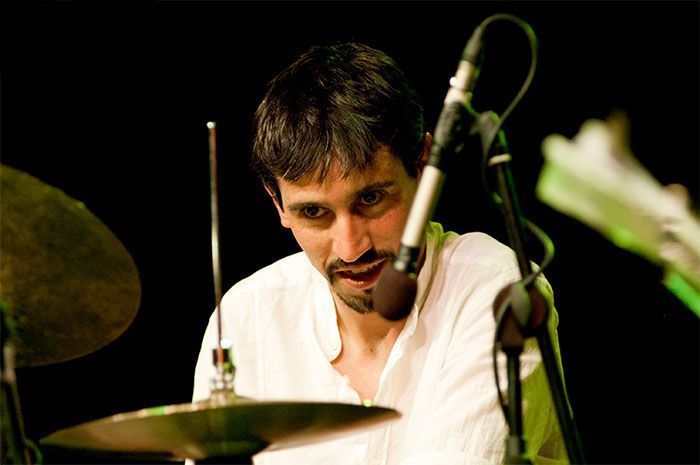
Judging by the way Pepe plays and by his multi-instrumental ability on percussion and drums, I think his learning process has been exceptionally well nourished: full of teachers and countless sources. I believe that reaching a level as exceptional as his on an instrument requires a vast prior background. Today at ISP we set out to get to know him.
An open mind
In music, as in other creative fields, we love multidisciplinary minds. We always try to get away from the concept of the "isolated musician." For example, there are guitarists who think the musical summit is Yngwie Malmsteen, Petrucci, Satriani and little else. In my view, and with all admiration and respect for virtuosos, the guitarist who dreams of Steve Vai could also learn a lot from hundreds of other figures: from Vinnie Colaiuta to Paco de Lucía, by way of Herbie Hancock or Carles Benavent. I'm not trying to create a catch-all where anything goes. I'm just trying to show an absolute diversity of styles that can be, or rather are, sources of learning for any restless mind.
I would even venture to say that trying to understand the work of Chillida, Bacon or Clavé (to name a few) also brings flexibility and focus to a musician. In short, you need flexibility, discipline, broad-mindedness, modesty and study.
Our guest today is one of those "books" every creator should read, for his dynamism, his knowledge of music and percussion instruments, and for his discipline and talent. We welcome Pepe Acebal.
Thanking him for his time and dedication in taking part in the ISP conversations between musicians, we get ready to "fire away" with questions.
Dear Pepe, the question is a cliché and a bit square, but it's a classic: when did you start with music, and why?
Well, I suppose my beginnings in music were like those of so many other musicians. My parents were always very fond of music, and at home there was a musical and cultural atmosphere at all hours. My older brother plays guitar, and that contributed a lot to my love of musical instruments, particularly drums and all kinds of percussion.
I must have been eight or nine when I was already making my own percussion sets out of everything I could collect around the house. I had to borrow drum kits for gigs on countless occasions, and I got by as best I could until I managed to get my first set.
What kind of twists of fate make someone with a passion for music move from place to place until they become a professional who makes a living from it?
Life takes you from one place to another for countless reasons. I was always clear that I needed to play and express myself on my instrument as best I could. To achieve that you need study, perseverance and contact with great musicians, from whom you can learn or with whom you can hold musical dialogues at the same creative level and with the same musical sensitivity. Unfortunately, that's sometimes not easy to achieve and requires efforts and sacrifices of all kinds. The determination you have to reach the goals you set yourself can help your development as a musician and as a person a great deal. If you have a clear goal in life, don't hesitate to run after it.
Do you think a drummer can learn something from a pianist, guitarist, etc., and vice versa?
I think any artist can learn something from another. I would venture to say that a musician is capable of assimilating the work of a painter, sculptor, writer, etc., and they in turn can understand the work of a musician.
Sensitivity is something common to all human beings; we just need to pay a little more attention to our feelings and give them a bigger role in our lives. As a drummer I can learn a lot from a guitarist or a pianist, but I can also learn from a carpenter, an electrician or a bank employee. All of them can help me see other sensitivities and assimilate them, and through music I will be able to, or will try to, convey them.
On your instrument, who have been your role models?
There have been a lot of people who have influenced me, always depending on the period of my life and the style I'm listening to or studying. From John Bonham, Peter Erskine, Elvin Jones, Ginger Baker, Steve Gadd, Mitch Mitchell, Bill Cobham, Jack DeJohnette, Joe Morello, etc., to more current drummers such as Brian Blade, Dennis Chambers, JoJo Mayer, Vinnie Colaiuta, Jeff Ballard or Ari Hoenig.
Any drummer can be an influence for me; in our country we also have great drummers, and you can learn something from all of them.
Many musicians consider percussion something completely separate from drums. Do you think they have parallels? Or do they have nothing to do with each other?
Percussion is a very broad concept, which includes both pitched and unpitched instruments. The xylophone, the vibraphone or the steel drum have nothing to do with a bass drum or timbales. What we usually see in bands, orchestras and so on is a percussion set with congas, cowbells, timbales, etc. Of course, these instruments have a lot to do with drums and are directly related to each other. This kind of percussion complements the drum kit in order to create and maintain the rhythm within the band. We have to be subtle when playing with another percussionist and realize that it's a job of uniting, not a rhythmic competition.
On the other hand, I play several things besides drums, such as cajón, darbuka, tabla, etc., and this helps me better understand many of the rhythms I play on the kit, or add another color and nuance to the various styles or pieces I have to work on, whether with that percussion or on drums. The more variety and plurality we're able to assimilate, the bigger and broader our language for expressing ourselves will be.
Less show and more substance. At this point in your professional career, how do you interpret that phrase?
Well, I know that in this little music world there are a lot of snake charmers and a lot of opportunists, but I trust in things done right and in daily work to achieve distant goals. I hope I'm not wrong in saying that preparation is the best path to great things, although I also know it isn't the only one.
What steps should a drummer who wants to learn, improve or perfect their playing follow? What's the best way to get the most out of learning?
I think that to learn something we must first know ourselves. No two people are the same, so there can't be one method or way of learning for everyone. We need to pay attention to our mistakes when playing, analyze the reasons behind things and practice what our instinct can't develop on its own. It's better to stop practicing a pattern for half an hour to analyze and understand it than to spend three hours practicing something played badly. We need to study our own way of playing to correct our mistakes and not dwell so much on how others play. You can learn something from everyone, but we must select what can be useful to us, or what best suits our way of playing.
Do you think jazz is the reward for a musician's intellect? Or do you think you have to be true to yourself and not "sell out" to the commercial side, even if it means more hardship?
No, I don't think so. Jazz is just one more style within the musical conglomerate; perhaps it takes more effort to understand or perform, but there are also folk or popular musics that share that common denominator, and they don't enjoy greater cultural or musical "status" for that reason. Flamenco is a clear example, since until quite recently it was, to say the least, a marginal music.
We have great composers making commercial music both in our country and abroad, but that doesn't make them worse or better musicians than those who don't. The crux of the matter is how far you can tolerate it, combine it or simply survive without doing it. If your way of life allows you to devote yourself solely to the music you really like, or that fulfills you, good for you. But if not, it's logical that we look for other resources or other means to achieve what we want or long for.
What has shaped Pepe Acebal the musician, and what are his goals today?
I really don't know. I suppose everything I've lived through has made me who I am and made me play the way I play. All experiences, both good and bad, shape us, and we learn from all of them. Music is a form of expression. To express yourself you need to have something inside you and good ways to communicate it. That's why it's so important to soak up everything we see and everything around us.
My main goal, like that of most mortals, is to try to improve every aspect of my life; to try to be a little better every day; to feel at ease with myself and to improve my musical level as far as I possibly can.
What projects are you working on? Do you feel musically satisfied with them?
I'm currently preparing to record a rock album with Chema Vilchez and a handful of other great musicians. The idea is to make a high-quality rock record without falling into musical clichés or easy rhymes. I also have some shows planned in China and India presenting Chema's new work, a flamenco-jazz album called “Tierra de las tres culturas,” an album of sublime quality, by the way.
While I'm in those parts, I'll take the opportunity to give some master classes on the cajón and its use in flamenco.
I'm preparing some shows with Razl; I'm also composing songs and playing gigs with my jazz trio of guitar, trumpet and drums. In addition, I'm studying, preparing some of those "one-off" performances, and researching the use of new time signatures in flamenco.
I can say that I'm satisfied, musically speaking, and I hope to keep working so it stays that way.
Where and how can we hear your work?
Well, my latest recording is the album of an incredible guitarist. His name is Razl, and his CD is titled “Rotonova.” It's a jazz-funk album that is being very well received in the U.S. and other countries. Here in Spain it's just starting to get exposure. It's an exceptional work featuring musicians of the caliber of Dean Brown, Mike Keneally, Bryan Beller, Damian Erskine, etc. Also, right now I'm having a little trouble with my website, but on my Myspace you can find videos with Chema, songs by my jazz trio, songs by Razl, previous work and other information about my musical journey.
As usual in our conversations, we now offer you a space where you can freely say whatever you want to the music community. An answer for those who are learning, for those who are progressing, for those who give up, for those who are still full of enthusiasm: is music worth it? What's your advice?
First of all, I'd like to thank the magazine for giving me the opportunity to work alongside so many great professionals and for always treating me so well.
I believe music is something that can help all of us a great deal, because it has the power and beauty to make us feel good and to help us be satisfied with ourselves. But I also believe that the business built around it discredits this art and sometimes makes it utterly repugnant.
Music is worth it, yes, but when it becomes pure business, it stops being rewarding and becomes something destructive.
I encourage everyone to get into this art and enjoy playing what they truly feel in their hearts; to explore; to learn in order to improve; to be stubborn and persevering on the difficult path, and never to give up, even if sometimes it seems like the best solution to all our problems.
Warm regards to all the readers.
Thank you very much for your kindness and your time. Welcome to ISP Música.