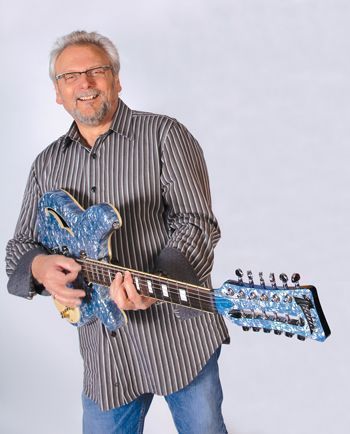
 Let him who has never spotted this British leader's name somewhere on his guitars cast the first stone. Bridges, pickups, tuners... And, of course, entire guitars. Yes, I'm talking about the creator of the 100% English-made Fret-King guitars, of some of the smoothest tremolos ever built, and of the six-roller nut that giants like Fender have trusted: Mr. Trev Wilkinson.
We sat down face to face with the genius who one day helped the world's guitar-playing population keep their instruments in tune, and who today has become a reference and a role model, especially in hardware.
After welcoming this veteran of the business, we began a chat in the very English style: formal, but fresh and pleasant. All that was missing was the tea.
What led you to build guitars, and at what age did you start?
I built my first guitar at art school at the age of 16.
Did you have any influential luthier or artist behind that?
Peter Green, Jeff Beck and, of course, Eric Clapton were a great inspiration to me.
Wilkinson products have a great reputation and excellent quality and reliability, which is why we find them installed on mid-range and high-end guitars. What led to including them on low-cost guitars now? And why did you choose JHS to carry out the development?
We believe everyone should be able to have good-quality products, at any price range. Wilkinson built its reputation by helping guitarists keep their instruments in tune. And the truth is that what you need to build the hardware required to achieve that doesn't cost much more!
Among the criteria that determine the price of parts are the country where the labor takes place, and the labor costs and wages. You can develop a high-quality product in a country with lower labor costs if you know what to tell your workers, give them detailed information, sketches, drawings and so on, and follow up with quality control checks. That gives us the chance to offer our customers, guitarists, access to more affordable hardware that performs better.
As for why JHS, we didn't choose them; it was really they who saw the opportunity to improve their products by working with an independent design company. They were one of the first companies to see the benefit of using Wilkinson hardware on their own guitars. So when their director, Dennis Drumm, asked me for guitar design advice for them, I saw a fantastic opportunity to help guitarists, beginners and professionals alike, buy the best possible instrument for them.
We see the most traditional designs in the Vintage by JHS guitar models, covering most musical styles. Do you intend to develop new designs together with JHS?
We always take care of every aspect of guitar design, whether it's classic or contemporary styles. What concerns us most with any product is that it offers good value for money, that it works properly and that it performs as it should in the field it was designed for.
We would never develop a guitar to satisfy a different style if it didn't work and click with the player.
Did you have difficulties in the beginning?
I think every company has its share of difficulty at the start, but when you believe in what you do, the difficulties don't seem so many!
We understand you tried to do business with Gibson in the early years, but finally succeeded with Fender. Is that true? If so, what happened with Gibson? Was there some dispute?
We offered the Wilkinson brand products to everyone connected to the industry at the outset, but it was Fender who showed the most interest in the Wilkinson Roller Nut, so we considered them the ideal partner. It's true we had some run-ins with Gibson, but it's too long and complicated to explain in a short interview like this one. Still, it all ended amicably. We have supplied hardware to all the major guitar makers, including Gibson.
What was it like working with Fender? Were you happy with the staff and the management?
I got involved with Fender during the start of their renaissance in the mid-'80s, and the enthusiasm of their R&D team back then, which included Dan Smith, was totally free of bureaucracy. It was great working with them!
Do you intend to design and produce higher-end guitars?
We believe we already produce high-end guitars in our Green Label series, especially the “Stvdio” line. However, I've said in other interviews that if you can't build a good guitar for 3,000 pounds, you shouldn't be doing it! The challenge I see and find most interesting is building a guitar for about 200 or 300 pounds! No matter how much you charge for a guitar, that doesn't necessarily mean it will be good!!! I think even some of our more expensive guitars offer good value for money, and they're not just expensive for the sake of it!
Let's now turn to your concept of the electromagnetic pickup. What did you have in mind the first time you designed a pickup?
I suppose I did what everyone else in this industry did: I looked at the classic pickups you could find on the first guitars, Teles, Les Pauls, Strats and so on. Then I tried to understand how those pickups were built and why they sounded the way they did.
In your opinion, what characteristics should a good pickup have, regardless of the style it's designed for?
The sound of a pickup is very subjective and personal. I think the most important factor in a pickup is the tone it produces. However, the way each person translates the concept of “tone” is very personal and really hard to quantify.
Do you intend to create high-output pickups geared toward heavier musical styles?
With a relatively small range of specifically targeted pickups, I think we already offer pickups to cover all musical styles.
Do you think guitar companies are currently cutting costs and lowering quality when it comes to choosing the right pickups to complete their electronics? And what about hardware?
Building guitars is like many things in other industries. You can produce focusing on price, or on quality. The reality is that the difference between components isn't always a matter of cost, but of specifications. Most of the major brands are trying to build better guitars, but Vintage by JHS are the ones setting the trend when it comes to selecting the best-quality pickups and hardware, and it's proving very successful for them. For this reason, many of their competitors are doing the same, and that makes everything easier and better for the guitarist, especially the beginner.
By the way, do your pickups compete with those currently on the market, or are they a new concept whose characteristics were unknown to everyone until now?
Many have tried to develop pickups to achieve new sounds by using alternative materials; but in my experience very few have, and in those cases, they have succeeded in this field.
We understand you have forged personal ties with Seth Lover to develop the WVC pickup model. Does this pickup really have the same characteristics and materials as the original PAF?
Yes, the WVC pickup matches the original PAF. I met Seth many years ago. He came to visit me at my factory in southern California. I had bought a winding machine identical to the one he used to build the early humbuckers, and he wanted to see it. He told me the whole story behind these legendary pickups, how he designed them and how they were made on the machine I had. It was fascinating. Before he left, I asked him if he could tell me how to create an “authentic” PAF, and to my surprise he gave me all the information I needed to create the most accurate replica possible, which is now the WVC pickup, and which includes the most important and costly part: the cover and the baseplate, made from solid nickel silver.
Are there other companies, apart from JHS, whose instruments currently use Wilkinson pickups?
Yes, many! Too many to list!
As for guitar bridges, one of your most acclaimed designs is the knife-edge tremolo, for greater precision. But a successful product often leads competitors to try to imitate a creator's mastery. Have you ever been forced to start lawsuits and legal action to protect your designs and force other companies to respect them?
No.
Any longtime Wilkinson endorsers?
Again, there are really too many to list! Many professional guitarists use guitars fitted with our hardware, but I think one of my greatest thrills was when Jeff Beck decided to use the Wilkinson Roller Nut on his guitars, and he still uses it today!!!
What can you tell us about Fret-King guitars? The Green Label line is built in local workshops in the UK, isn't that right? What is the difference between the Fret-King guitar concept and the Vintage one?
Yes, the Green Labels are built here, in my workshops, by a small group of dedicated, veteran builders. We use only the best materials and components available, meticulously selected for their quality and consistency. The guitars are finished and set up to a very high standard, with a great deal of attention paid to feel, frets, action and so on.
Almost every musician understands Wilkinson as a company that makes hardware and pickups. Yet you have managed to create your own line of guitars. What led you to create guitars, and not just pickups and hardware? What's more, why now?
In answer to your first question, when I built my first guitar, in the late '60s, my desire to create a complete guitar was forged and has been maintained ever since.
Fret-King, Vintage, Italia and other brands I've designed for have allowed me to do it!
Where are the guitars assembled? Where do the raw materials (wood, metal, etc.) come from?
The Green Labels are assembled here in the UK. The Blue Labels are built in a small factory in Korea where I've worked for more than 14 years. It's almost like having my own Custom Shop.
The Vintage products are built in several Asian factories that we've selected to assemble the guitars to the standard we require. The woods come from the same American, Canadian, Indian and African forests that have supplied guitar wood since the beginning of time. In addition, some of the areas where we build also supply native woods in small quantities.
Have you ever worked hand in hand with another guitar component company to research new technologies or collaborate on joint products?
I maintain many ties with guitar parts manufacturers around the world, but all my products are designed by my company and built to our specifications.
If it were offered to you, would you support and deal with any other major guitar manufacturers today?
I think we already support many brands, because they buy and use our Wilkinson hardware! Our expertise is available to customers, new or existing, to advise them and help them choose the best product for their instruments.
We greatly appreciate the collaboration of this musical eminence. Although it was a short interview, it has become clear that all instrument-making companies age like wine: some turn to vinegar and others get better. Fortunately, our guest, thanks to his excellent vision as a musician, builder and businessman, has proven to be one of those who improve with age, offering products whose quality, at this price, is very hard to find from other brands.
With us he was friendly, gracious, open-minded and polite. As we said, all that was missing was the tea.
The only thing we regret? Not having had the 100 pages this month to feed on the experience of this English giant. With veteran figures like this one, our thirst for wisdom seems to know no satiety.
He added a personal note: we are going to be invited to his workshops in England. Excited and breathless, we thank him again for this gesture, which will no doubt get people talking and will be captured in a future ISP issue, with a special feature on the upcoming visit to Mr. Wilkinson's factory. Stay tuned!