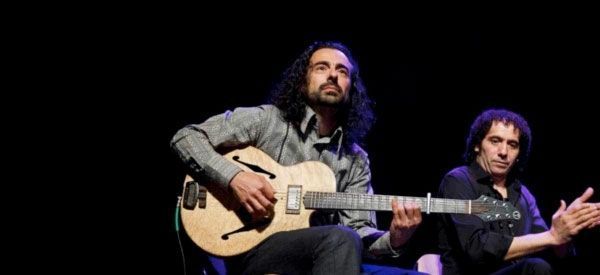
 A color halfway between flamenco guitar and electric guitar, something authentic and surprising. A new sound within flamenco, distinguished by seeking inspiration in the oldest cantes and palos, born under the guidance of Pepe Habichuela, in which, for the first time, the electric guitar sounds truly flamenco.
The musician. The art.
One fine day, by one of those accidents that happen in life, I met this great guitarist. A series of coincidences that at first had nothing to do with music became the path that would cross our lives.
A very dear friend told me about someone I didn't know at the time (Jaco Abel), a musician. Well, people tend to use that word lightly sometimes. I don't usually grant that title, musician, in my mind until I personally confirm that someone is one, and of what “caliber” (you know what I mean).
Shortly afterward I met this artist in person. Just seeing his gaze, his aura, I knew his inner world was vast. Listening to the first few seconds of his work, I realized the word musician fell short for him. A mix of art, a thirst for exploration and plenty of hard-won experience. What struck me at the time was the great mastery of his hands, the virtuosity he gave away and, at the same time, the way he channeled everything he had learned. The search for expression, for sincerity, for authenticity.
Jaco Abel's music is poetry. Verses for cultivated ears. His notes overflow with colors. Colors of discipline and study, of the street, of restlessness, of life, colors of feeling... A rainbow full of aromas and nuances that overwhelm the senses of those able to perceive them.
Through Jaco, I met Tomatito (José Fernández Torres) in person. I remember us watching a concert by this giant of music together. At the moments when Tomate's guitar gave me that pinch in the soul, Jaco had that knowing look. I understood then that we both understood a common language far removed from words and everyday things.
Since then, I've had the opportunity to keep enjoying Jaco Abel's art: live performances of his albums, concerts with Don Pepe Habichuela and Josemi Carmona... how great they are. I am always eternally grateful to anyone who shows me all, or part, of what I still have to learn. Jaco Abel and his musical circle are an inexhaustible source of richness, for their magic, their philosophy and their way of understanding music. Today I want to share that gratitude with you, ISP readers, and show, to whoever feels the call, a path that opens doors for the development of any musician eager to drink in the culture of others who explore and share their wisdom.
Dear Jaco, it's a pleasure to have you in our pages again. Today we're taking a deep interest in your current work, your evolution and the mark your signature leaves: electric flamenco. I think it will be very enriching for all our readers if you help us understand your research and grasp what it really means, because it is surprisingly great and revolutionary.
Thank you very much; it's an honor to be your choice.
As often happens with a creation or discovery, things mostly happen through inertia or chance; at least that's what has happened to me, and it's only now that I can look back and analyze the process and the results a little.
For me, innocence, time and freedom are the foundation of learning, but there is also discipline and technique. I think that, in a certain way, an inner voice of expression has awakened, and it was Pepe Habichuela who made me sure of it and closed the circle, giving me the encouragement I needed to start my career as an electric guitar concert performer.
It all happened to me without really thinking much about it, but the fact is that you must never stop believing, dreaming, searching and learning, even though on many occasions it may seem you're in the dark with no direction at all. As in life itself, in art there comes a moment when the different stages you've gone through consolidate, but it has to be the artist who identifies himself, and that really is a great challenge. So I now feel I'm in a fruitful period, evolving every day, full of new things and discoveries; I no longer just play sounds, but am finding a meaning and a very deep respect in my music.
1. As I mentioned a little earlier, there are many aromas in your work, but you've taken a surprising personal direction. How have you been adding flamenco to your compositions? What does it awaken in you?
Gypsy flamenco has been part of my life since I was born; it's in my blood and my heritage. My grandmother, who is from Almería, from the Garrucha area, had a gypsy tablao in Barcelona's Gothic Quarter in the late 1960s, where we went often until I was 6. Back then the best artists of the day came, like Farruco, el Güisa, etc. Since then I haven't been able to escape it; my inner pulse is flamenco, something you absorb in childhood, in the subconscious. When I've played other kinds of music, that has always essentially been my difference; I've never been able to play like everyone else. When I played blues, jazz, funk or African music, my phrasing was different, in bursts, like the waves of the Mediterranean. Now, being able to play the original flamenco language on the electric guitar awakens in me the beginnings of life itself, childhood memories and feelings hard to put into words, because they take me to the beyond, like an inner dream where everything fits: life and music.
2. Convention makes us think that any guitarist who plays and explores flamenco goes through nylon strings. You're not conventional, thank goodness. What made you want to stay with your expression on the electric guitar and develop this concept?
Yes, flamenco comes from nylon; that's how you hear it inside. I switched from the bajañí (Spanish guitar) to electric at 14 and developed all my technique on this instrument with steel strings and a pick in my right hand. There's a long way between knowing flamenco inside your head and playing it on the electric guitar, but it was with Pepe Habichuela, sitting on the sofa in his house almost every day for seven years, that I really learned it; and then, when I played it on electric, a new right-hand technique came out intuitively so I could reproduce on my instrument what I heard from the master's flamenco guitar... my God... what patience he's had. :-)
I remember asking him at the beginning if I could bring a recorder now and then to capture ideas, and he told me very seriously: “No, flamenco is learned by listening, watching and feeling... like my son.” I answered, “... but Pepe, that's going to take me many years”; he smiled slightly and said, “Yes.”
3. And how have you fused all of this?
I don't think of my music in terms of fusion; maybe years ago I did, but for a long time now I've been doing what I feel and what belongs to me, what life has given me and what I've learned through oral transmission of the “Habichuela” flamenco essence; and that's how I reproduce it on my instrument. It sounds different because the sound of the instrument is different; I think it's more like an evolution or a parallel path. Jazz musicians who take ideas from flamenco and improvise on it without knowing the foundation, without knowing where the melody of the cante is, the different palos and the sense of rhythm, in my view aren't heading in a good direction; we don't feel anything, there's no pinch when we hear that. Flamenco isn't like jazz; it comes from Hindu, Persian and Greek roots developed in Andalusia... nothing to do with it. Jazz comes from Africa and Europe, developed in the southern US, and although there is an analogy in the unjust torment both peoples have suffered, one since the deplorable Catholic Monarchs in Spain and the other through the terrible slavery in North America, flamenco is unique: it doesn't invent, it remembers. It doesn't express a fragment foreign to its culture, but reproduces memory to this day; now that's something we enjoy hearing.
That's where the great purity and richness of this art lies. There may be flamenco schools in any country and perhaps very good performers, but memory is only part of childhood and of family tradition maintained and passed down orally for generations. There's no shortcut, no “express” flamenco; you have to respect and listen to those who came before in order to know the language well.
4. Flamenco is a world with a lot of rigor. Conservative. I know your work has been very well received. How did you manage it? How have you managed to make even the most severe and demanding noses breathe in “the real” flamenco?
The reception the CD has had among the most specialized and conservative critics has been surprisingly good. I think that when things are honest and you're not pretentious, critics can hear that too. I haven't tried to do anything more than play who I am, where I come from, what's in my inner subconscious. When I recorded a passage and played it for Carlos Habichuela and Pepe... they'd look at each other... if they smiled knowingly, they helped me see the right path and the flamenco sense of the music; you learn a lot that way.
I've received nearly 40 reviews from the most specialized newspapers, even from Iran, Italy, Russia, the Netherlands, etc. All of them have also been very good, to my surprise, and some quite descriptive, which has helped me grow stronger as an artist and trust myself. Although, I'll tell you something, what really terrified me was the reaction of the youngest gypsies, who are pure of soul and don't mince words. Today, luckily, they ask me to let them play a little on that shiny guitar that you make sound through the washing machine (the amp) with a cable.
5. You've worked and collaborated with great artists, and they with you. Who and what would you highlight about them? Have they given you something, and what?
Every collaboration has its share of importance. One of the first was Ramón “el Portugués,” who sang on the bulería “la Canita.” Listening to him fills me with great respect; he recorded some old lyrics by “el Cojo de Huelva” and La Niña de los Peines that are more than 80 years old. Ramón is one of the great old-school figures, like “Habichuela” or Jorge Pardo, who have already created a school and have an unmistakable sound. “El Paquete,” Ramón's son, also sang two songs; he had never sung as a soloist before, but his voice is really special, and he's also a great guitarist. We've spent a lot of time together learning from each other. It was hard to convince him, but in the end we caught him in a soft moment one afternoon and... bam!!!
Ramón “el Portugués” is currently singing with us live; seeing and hearing him is quite an event. The malambo with Pepe is also a very special piece, composed by the two of us. I think I irremediably love the old styles... as Ketama said... “es ke me han kambiao los tiempos” (it's that the times have changed on me)... and, in my case, the guitar.
6. What does your latest album, “Flamenco Eléctrico,” contain and teach?
In the beginning, I didn't intend to make this particular album; I just wanted to capture the passage of time and the sessions with Pepe and various families. I didn't know what I was going to find, nor did I have the right instrument back then. It was halfway through the recording that the “flamenco electric” guitar appeared, and that gave me a lot of strength to continue and get the CD out.
At first, during the recording, I realized that on its own the sound of my electric guitar was rather soft compared with the flamenco guitar; and since I have some knowledge of electronics, I got down to work and looked for a way to make it sound more flamenco. When I found it, I went to Amsterdam and asked Dani Marcovich, the only luthier who has been making guitars for me for 14 or 15 years, to install it in my electric, and we improved it together. He is now finishing the first flamenco electric guitar conceived and designed as such from the start, which I hope to have in October and with which I want to record my third album.
I also took an old Goya “Rangemaster” guitar out of the trunk; I had removed its frets when I was 19, and it sounds sweet and very flamenco, like a kind of lute. I also play bass, percussion, palmas (handclaps), etc. We mixed it with Álvaro Mata in a “makeshift” studio belonging to Manuel, a good friend, and the photo shoot was handled by Margarita Izquierdo; as the icing on the cake, Alejandro Hasler made two impressive pen-and-ink drawings for me.
7. Are you going to continue along these lines?
A large part of the album “Flamenco Eléctrico” is based on some old cantes from Granada, which are melodies and harmonies familiar to me, that I felt I knew and had heard hundreds of times, like the children's songs we all know, simpler perhaps than today's flamenco, but full of memories, which take me back to the first positions of the essential chords on the Spanish guitar that I learned at an early age at my mother's flamenco dance and music school. For me there's no other path now; the future lies in memory, although several good friends have told me they miss the effects and distortion. I don't know yet, but perhaps in the future those sounds will reappear, since they're also part of me and my life... things are coming on their own now... there's still a lot to learn...
8. I know that several multinational companies are interested in your signature flamenco/electric guitar models. I don't want to jump the gun, but what does it, or will it, consist of?
Like you, I'm not one to jump the gun on these things either, but I can tell you that after some meetings with one international company in particular, there seems to be considerable interest in the design and components of the flamenco/electric, which brings the same elements as a flamenco guitar but with a fully electric sound. It's hard for me to explain the sound specifically, but think that, in addition to the electric sound, you also hear the golpe (tapping on the guard plate), rasgueados, slurs, the sound of the body... like a flamenco guitar.
How have you adapted an electric guitar to give you better results for flamenco?
By spending many hours thinking and testing until I found the solution to problems I'd never had before; sometimes one solution brought me another problem. I spent several months with the studio in a mess. You should have seen it, full of cables, pickups and components; you couldn't even get in. Luckily, as a kid, my mother made me study electronics in vocational school, and told me that if I didn't pass she wouldn't let me play guitar. The magic of life, as I told you. Without electronics I wouldn't have achieved this sound on the CD, and without Pepe Habichuela neither; it's as if everything I needed to make this album day by day came from yesterday.
Speaking of guitars, what do you need in one, and what have you achieved with the modifications or ideas you've put forward?
I'm not a guitarist of a single instrument, and I never have been; for each stage life has revealed to me, I've had to adjust and adapt. The electric guitar on its own has specific characteristics that perhaps aren't well suited to playing flamenco at first, for example the sustain is longer, they're less rich in harmonics, or when you use a capo you have to redo the spacing. I've tried to adapt to those differences and make the most of them. With the modifications, the electric guitar has been “flamenco-ized,” with a much richer sound thanks to the golpeador (tap plate), which also gives it much more dynamism and snap... then, for it to sound good, you have to caress it.
9. Do you reject nylon-string flamenco guitars? Do you feel uncomfortable on them?
No, not at all. I love the sound, I'm captivated by it, but their necks are very wide, too wide for my hand; I don't have the necessary precision. Also, the string spacing is different and the fingerboard itself has other measurements. I learned flamenco by listening to it on the flamenco guitar, and although as a teenager I completed my classical guitar studies at the Conservatory and so on, I was already playing electric; I feel like an electric guitarist. But in life you can never say “I won't do it.” At 14 or 15 I dreamed of a flamenco guitarist with steel strings; even back then I put them on a flamenco guitar I had, but the tension tore the bridge off the soundboard; and it hasn't been until now, after 20 years, that it has finally arrived.
In any case, Juan Miguel Carmona, from Granada, is going to build me a bajañí with a short-scale wooden peghead soon; we'll see how it feels and what happens... maybe when I turn 70? :-)
10. What are your most immediate projects?
This August I was playing in Mojácar, and a few days ago I got back from Budapest, where we gave a concert booked by the Spanish Embassy and the Instituto Cervantes. I'm currently preparing an instructional DVD that I've been offered for the North American and Japanese markets, and I'm already working on my third and fourth CDs. I also produce and record on other albums: Bernardo Parrilla's is coming out now and Moy Natenzon's soon, on GCProducciones. I also give master classes or seminars where I explain the music I play and the concept of the Universal Clave; I have my own record label, and I devote about three hours a day to the instrument. Of course, I go to see “Habichuela” quite often to soak up even more...
What about playing live?
It's taken a lot, but I'm a completely independent artist, owner of my time and my work, which is easy to say. I haven't sold the rights to my work to any manager or record label; I'm working only for my modest label, GCProducciones. All the buzz created since the recent release of “Flamenco Eléctrico” has come very quickly and almost by surprise, without a real promotional campaign. Little by little I'm booking concerts, but I'm starting to need help. I'm talking with a few show promoters who would handle promotion and bookings, so you can enjoy live shows in Spain more often. Until then, you can check upcoming dates on the website www.jacoabel.com, where you can also contact me or the office directly.
We close this conversation by leaving, as always, an open space where our guest can address all ISP readers in whatever way he sees fit. Jaco, I'd like you to leave some reflection for those starting out in music and for those who thirst to learn, whatever their level and artistic stage.
I believe that honesty in life and a noble awareness of one's actions inevitably have an impact on the artist, on his voice and on how he is remembered. Music is the expression of life itself; the moment it separates from life, for me it's no longer worth anything.
To those who are starting out, know that music never ends; and to those who are eager to learn, learn from the old ones, for they are the memory of our childhood.
In a letter Steve Khan wrote me in '94, a few days after I gave him a cassette with three songs, he told me he didn't like being critical at all, but that he thought my sound could create a unique space in contemporary music, if I didn't give it up.
(That was more than ten years ago now.) Perhaps that's the hardest part of all: not giving it up. Never stop dreaming, playing and living... time will give you the answer.
Thank you for your courage and your exhaustive dedication to creation. You're great. Thanks to Jaco Abel.
ISP
Thanks to you for your much-appreciated work.
Biographical overview
Is “Electric Flamenco” possible? How do the most classic palos sound on a Marcovich? No one knows better than Jaco Abel, the first flamenco guitarist to play on electric guitar thanks to a self-taught technique that results in a unique, different and new sound, yet unmistakably gypsy.
Jaco Abel was born into art: his father was a flamenco guitarist and dancer and his mother a classical/Spanish dancer. From the age of three months he was involved in the world of music, traveling with his family, who at the time ran the flamenco show of a circus all over Europe. Music was with him from his very first days, so much so that, according to his mother's notebook, among the first words he spoke when he began to talk was “ayaya,” the word he used for the guitar.
His musical career began at the age of eight, when he started studying classical violin at the Terrassa Conservatory of Music. His training continued as he learned all kinds of instruments. At 13 he studied electric guitar at the Aula de Música Moderna y Jazz in Barcelona, and at 14 he returned to the Terrassa Conservatory of Music, this time studying classical guitar and trumpet. In this way, although he was always faithful to the instrument he had loved since early childhood, the guitar, he learned music from different instrumental perspectives, creating a completely self-taught system. He also studied modern harmony, arranging and electric guitar with Ramón Montoliu, Pere Soto, Gabriel Rosales and Don Mock, among many others. Later, as the favorite pupil of Maestro Pepe Habichuela, his great mentor, he perfected his flamenco in Madrid.
On coming of age, at 19, and having switched from Spanish guitar to electric, his interest in music led him to travel the world for 15 years. During that time he came into contact with jazz improvisation, blues, classical music, African music, South American folklore, Balkan music, etc.
In 1986, at 20, he landed his first contract accompanying the Four Tops at the Casino de Ibiza, while also playing at Café Pereira alongside Thijs Van Leer. That same year he moved to Madrid, where he began working on the flamenco-fusion circuit with Joseph Salvador, Antonio Ramos, José María Cortina, etc.
Then came his North American period. During his time in the US, he played, recorded and toured with Jim Coil (L.A. Express) and Mark Cardenas (Prince & the Time), and also played gospel in several well-known churches in Seattle.
In '94 he moved to the Netherlands, where he toured several times with Fra-Fra Sound, Lilian Viera (Zuco 103) and Jaime Rodríguez “De Cuba A Colombia,” but it wasn't until 1998 that he recorded his first CD under his own name (although it wouldn't see the light of day until five years later). It featured Jeff Ballard, Joseph Pérez Cucurella, Ramón Valle, Thijs van Ruller, Mike del Ferro, Stefan Lievestro, Saskia Laroo, Benjamin Herman, Jay-Tee Teterissa and Wibaud Burkens. Also in '98 he took part in recording Debora Carter's solo CD, “Scuse Me,” and Jay Tee Teterissa's “Play da Bass,” with David Garibaldi, Mike Stern and Alain Caron.
During this period, Jaco continued playing at many jazz festivals far and wide: North Sea Jazz Festival (Netherlands), Montreux Jazz (Switzerland), the National Theater of Sarajevo, Sofia Jazz (Bulgaria), Beirut Hamra Jazz (Lebanon), etc., collaborating occasionally with Jimmy Smith (organ), Me'Shell Ndegeocello (bass/vocals), Foley (Miles Davis), Candy Dulfer, Randy Bernsen (Zawinul Syndicate), Jesse van Ruller and Tower of Power (USA), among others. In 1999 he recorded as a guest soloist on the CD by renowned Venezuelan percussionist Gerardo Rosales, also taking part in its launch at the well-known Bimhuis jazz club in Amsterdam and at Paradiso alongside Larry Harlow (Fania All Stars).
In 2000 he composed, recorded and mixed his first program for Spanish dance: a 20-minute work for six dancers based on two poems by his mother, Pilar Llorens, one of the most accomplished figures in the world of dance as a dancer (soloist in the ballet of Antonio and José de la Vega), writer (Montsalvat) and historian (History of Dance in Catalonia). That same year he also composed and recorded his second work for Spanish dance, a five-minute solo for soloist dancer Gala Vivancos.
A year later, on his return from New York, he was a guest soloist with the group Opoyeye at the Bimhuis in Amsterdam, followed by a performance in Barcelona with renowned Réunion Island (Madagascar) musician Meddy Gervillé. Also in 2001 he toured all over Spain on the “Alma” tour with José “el Francés.”
In 2002 Jaco Abel was hired by the French government to give a seminar on flamenco-fusion and polyrhythms at the Réunion Island conservatory in Madagascar, along with a tour with Meddy Gervillé Quartet's group of virtuoso musicians. That same year he moved to Madrid, where, after finishing the second album and second tour, “Jugando al Amor,” as musical director for singer José “El Francés,” and having recorded the single with Laura Pausini, he played and recorded on various projects with Jorge Pardo, Antonio Serrano, Pablo Martín, Gerardo Núñez, Estrella Morente (Calle del aire), Ketama, etc. That same year he also produced and recorded at his Madrid studio the album “Boa Voz” from Rio de Janeiro, a CD of traditional Brazilian capoeira music.
In the years that followed, his musical productivity continued, and his restless curiosity led him to found the record label GCProducciones, where he currently produces, plays on and releases a whole series of albums with musicians from the flamenco scene, with national and international distribution already in place for its catalog.
In 2003, steering his career as a soloist, he released his first album, “Gitano Cromático,” on which practically all the tracks are live first takes recorded in a Barcelona studio. Virtuoso Cuban pianist Ramón Valle collaborated with Abel on three of the album's tracks (it was originally composed in 1993, after the formation of the Jaco Abel Trio, and recorded in 1998). The album, which combines flamenco rhythms, jazz and world music (Brazil, Cuba, Africa...), is a journey through the richness of flamenco cadences and harmonies, all combined with jazz and improvisation.
In 2004, together with Pablo Martín, he flirted with film, recording the music for the “making of” of Mel Gibson's “The Passion of the Christ,” and also composed and recorded all the music for Justina Rodríguez's 20-minute short film “Las Hormigas.” Around that time he was also finishing what is considered the first flamenco violin CD, with Bernardo Parrilla, which will be released soon, and began working on his second CD of flamenco played on electric guitar.
A year later Jaco Abel took part in the “Flamenco entre Amigos” festival, sharing top billing with Pepe Habichuela, Diego Amador, Josemi Carmona and Farruquito, and went on to collaborate on various projects with Barbería del Sur, Joaquín Cortés and Tomatito, among others.
Last year, 2006, saw the birth of “Flamenco Eléctrico,” the fruit of the sessions and concerts of recent years and the influence of his teacher Pepe Habichuela, the great flamenco legend.
Here Jaco Abel fully reclaims his flamenco heritage with the electric guitar, giving rise to a completely new sound. Many of the harmonies and melodies on this second album come from old cantes, passed down by word of mouth, generation after generation. With his modified Marcovich, Jaco takes on bulerías, soleás, tanguillos, taranta, alegrías... making an electric guitar sound truly flamenco for the first time.
Abel's collaborators on this album form a very select representation of today's finest flamenco artists, including the aforementioned Pepe Habichuela, Ramón "el Portugués," Jorge Pardo, Manuel, Bernardo and Juan Parrilla, Josemi Carmona, Pepe Luis Carmona, Ana Salazar, “el Paquete,” Rafael Estévez, Bandolero, Luky Losada...
Although his sound may seem strange at first hearing because it's different, Jaco Abel has been praised by specialist critics and is currently considered the leading reference for flamenco electric guitar.