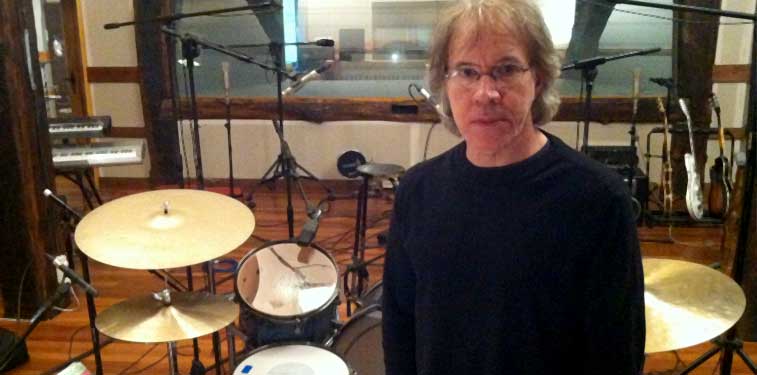
Some names make up the history of music in our country. Our guest today is one of them. At ISP Música, we always try to cover the real spectrum of music. And when we say the real spectrum, we’re not talking about the commercial side the general public knows. To make records you need real musicians, not just the ones who put their face out front as extras, but artists like Ángel Celada, who we’re talking to today.
Anyone can have a guitar at home; the same isn’t true of a drum kit. How did you get started? What was that “Mom, I want to be a drummer” moment like?
Ugh! Complicated. For some reason I still don’t understand, my calling was clear. I loved music and wanted to be a drummer, but first there was the difficulty of being able to buy a kit and then, where do you put it? I was given one, and a friend’s father let us use a rehearsal space where I took my first steps. Bands that were already active in Vitoria started calling me, and that let me keep learning and have a space to practice. As for my family, well, as anyone can imagine, my parents wanted me to pursue a more conventional career, music as a hobby yes, but not as something that would take me away from that… It was a matter of perseverance; little by little they saw that I was serious, and... now, of course, they’re my biggest fans.
Who were your influences?
Back then I mostly listened to blues-rock, bands like Led Zeppelin and especially Free. That band marked me in a very special way; I loved their music, well, I still do. Free has been my rock band. I have real devotion to singers; I often say I want to play the drums the way Paul Rodgers (Free), Steve Winwood and Roberta Flack sing… What a wonder to sing like that. As for strictly drummers, at that time my references were Simon Kirke (Free), John Bonham, Charlie Watts… Then came Steve Gadd, Billy Cobham…
Who do you think are the influences today?
It’s hard to answer that question, it’s very personal. I can answer for myself; there are many. I especially like settled drummers with a big, thick sound, which isn’t the same as hard or aggressive. I love Mickey Curri, Abe Laboriel, Steve Jordan… and even though he’s no longer with us, Jeff Porcaro: his groove, his sound, his rhythmic quality was superb; he was unique, and I’m not the only one who thinks so.
You’re considered one of the best pop-rock drummers in Spain and you also love jazz... Which musical style do you feel most like yourself in?
As you can gather from what I’ve said so far, I’m a drummer with a clear tendency toward blues-rock and R&B. Even though I flirt with other styles, that’s where I’m most comfortable, and I love medium, slow or very slow tempos, both straight and swung. There’s space, you can luxuriate in the sounds, in the notes… Chad Smith (Red Hot Chili Peppers) said: “Playing fast, really, anyone can do it; playing slow is truly hard.” You can get to playing fast by practicing toward that goal, but for playing slow the method isn’t so clear. It’s like a magnifying glass: the distances between hits are greater, it’s hard to be precise, it demands playing very settled and having a great inner tempo.
Is there such a thing as playing drums the Ángel Celada way? Is the tuning of the toms on your kit related to that particular flavor that comes through in your unmistakable sound?
Of course there is, it’s the way I play… hahaha! Honestly, I don’t know about that. If it were so, great; either way, it’s not something that worries me. I try more and more to play the way I feel, well, I don’t even try, it’s inevitable. Over time I think this gets more pronounced, as a musician and as a person. As for sound, look… painting is for the eyes, food is for the taste, music is… for the ears, right? Sound is very important. I don’t think it’s only the tuning of the toms that characterizes mine; it’s a bit of everything: the snare, the kick, the sizes, the choice of cymbals. I try to make everything empathize with each other. I look for a warm, homogeneous sound where nothing breaks out or stands out in a particular way. That’s why I use big sizes, both in shells and cymbals; they’re warmer and more discreet, they blend better with the music, and because they stand out less they go more unnoticed, and they make you play differently. I don’t look for references; my reference is that sound I have inside me. It’s a feeling, and when it happens, I say: “OK, this is what I wanted.” But without forgetting that, in the end, the sound, to a very important degree, is yours; that’s why on the same kit with the same tuning, I’ll sound different to every drummer.
El Último de la Fila, Mecano, Serrat, La Orquesta Mondragón, Revólver, Nacho Cano, La Unión, Manolo García... You have a long career behind you, but “hidden” behind your drums. How does it feel to be in the shadows? Playing with so many people, do you work, do you learn, or both?
Of course you learn; you learn from everything and in many ways, not only professionally. You live together, you share… And it’s also obvious that you work. Music is my passion but also my trade. I always say I don’t play for money, but if there’s no money I don’t play. As for being in the shadows, what shadows? Look, this is a calling. I don’t feel like I’m in anyone’s shadow, I really enjoy my work. It’s as if a soccer goalkeeper wanted to enjoy the glamour of the forwards who score the goals; then he’d have picked the wrong position, and that’s certainly not my case.
Many readers sometimes feel discouraged by how hard music can be when it comes to making a living. Any advice for not losing heart? Do you think drummers are valued enough in Spain?
I understand that if things aren’t working out, discouragement shows up. It’s hard for me to give advice unless it’s very obvious. In this case it’s delicate; I’d say that if it’s a rough patch, don’t be impatient, that in every aspect of life there are seasons, and patience is a great virtue. There’s a saying I love: “Be cautious in joy and serene in suffering.” If it’s not a rough patch, it’s complicated. The cliché would be to say believe in what you do, be persistent and, if you have talent, sooner or later it will come. But who decides who has talent and who doesn’t? Sometimes it’s complicated; some talents are very obvious and others perhaps more hidden, harder to detect. History is full of cases who were dismissed at some point and later became great. There’s also the luck factor… Perhaps enthusiasm and passion are two virtues that can keep us from despairing.
As for whether we’re valued, the truth is that I have worked with musicians with whom I felt valued, and I felt respect and admiration, and that’s how it should be, since the drums are a very important instrument. In any case, I don’t think musicians in general are valued enough.
The way things are, can you make a living from music? What does it take to break into the professional circuit: playing well or being adaptable?
I’ve been making a living from music for a long time, so obviously it can be done, though it’s another matter that we’re a lucky few. I know there are musicians who aren’t having such a great time and many others who supplement their income by teaching, and so on. I don’t think it’s really easy, although nothing is easy, easy. Anyway, you always have to stay alert.
What does it take to break into the professional circuit? I don’t think this is an era of great interest in style. Being adaptable will always help for the many jobs where they want a musician who does what he’s told or what others have already done, and that doesn’t have to clash with playing well. I admit I admire musicians with a distinct identity, but that isn’t always a help from the standpoint of the professional circuit.
In general, what advice would you give to new generations to improve as musicians?
As I told you, advice is delicate for me. I’d tell them the obvious: work as smartly as possible, few things are achieved without effort. Sometimes it’s also good to work at making it simpler. Simple isn’t easy and can be full of beauty. Sometimes you’re working on complicated things and, in any situation, something apparently simple shows up and can trip you up. It’s important to keep that in mind; sometimes we devote an excessive cult to complication. For me, virtuoso comes from virtue, not necessarily from making it harder. I don’t understand music as something with that circus-act connotation of “even harder still.” I’d tell them to be curious, to have an almost unhealthy curiosity. Sometimes I don’t understand the absence of doubt; doubt is intelligent and leads you to curiosity, and with curiosity you learn. I’d tell them that when the time comes, be themselves, otherwise you run the risk of being an imitator. And of course, listen to a lot of music, go to the roots, listen to the masters, but not only based on your instrument, with a broader view; sometimes it’s worth stepping outside it and listening differently. It’s important to have references. Everyone should have their own radar and be guided by their own intuition. I don’t like to say, or to be told, that there’s only one path. Let’s not forget there are many different kinds of musicians and they don’t all get there by the same methods.
With the career you’ve had, are there any dreams left to fulfill?
When you’re in a learning mindset, you don’t think about your career. I don’t have specific dreams; what I have is an intact enthusiasm for continuing to make music.
Any anecdotes from all the tours you’ve done?
I’m not one for telling anecdotes, unless it’s in a get-together with friends, but I’ll tell you one that I find original. Touring with El Último de la Fila, I invented a character and called him Jacinto Martín. On the band bus during our travels, I would often turn into Jacinto Martín and perform; sometimes I even dressed up. He was a kind of Rambo, but small-town. It made the trips feel shorter and we cracked up laughing. I wrote a song (which later became our anthem), a real hit that I christened “No me digas que no,” about the girls, of course! After my performance, we’d usually sing it, and it went like this: I would sing “No me digas que no” (with lots of vibrato, jota style) and they, all in unison, would answer “Dime que sí” (with similar vibrato). Then me: “Que no me digas que no” and them: “Que me digas que sí.” Me: “Que no me digas nunca que no,” them: “Que me digas siempre que sí.” And finally, with a scandalous shout, me: “NOOOOOOOOO” and them in sync: “SIIIIIIIIIIIIIII,” and we’d automatically crack up laughing. What a hit...! Well, one day in Barcelona, with the Monumental packed to the rafters, Manolo (Manolo García) came up with the idea, in the middle of the concert, of introducing Jacinto Martín. Damn! I couldn’t believe it. He invited me to come out in front of the stage to sing the hit… I wanted to die… but I had no other choice, because he wouldn’t continue with the concert until I sang. So I had to shed all shame and sing “No me digas que no” with backing vocals and everything, imagine, incredible! Well, he repeated this at Las Ventas (in Madrid), and in a few other places. In the end, I’m telling you seriously, some people even asked me for autographs as Jacinto Martín. Later, on a tour with Rosana, the same thing happened to me. My career as Ángel Celada was in danger, hahaha…
What has been your best experience? And the worst?
The best? I don’t know, I’ve had very good experiences. Recording “Taupadak” on my album “Angelitos Negros” as a duet with my son Víctor was wonderful. Anyway, I hope the best is still to come. And the worst? Of course there have been a few bad ones, but I try to forget those.
We know that since ’92 you’ve been an endorser of MAPEX acoustic drums, but what is your relationship with electronic drums? Do you find them reliable, do you find them handy for special situations, or, on the contrary, do they inevitably feel artificial in touch and sound?
My relationship with electronic drums is nil; it doesn’t exist. I respect everyone’s views, but for me, they hold no interest. As you rightly say, they feel absolutely artificial to me. When I play one, I say: “This is another instrument, this isn’t what I wanted to play when I was a little kid.”
From the ISP get-togethers, our team and readers, thank you to Ángel Celada.
Ángel Celada uses:
- Mapex Orion drums
- Meinl Byzance and Mb20 cymbals
- Regal Tip “Ángel Celada” model sticks
- Remo heads