MEYER invited us to see two new products in its catalog: a dual-12" powered monitor, and a small 300 W UPA (called the “junior”) with an 8 3/4" driver, so I had to pack my bags and head to Seville. It's not that I dislike traveling, but once the season is underway I'm usually wiped out from doing gigs, and catching a high-speed train around eight in the morning to come back on the last one of the day... struck me as a bit rough. But this time things were different. At the editorial office the talk was that we had to interview none other than Buford Jones!, “the prophet” to me. My fatigue vanished and I announced at home that I was heading south. We sound engineers aren't usually figures whose names get remembered, unless it's within the trade, so I'll give you a short introduction to the man at hand (besides advising you to look him up online).
Buford entered the business at 23, after studying electronics. He started working for Showco and, after going to solder some cables at a gig, he was asked to set the mix. A few months later he was mixing the legendary LED ZEPPELIN, going on to bands like THE WHO, BOWIE, ZZ TOP... and PINK FLOYD, with whom I got to hear his work. Besides the classics, he has covered areas such as country, Latin music (he has worked with JULIO IGLESIAS and SHAKIRA), singer-songwriters like JAMES TAYLOR, and artists as demanding as PRINCE.
And he is still at it, not only with live bands, but also running, at MEYER, the relationship with touring companies and the educational side, from MEYER's offices in Nashville.
That's no small résumé, and now let me tell you how absurd my interview seemed after hearing his seminar, which I have translated and from which I have pulled out the most interesting parts. Pay attention, because every word is worth it:
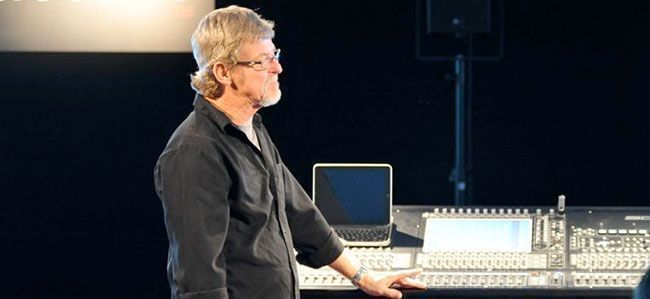
Buford Jones: Hello, “welcome, friends” (in Spanish), thank you so much for taking the trouble to come all the way here. I really appreciate your joining us today. I also want to thank Rafa, Meyer's manager in Spain, for bringing me. Well, what we're going to do is a little seminar. I'm part of Meyer's “education” department and I give talks all over the world. What I'm going to talk about today is mixing in general and live mixing (life on the road), so there won't be anything technical.
What I want to talk about is our sound mixes of the last 25 years and the many artists I've worked with. I want to take you through history, go back, tell you how I got involved in the music world, how I became a sound engineer and how things went for me. Well, we'll talk a bit about history and the definition of the sound engineer, mixing techniques and perhaps a little about how mixing consoles work, how to organize the control position, setup, isolation; in short, some of the things that surround the world of mixing.
Well, my father, Raymond Jones, was a luthier (guitar builder). He also built pedal steels and played piano, so I was born into a family closely tied to music. When I got interested in playing guitar I was 14, and my father made me a guitar out of nothing but scrap materials; later he made me another. So with these two guitars my father built for me, I started playing. I was very young, in high school. Afterward I did a three-year postgraduate program in electronics and learned the basics: repairing instruments and a lot of hi-fi equipment. I built some speakers and my father built another one, which was part of the same rig. I loved playing, I loved jams. So, as they say, like father, like son. My own son, today, is a performer and maybe someday he'll be a sound engineer too.
My story, my introduction to professional audio, began after repairing stereos. I came across a company called Showco Sound, which was at that time one of the biggest companies in the United States, along with Clair Brothers. I was very lucky, because the first day I started working for this company, they sent me to repair some cables and some consoles, and at the end of the day they told me: “pack your bags, you're going to Atlanta, Georgia, to work with one of the most important bands in the country.” It was 1967.
“I learned in the trenches”
So with that training, because I didn't have the fantastic schools we have now, I was extremely lucky to be right in the middle of a huge stadium with a major band playing, and that's where I learned, through fieldwork, in the trenches, you could say. You have to learn very, very fast when you're on tour, and that era was a very rich period for music; many bands, and very good ones, were touring in the late 70s. Showco couldn't build the boxes and systems fast enough to keep up with the size of concerts by bands like Led Zeppelin. I'll give you an idea of the bands I toured with, not just the bands I mixed; many of the tours I worked on were multi-act tours. These are backstage passes from some of the tours I took part in over the years. Some of the bands are from when I worked with Showco and others from afterward, when I went independent (he showed us slides of passes from jaw-dropping bands). This one is from when I came to Spain in 1988, in Madrid. Was anyone at the concert? (He's referring to the Pink Floyd concert.) Well, it seems like it was a long time ago. I was very fortunate to work with one act after another, a good learning experience over the years, and being able to diversify by working with so many very different artists. Some might say: “Hey, it's been rough on this guy doing his job for so long!” But hey, that's fine, retirement is still a long way off! The Counting Crows is one of the last bands I worked with in the United States.
Then and Now
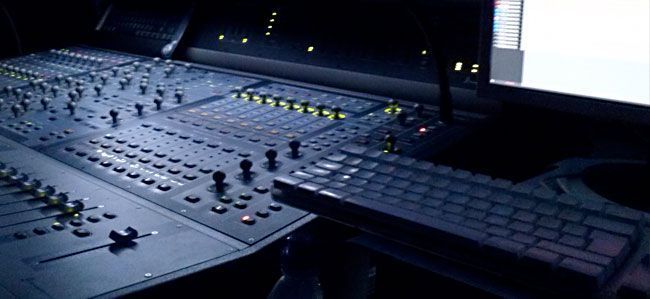
Now I'll go over how we used to work and how we work today. This is the first console I worked with, from 1971. On this very console, which I still like, I mixed Led Zeppelin, The Who, The Carpenters... and many, many other artists. And this is the console we used to work with (he showed us a photo of two racks). It was built by Showco and based on an old design: a simple two-way crossover and a small seven-band parametric EQ. This console was used on one of Led Zeppelin's early tours, in the early seventies. That's what some of the sound systems used at that time looked like. Later, a third way was added to these two-way systems; either way, the systems kept growing. After that I worked with a console, also built by Showco, that had all-parametric channels (one of the first), with three-band parametric EQs. It was a good, very new console, and I did David Bowie's tour with it in 1974, although we were still using some of the old gear alongside the new console.
Things kept growing in the 80s, and Pink Floyd's setup was even bigger. With three Yamaha PM3000 consoles, a joystick console and four sends to handle the quadraphonic.
I was very lucky to be one of the first to mix on consoles with parametric EQ in that era. Consoles were getting better. So were sound systems. For example, the one used at the Red Hot Chili Peppers concert in New Zealand: the rig was set up in duplicate, with the vocals on one and the instruments on the other set, apart from the subs. That way they were also kept separate. And for that to become a reality during the concert, twice as many speakers were needed (at this point, those of us attending the talk saw a succession on screen of mixing consoles and their evolution).
The Sound Engineer
Well, let's talk about what a sound engineer is. “Sound engineer” is a way of naming very different things, but basically a sound engineer is a systems engineer and a mix engineer. Often it's the same person, and in fact it should be. On long tours for big artists these responsibilities can be left in different hands. In my case, there's an engineer who tunes and prepares the rig, and my job is more like that of a musician: I run my console, I mix, and I put all my concentration into it. (When we talked in private he confessed it's the part of his job he loves most, along with the audience's response, elements that make him just another member of the band.)
Mixing takes enormous concentration. If there's both a systems engineer and a sound engineer, both of them are responsible for making the show happen, and the technical work has to be solid so that I can focus solely on the mix.
“The best way to learn is to watch how things are done; there's a lot to learn by observing”
There are many ways to get started in this work. I'm sure the sound engineers here know that, but young people should know that love of music is reason number one. Loving music, being able to play it, to play an instrument, is extraordinarily important. Today there are many ways to learn: music education at universities, schools, books, magazines... and there's more and more, like we've never had before. I had nothing but the challenge of facing the gig head on, trying to learn and get it done; so your education is very important. Try to learn as much as possible in every field you can, not only on the technical side but on the musical side too. The best way to learn is to watch how things are done, how the trucks are unloaded, how the setup is put together. There's a lot to learn by observing, and if you do it attentively, it's quite likely that in the long run you'll get hired.
For me, studio recording is also very important. I usually play at home, I play guitar... When I play with my father, we've learned to place the amplifiers so we can hear each other and so it sounds better when the mix is made. So the importance of the sound engineer lies in the fact that the whole show passes through the hands of one person: the act shows up, the band plays and everything passes through two hands and two ears up there, behind the PA, and that's what the audience hears. This is the most important part. Leaving the audience satisfied with a great show takes a lot of concentration; it's a very important job. When the audience is satisfied, when they've had a good time, they come back. They are the ones who pay everyone's salaries: they pay the artists, who pay the company, which pays the sound engineers. That's why it's so important to give the audience the best possible show. What it comes down to is making the sound consistent, and in the final sound it's very complicated, because you have to deal with different rooms and different acoustics; the end result must be consistent. (He also explained to us in private that for him, consistency means the sound and the mix being of the same quality and as similar as possible from one concert to the next.) You have to work intensely to achieve that consistency: when the gig is your responsibility and the mix is consistent, more people call you, and that assures you a long and prosperous career. To understand the importance of this job a little, we also have to look at studio work, where there's a tape you can listen to, rewind, improve, rewind again, and so on, but in a live show you only get one chance, one hour to get everything right; hence the need for extremely intense concentration. Many different albums can be recorded in a single night, so there's a lot to keep under control, and many elements are involved in a single mix.
“The nice thing about doing a mix with a well-aligned, well-tuned system is that it's more like the work of an artist, a magician...”
As for tuning the system, I don't want to dwell on this subject too much, but what we did in the early seventies was just: “check one two, check one two,” a bit of EQ and that was it. That was all we could do until the band arrived and we could adjust with them. As time went by, more and more tools showed up to work with, real-time spectrum analyzers, and now we have incredible tools, like SIM and MEYER's MAPP Online, and with them we can predict how to set up the system even before walking into a venue. So being able to be prepared is extremely important and very beneficial to the final sound of a tour. Since you have to invest less time in making the mix, you can concentrate more on doing your job. The nice thing about doing a mix with a well-aligned, well-tuned system is that it's more like the work of an artist, or a magician... But with the sound you're working with at the console and leaning on a certain frequency, the levels of that frequency carry over to the PA and, in the same way, to all the outputs sent to other parallel systems, to TVs and other areas, forcing us to work with a flat spectrum in the sound systems. When you have that advantage, then you can mix "musically," not technically. You can be on the guitar solo and at the same time look at the keyboard and know what's happening with the rest of the instruments, and mix the solo with everything else... That means mixing musically.
Now we'll concentrate on tuning and aligning the PA, which is much more important than having the graph show a linear response. If you tune the PA properly, and this is something I insist on a lot in my seminars, if you properly align all the gear, you'll find yourself with much less EQ work.
“We've spent thirty years raising sound levels unnecessarily, and the time has come to bring them down”
Sound levels, above all, are very important. We've spent thirty years raising sound levels unnecessarily, and the time has come to bring them down. It isn't necessary to use all of a system's power. You can use its effects and its dynamics instead of turning the volume up higher and higher and deafening people. That's possible because all the systems are interconnected and return to the main system, so there's no need to turn it up to be covered. That way, by not raising levels so much, we can get a powerful mix that isn't deafening. The biggest compliments I've received throughout my career came when I learned to bring the levels down, once I reached that point. That way, when the show ends, people come over to the mixing desk and say it was a great show, that they enjoyed it, and that's what everybody wants!
His Techniques
These are the techniques I usually use when mixing. I think a visual approach is important, doing things by eye. You have to pay attention to the console all the time, to the screen, scanning the mix (for him, looking across the desk from side to side). We mix by watching faders and VU meters on the console. It isn't about concentrating on a single sound or a single instrument; you can scan up and down so you can make quick changes and still keep the big picture, and that way make whatever adjustments are needed faster.
The sound engineer has two jobs: the first has to be the mix, its quality, and the second is the value of the sound, the quality with which it reaches the speakers. But I prefer to listen as if I were part of the audience. I prefer to hear the whole, even if the sound system is poor. I want to hear everything, so the mix will be better. Learning each of the frequencies is very important. I think all the sound engineers here know there are different ways to learn, even manuals on the Internet for learning to identify frequencies quickly and by ear.
Back to testing the instruments: our ear is what matters most. While instruments are being tested there are real-time spectrum analyzers, but what's important is our perception of the sound, so I listen, I watch the spectrum on the screen, and then I do my job. Listening to the instrument is much more important than the placement of a particular microphone. When you know the quality of your microphones, you already know which one to use.
It's also important to be organized, to keep things in order. There are many engineers who aren't as tidy as they should be. My daughter Ana, who was born six weeks premature, was born in the middle of a Pink Floyd tour, and I spent that whole time at the hospital between shows on the tour. It was complicated to be able, at the same time, to pull off the show every night, so I learned very quickly to keep things organized. I designed a program that helps me keep things in order. This program identifies who is singing, when the solo is coming, and is able to change some of the gear, for example, switching the reverb when needed. I recommend that you take notes on your jobs, so that if something goes wrong (let's hope not), you have a record to go back to and can pass it to someone else who can help you solve it, and in that way keep the show consistent.
“Getting to know the musician, becoming his friend, telling him the truth, working with him side by side is very important”
One way to improve your work is to get to know the musician, become his friend, tell him the truth, work with him side by side. This detail, for example, is very important. When I was working with David Bowie in 1974, on a very long tour, he had serious sound problems and they called us. So we had to come in and mix a very complex show without any kind of rehearsal. David made a script for me. It's a very clear book that shows the microphone placement on a very large stage, and the list of songs he was playing at that time. It shows my position on the stage, where the band was placed and the many microphones there were on stage. David wrote the book out in his own hand to help me mix. It's a really old book, 33 years old now. In any case, the only way I was able to mix the show was by having that book. In addition, there was good communication with him, so I could do a mix that made the show sound as good as possible. I couldn't have done it without him. So it's important to win over the artist and his trust, as well as to discuss all your issues, problems and doubts with him.
Other Ways of Mixing
Now I'm going to show you some very different ways of mixing. This doesn't mean I recommend them, it's just that they worked for me. With one of the most important country artists in the United States, Faith Hill, I mixed from inside a truck. The reason this way of mixing worked was, well... it wouldn't have worked if there had been big guitar amps, but in this case there weren't any and the drums were enclosed, so there was no background noise. The reason I did it this way was that they needed a consistent mix night after night. Also, since I recorded the show, at the end I could listen back and make some final EQ tweaks so the band could hear it. Faith Hill could listen to it and make whatever changes they considered necessary. With this, I stress the need to concentrate when you work and that frequencies should be flat. Most engineers lately emphasize the need to boost the volume of the bass, and if you look at the frequency range, you'll see that the mids are more common than the lows. I have cut the lows at the crossover, leaving the response flat, then using EQ on each console channel when necessary. This doesn't only work for PA consoles, it also works for TV mixes, recording mixes, or whatever. Getting a flat response can make different situations have a similar response. Going back to the consistency of the mixing work, it helps me a lot when I use this format, and it's a technique I've been using since the late 70s: cutting the lows and building from the back up. You can still get a wide range of bass and apply it to the system from the console.
(At this point he started playing us stereo mixes pulled from his console through the PA that MEYER Spain had set up for the conference, an M'elodie. We start drooling...)
You can listen to something from 20 years ago, listen and learn from recordings of different artists. Notice that the mix is consistent even without multitracking, without remixes, just the mix of that night.
Regarding the involvement of the record producer, I can't help stressing that on your own tours, if you work with the album's producer, there's a lot you can learn from those who mix them. I think that on tours that are being recorded there isn't enough collaboration between the two. There's a lot to learn there and I recommend that you do it if you can.
“Working with Pink Floyd was my second experience mixing final sound in surround, and it was a true pleasure”
I consider myself very lucky to have been able to work with Pink Floyd on their 1987/1988 world tour. This was my second experience mixing the final sound in surround, and it was a true pleasure. This will give you an idea: I had a forty-channel console with a sixteen-channel expander just for the drums; on this console I had the instruments and the vocals. Another one, also forty channels, was only for effects returns, delays, and so on. I had a console with a joystick, with four inputs and four outputs to distribute the sound in surround around the whole space. The typical quadraphonic mix, which you don't see much in the end. Mixing the instruments into the rear channels is much harder than working with effects, but that is what I did on David Bowie's tour, with a 5.1 that had a center channel. But with Pink Floyd, I called it Floyd.1. I used the fronts and the center of the 5.1, which is virtual, and I did it with the mono image from the center of the PA.
All of this is a sample of the experiences you may come across as sound engineers.
Today we have seen the numerous technical advances in the field of mixing and consoles, how today it's possible to work with laptops and even PDAs. I still prefer to keep mixing on consoles, with systems that are easy and quick to set up, given how little time there is for soundchecks, so as to gain more time for the sound check.
Buford Jones continues to work as a sound engineer on tours, and he also runs Meyer's education department and manages his office in Nashville, where seminars and demos are held. He advises us to keep learning to improve our work. He insists on protecting our ears, because the work of an engineer can put our hearing at risk without our realizing it. He recommends that, during stretches when there's no work to do on tour, engineers not go out partying, because tours are very long and you have to conserve your energy, so it's better to use the free time to learn. He advises us to keep chasing our dreams, which in his case came true and which, as for him, can happen to anyone.
For my part, many thanks to him, for that PINK FLOYD concert, for this wonderful talk and for the mix of “Delicate Sound of Thunder,” which I advise you to listen to in detail. Buford Jones, above all, a prophet of live sound.